Do you suffer from Rider Knee Pain during and/or after time in the saddle? Or perhaps you suffer from knee pain every day and riding makes it worse? In this article, I am going to explain some reasons why you may be suffering and how you can determine the cause and manage the pain.
Causes of Knee Pain
Causes of knee pain include arthritis, strained ligaments, tendonitis, and muscular tightness. You could have any of these that are more noticeable through riding but riding itself doesn’t cause knee pain.
Arthritis
There are 3 types of Arthritis:
Osteoarthritis
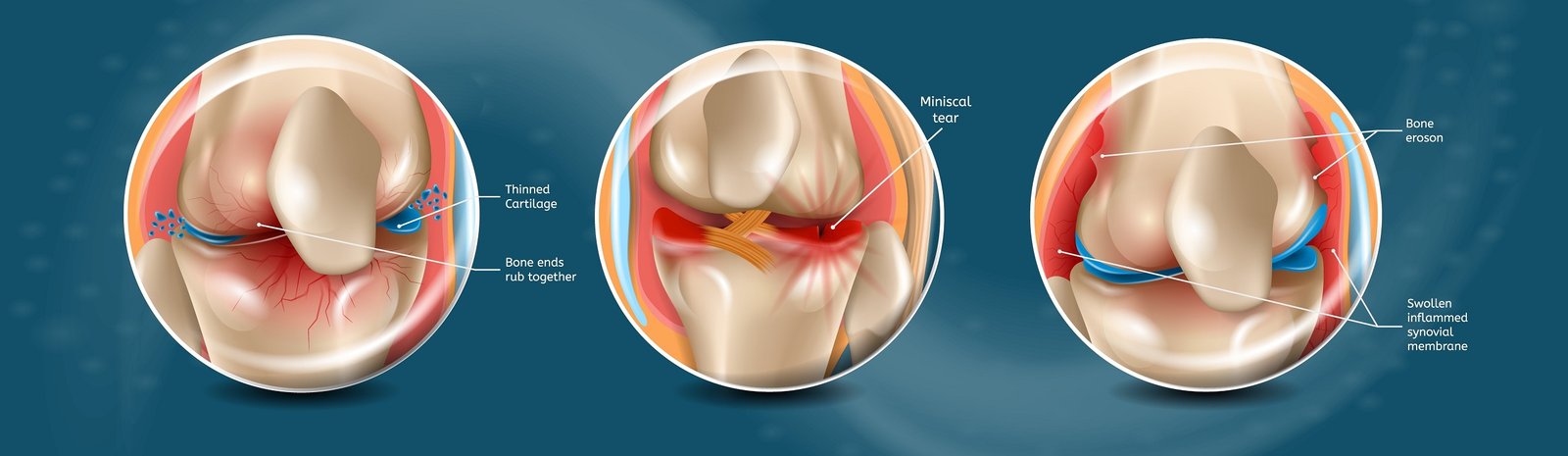
This is the most common of the types. Osteoarthritis wears down the cartilage which is the cushioning between the bones in your knee joint. Without the cartilage, the bones rub together which causes pain, stiffness and restricts movement.
Post-Traumatic Arthritis
Following a trauma like a break or an impact. The cartilage starts to thin and the bones rub together and cause the same symptoms as Osteoarthritis. It may be years after the trauma before you notice.
Rheumatoid Arthritis
This is an autoimmune disease where your unhealthy immune system triggers inflammation in your joints even though there is no need for the body to do so. It believes there is an infection, an injury or a foreign invader when there is not.
When you believe you have arthritis you will visit the doctor who will check if the joint is swollen/inflamed, the range of movement and ask a number of questions. The one key point to remember is.
To diagnose arthritis of the knee officially, you will need an X-Ray and/or MRI.
You cannot diagnose without. It is an assumption.
Meniscus Tear
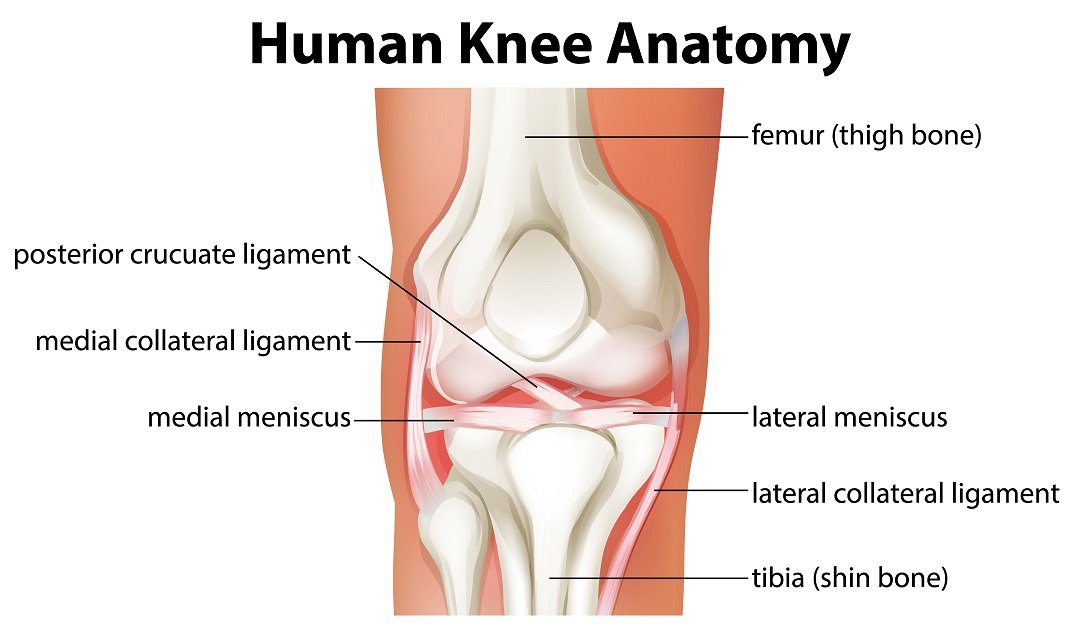
The meniscus is a piece of connective tissue that sits below the thigh bone (femur) in the knee joint. It acts as a shock absorber and enhances the stability of the joint. They are often caused by sharp sudden changes in direction such as in football or running. The cartlidge also thins as we age.
In a meniscus tear, you will often experience intermittent knee pain which can be sharp. This is because when you bend and straighten the leg the flap of the tear can get caught on the knee bone. Sometimes it will stay caught for a period of time which causes constant pain until the flap returns. Other times the flap just ‘flicks’ as the knee bends and straightens which causes the sharp shooting pain. Not always, but you may also experience swelling.
There are a number of movement tests that can be performed to assess if you have a meniscus tear although these are not reliable as the tests may not move the flap at that given time. Similar to arthritis. The only way to know for sure is to have an X-ray or MRI
Ligament Sprain
Similar to a meniscus tear, you can strain your knee ligaments by sudden changes in directions, twisting of the knee, or over-reaching. A sprain may also be caused by impact.
There are 4 ligaments within the knee joint.
Posterior cruciate Ligament (PCL) - Controls backward movement of the shin bone
Anterior Cruciate Ligament (ACL) - Controls rotation and forward movement of the shin bone
Medial Collateral Ligament (MCL) - Provides stability to the inner knee
Lateral Collateral Ligament (LCL) - Provides stability to the outer knee
Tendonitis
When a tendon becomes inflamed it causes swelling, pain, and discomfort. There are many causes of tendonitis such as strain, overuse, injury, or too much exercise. To determine if you have tendonitis a doctor will take a small amount of fluid from the joint to test. Tendonitis can occur anywhere in the body but for the knee to be affected it is normally associated with those that run or cycle long distances and those that play jumping sports such as basketball where the force of hitting the grounds strains the tendon.
Muscular Tightness
The quadriceps tendon (front of thigh) sits over your kneecap and your hamstring (back of thigh) attaches to the back of the knee
When these muscles, either individually or separately, become tight. The muscle shortens pulling the tendon taut across the joint which applies pressure to the knee area. This pressure can make it feel like the issue is within the knee itself. Inflammation doesn’t usually occur from muscular tightness but it is possible. Especially if you have tight muscles and riding is aggravating those tight muscles.
Tightness in the quadriceps and hamstrings can occur in many ways. Such as being inactive, sitting for long periods of time. Repetitive exercises which target these areas but are never stretched/massaged.
Muscular tightness can be assessed formally by Soft Tissue Therapist.
How Do you Find out Why You Have Knee Pain?
As you can see from the possible causes above the knee pain symptoms you may be experiencing are all similar. If you are concerned that it is possibly anything other than muscular tightness then go to your doctor and ask for an X-ray or MRI. There are other methods but these are the most common. Such tests are the only way you will know for sure.
Assuming that the doctor has cleared you, muscular tightness may be the cause of your knee pain. A Sports or Soft Tissue therapist can identify which muscles may be causing you the issues.
Alleviating Knee Pain
In case you have tendonitis then you will need to reduce activities and reduce the inflammation by applying an ice compression. If it doesn’t improve your doctor may discuss steroid injections or surgery. Because of its nature, you will need to be guided by your doctor and work with them until the issue is resolved. Be strong and if you are not getting answers. Ask them to refer you to a specialist.
If the cause of your knee pain is arthritis or muscular tightness the best way to manage pain is to actually lengthen the muscles surrounding the knee joint through stretching and massage and improve the strength in your legs. The more you move, the better it will become. Having regular Sports massage or Soft Tissue therapy (not holistic massage) will also improve the tightness in the muscles as well as aid recovery in the muscle fibers.
You can of course take pain relievers and anti-inflammatories but on the understanding that this will simply mask the problems. It will not solve them.
Will Riding Make my Knee Pain Worse?
As mentioned above. Riding doesn’t cause knee pain but it will highlight that there is an underlying issue. Without knowing what that underlying issue is and then dealing with it then yes. Riding will make the knee pain worse.
The truth is many riders don’t know the real reason for their knee pain. It has not formally been diagnosed, rather just ‘labeled’. When you have tight leg muscles and/or arthritis of the knee then not exercising and having regular sports massage only makes it worse over time. Riding will become more and more uncomfortable.
Read our next article to learn how to Prevent Knee Pain when Riding
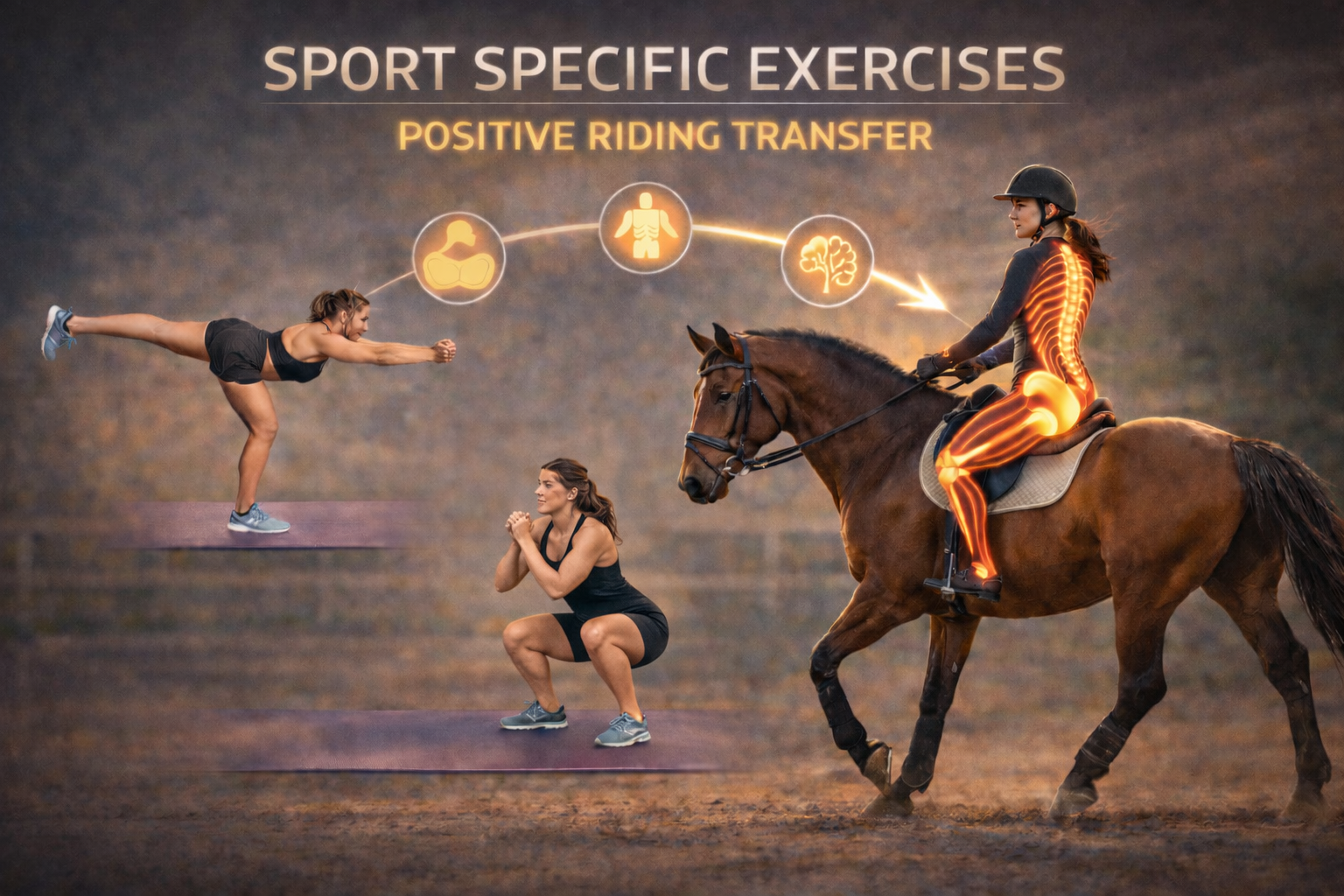
An equestrian workout is exercise aimed to specifically improve your riding. Using a range of variety to help ‘condition’ the rider’s body for the sport.
An equestrian workout is different from general fitness. Being fit generally means having the ability to perform everyday tasks with ease.
Whilst any form of fitness is beneficial, there is a difference between being fit and fit to ride. For you to become a conditioned rider you must train the muscles riders use, in the variety of ways the muscles operate when in the saddle.
What is an Equestrian Workout - And Why It Matters
Sports like horse riding, at any level and in any discipline, require the rider to have the appropriate strength, mobility, and awareness to meet the demands of the sport.
An equestrian workout is designed specifically to prepare your body for those demands — not just to improve general fitness, but to improve how your body actually functions in the saddle.
Because there is more to riding than simply not being out of breath.
Riding requires coordination, balance, control, and the ability to move your limbs independently while maintaining stability. This is what allows you to communicate clearly and effectively with your horse.
Unfortunately, activities like running, cycling, or yoga — while beneficial for general fitness — do not provide the full stimulus needed to support riding. They don’t train the specific movement patterns, control, or muscle coordination that an equestrian workout develops.
What Does an Equestrian Workout Actually Do?
An equestrian workout focuses on conditioning the muscles and systems your body relies on when you ride.
This includes developing:
Muscular strength
Cardiovascular fitness
Mobility
Coordination and reaction
Muscle recruitment (how muscles work together)
This is what rider conditioning really is — using targeted exercise to improve how your body performs in the saddle, not just how it looks or feels off it.
Why Riders Need Equestrian Workouts Specifically
Whether you are a leisure rider or a competitor, following a structured equestrian workout approach is important — not just for you, but for your horse.
Horse riding requires multiple muscle groups to work together to keep you balanced, stable, and aligned without collapsing or relying on the horse for support.
Without this, riders often compensate by:
Pulling on the reins
Gripping with the knees or thighs
Collapsing during transitions
Losing balance in the saddle
These are not conscious choices — they are physical responses to a body that isn’t fully prepared for the demands of riding.
If your body hasn’t been conditioned correctly, it can also lead to:
Slower progress in your riding
Increased fatigue
Aches and pains after riding
An effective equestrian workout helps prevent this by preparing your body to meet those demands properly.
How Your Body Affects Your Horse
When you are not in control of your body, it directly impacts your horse.
It can lead to:
One-sidedness
Uneven muscle development
Tension or soreness
If you collapse during a transition, your body will instinctively try to stabilise itself. Most riders do this by gripping or using the reins.
This is a natural reaction — but it is not an effective one.
To stabilise correctly, your body needs coordinated activation from multiple muscles, including:
Glute medius
Transversus abdominis
Multifidus
Obliques
Diaphragm
Erector spinae
This level of control doesn’t happen automatically. It requires targeted training — which is exactly what an equestrian workout develops.
Why General Fitness Isn’t Enough
One of the biggest misconceptions is that general fitness translates directly to riding.
It doesn’t.
Running improves cardio but not rider-specific strength
Yoga improves mobility but not control or stability under load
Cycling builds strength but limits mobility and coordination
Each form of exercise has benefits — but none of them fully prepare your body for riding on their own.
An equestrian workout bridges that gap by combining all the elements you need in a way that directly transfers to the saddle.
How to Build an Effective Equestrian Workout Routine
To become properly conditioned for riding, your training needs to develop:
Strength to maintain posture
Coordination so muscles work together
Cardio fitness to sustain performance
Mobility for independent movement
You can achieve this by combining different types of exercise — for example:
Strength training + mobility work
Cardio + coordination-based training
But the key is not just doing more — it’s doing the right type of work.
That’s what makes an equestrian workout different.
It is structured, specific, and designed to improve how your body performs when you ride.
The Bottom Line
Riding well places a significant demand on your body.
If your body isn’t prepared for that demand, it will compensate — and those compensations are what show up in your riding.
An equestrian workout doesn’t just make you fitter.
It improves your control, your balance, your communication, and ultimately, your partnership with your horse.
Because better riding isn’t just about what you do in the saddle.
It’s about what your body is capable of producing when you’re in it.
Start Understanding Your Body First
If you want to improve your riding, the first step isn’t doing more — it’s understanding what your body is currently doing and why.
✔ What I look for when assessing riders ✔ How your movement patterns affect your riding ✔ Why your body responds the way it does in the saddle
Ready for a Structured Equestrian Workout?
If you’re ready to go beyond awareness and start improving how your body actually performs in the saddle, my rider-specific programs are designed to give you that structure.
These are not generic workouts. They are targeted equestrian workouts built to improve:
✔ Strength ✔ Stability ✔ Coordination ✔ Balance ✔ Control
I attended a clinic with Manolo Mendez in Poland on 26th – 28th April 2019. It was truly enlightening and awakening to see a person have such a connection, with not just a one-horse, but all of the horses he met.
I believe that learning never stops and will always seek the opportunity to further increase my knowledge and experience. Whether it be riding, fitness, horse training, anatomy, physiology, or therapy.
The more I know, the more I can help riders help themselves, to help their horses.
Background
Manolo is a seasoned horseman; he likes to say he has over sixty years of experience living, breathing, working with and training horses. He started his professional career at the young age of 14, training the Alvaro Domecq’s personal horses, to later become one of the six founding members of the Royal Andalusian School of Equestrian Art. Manolo is well known for Classical Dressage training. With specialist skills in training the Piaffe, Passage, and Pirouette, known as the 3 P’s without coercion or force.
Manolo uses a holistic approach to training, looking at the horse as a whole to sympathetically train, develop and rehabilitate. An approach that is sought after by many professionals and individuals across the world. It helps with straightening, releasing tight, stiff, and crooked horses. And to assist in the development of correct posture, movement, and gait enhancement.
For the 3 days, I sat in an indoor arena for about 10 hours a day. In so many layers of clothes to keep warm in the cold and damp weather that Poland greeted me with. Despite being so so cold I was fascinated, mesmerized, and moved by Manolo’s ability. How he saw, felt and understood so much from a horse in such a brief encounter. I was not able to leave, despite how cold I was. It was truly enlightening and awakening to see a person have such a connection, with all of the horses he met.
There were a total of 8 riders who each had a session a day with Manolo. This allowed you to see the progress over the 3 days of the clinic. Whilst many of the sessions started mounted, but if Manolo saw that the horse was stiff, tight, anxious, nervous or just unsettled. He would then ask the rider to dismount, and un-tack horse to then work with him from the ground.
There were times when Manolo would just walk to the horse and touch a specific area. The horse would immediately react as if Manolo heard the horse tell him exactly where there was an issue. It was truly emotional to see as you saw Manolo change, as he felt the pain himself, sharing it with the horse.
The sessions lasted as long as they needed to in order for the horse to feel comfortable and confident in their environment. With whatever task was being asked of them. For some this simply meant walking around, a little lunge work, some in-hand, and bodywork from Manolo. There was never any rush. Pushing, forcing, or frustration from Manolo. If the horse ‘expressed’ themselves Manolo was listening and would say ‘ok’ and go with whatever the horse needed.
When allowed a voice, many of the horses had much to say. Expressed through their body language, head tossing, and resistance to settle due to nerves, anxiety, or tension. Or perhaps they were already saying it but there wasn’t anyone listening or they didn’t understand what was being said?
I think it is easier to think that horses are resistant, lazy, and naughty rather than that they are trying to communicate with you.
Manolo loves to give you analogies and detailed descriptions to help you understand to educate and increase your understanding. To show you that it’s not complicated; it’s simple when you look and listen. I love this. I will never be Manolo but if I am prepared to look, listen and feel then I can learn how to be better for my horses.
Whilst the sessions were perhaps not what the rider originally hoped for it was clear that Manolo’s approach of watching, listening, and going back to simple basics paid dividends. Come to the next session you could see the horse had changed. They were freer, more content, and soft in the eye. More willing to listen and work alongside Manolo and their owner/rider.
I am unsure of where it really comes from, the need to rush a horse through its experiences and education. It seems that society expects horses to be at a certain level by a certain age. Irrelevant of the fact that they are still young. To be able to perform a variety of moves such as Travers, Shoulder In, flying changes, Piaffe.Yet the horse has not been granted the time to become balanced, have straightness and rhythm to work with regularity and ease.
I have felt that pressure myself with my girls. Being made to feel that they should be competing at a specific level or have achieved such moves but I have never pushed them and at the age of 11 now, they are just starting to really expand themselves and for my resistance to the pressure I will have happy, healthy horses with longevity.
Manolo uses a cavesson and bamboo for groundwork and nothing more as it is important to allow the horse to work without restriction and stress and to develop a fitter, healthier, sounder horse. Whilst watching him working on the ground with the horses it was easy and quick to see how the horses started to correct slight imbalances such as leaning into a circle, flexing outwards and shortness on a side. When allowed to move correctly and freely.
Manolo’s Teachnings
Manolo expressed that when working a horse on the ground it is important to make the work as easy as possible. And then they will give back 10 times more because you have allowed them to be comfortable.
Manolo has many stories to tell but the main message is you must treat horses with respect and kindness. We would not like to be strapped up and made to rush around unbalanced, horses are just like people. When given the opportunity to be comfortable and free through the body and mind the horse will be happy and want to work.
This is something that I think we may be starting to forget. Some appear to be more interested in their pride, stature or the money the horse can generate for them; the latest gadget, fashion or luxury item or promise of peer respect, success and vanity.
“ Be kind to your horse”
– Manolo Mendez –
Manolo always focuses on the horses and works on what they need to work on to find balance and regularity in their movement. Whilst the rider may want more advanced work, Manolo does what the horse needs. This is a quality I greatly admire and respect.
A quality that I think many instructors have lost or never found. In order to create harmony between horse and rider, you need to work within the capabilities of the horse, not the desire of the rider.
“A trainer should act like a horse’s bodyguard and not let anything bad happen to them in lessons. The horse knows when the trainer’s instruction is causing him pain”
I have found it hard to write about such an experience as I came home tired, emotional, and feeling a little broken. Feeling that perhaps I have let my horses down at some point.
I’ve listened to an instructor push my horse when I should have protected them. Or been too focused on what I wanted to achieve. That I did not see what they needed.
Whilst I know that this would never have been intentional. I can’t help but think ‘have I let myself and my horses down?’
It has taken me a few days to get my head around how I have brought my horses up through their years. But have come to the conclusion that yes, I have made mistakes but. My continued desire to learn and strive for better harmony and partnership gives me some reassurance that I have and will continue to. Be the best that I can to make their lives better.
What I have learned or more so remembered is that. I have horses because I love them and it is not about what they can do for me. It is about what we can do together.
Treat your horse with kindness and respect and allow your horse to grow healthily both physically and mentally naturally. Protect them from those that may harm them, intentionally or not.
You are their partner, their friend, their protector.
I Urge You
I am quite shocked that most of the people I mention Manolo to have never heard of him. Especially in the dressage circles but I urge you. No matter who you are, go to one of his clinics, open your eyes, your mind, and listen. Remember why you have horses and see that it is possible to help your horses through correct training, kindness, and patience more than spending money on material items they just don’t need.
I would love to hear your views so do not hesitate to contact us. Subscribe to our newsletter for free, or click here to get in contact. Keep up to date with the latest content by following our Social profiles on Facebook, and Instagram.
Endurance Rider Fitness by Tracy Thompson, Endurance Rider since 1990. Tracy suffered a spinal injury in 1998, but with the continued support of her fellow riders and husband, Tracy has been able to compete alongside her son, Jamie and complete yet another 160km.
Many years ago I worked in a trekking centre and was stunned by how much difficulty people could have trying to get on the horses, with the more mature amongst them saying things like” I have lost my spring”. At the time I couldn’t comprehend what on earth they meant and suspect I was far from sympathetic but their words have now come back to haunt me and I realise I owe them an apology!
I have mobility problems as a result of a spinal injury in my thirties but have been fortunate enough to be able to continue to ride. The horses have been my sanity and provide me with the freedom to go places that I could never reach on foot.
The Wake Up Call
Through my love of Endurance Riding, I have been able to explore lots of the British countryside and I am very fortunate that my fellow Endurance Riders are a great group of people and are all too willing to open any gates that I can’t manage from the horse.
Over the last few years, I have noticed a marked decrease in my range of movements and mobility. One of the biggest issues is getting on the horse. (When I say horse I actually mean 14hh pony but let’s not split hairs). I use a mounting block and provided the pony stands still I can just about launch myself into the saddle. This is a far from an elegant procedure and often involves a little swearing and cursing. If for any reason I have to get off I am completely stuck and have to hover about hoping some well-meaning hiker will take pity and hoik me into the saddle.
Rider Endurance Fitness - Begins!
At the start of 2019, I was feeling pretty despondent about the whole situation and was beginning to wonder what I could do to remedy things. A friend mentioned RiderCise® and suggested it might help.
RiderCise® is the brainchild of Clare Gangadeen who is a rider, Soft Tissue Therapist and a Personal Trainer with much experience in the Fitness Industry. Using all her skills, knowledge and real-life experience with riding and training people Clare developed a series of programmes that are specifically designed to improve fitness, strength, mobility, stability and balance in the saddle. RiderCise® provides Online Programmes to riders at any level, in any discipline across the world, making Rider Fitness Easy and Affordable.
It sounded too good to be true but I contacted Clare to learn more and she explained how you can access her training programmes via an App on your phone and given my individual needs she was able to adapt the programme and was always available to help.
January 7th found me starting on the RiderCise® 9 Week Rider Challenge, which is something that Clare offers riders to allow them to see how easy it can be to improve their Rider Fitness, totally Risk Free! Not only do you get direct access to Clare for help and guidance when needed but you can cancel anytime.
Support Matters
Despite being useless with technology I found it very straightforward. The ‘Challenge’ starts at Foundation level and begins with ten minute sessions that are easy to fit into your day. There are a set of exercises with written instructions and a step-by-step video of how to do them properly; there are also a range of stretches. As the programme needed to be adapted due to my mobility issues, Clare took a very detailed medical history so she could customise the programme. She plays a very active role in the ‘Challenge’ and regularly messages to see how you are getting on. I have been amazed that despite messaging her at some random hours she still responds very quickly.
At first I found some of the exercises nigh on impossible but was surprised to find that each week they became a little easier. They focus on quality rather than quantity and gradually you increase the repetitions. They are something you can do almost anywhere, which makes it easy to fit into a busy schedule.
I did encounter a slightly embarrassing moment when I was doing the” Bear Walk”. This involves walking along on all fours and I was doing my best Grizzly impression around the kitchen floor. I had not put in my hearing aid and so did not hear the arrival of the delivery man. I had my back to him as I wandered around the kitchen on all fours and it was only when I turned round I spotted him standing at the door looking somewhat bemused. I inelegantly hauled myself to my feet and thought I owed the poor guy an explanation.
I told him I was doing an exercise programme and that it involved Bear Walking. There was a look of horror on his face as he practically chucked the parcel at me and shot off muttering “bloody hell, naked exercising whatever next?”
I was bent double laughing at the thought of him going back to the depot with tales of crazy women.
Endurance Rider Fitness Does'nt Mean Hours of Effort
On a more serious note I can’t believe what a difference a few minutes a day can make. I feel suppler and my posture has improved, as my core muscles have got stronger. I love the way that the workouts can be moved around to fit in with your life and that the exercises are very varied so you don’t get bored. Clare manages to find something to challenge you and is so supportive. It’s like having a personal trainer at your beck and call.
Horse riders spend a great deal of time and money getting horses fit but we are inclined to be a bit lax when it comes to our own fitness. Recent studies have shown what a dramatic impact the rider can have on the horse’s way of going. Injuries and weakness in riders often cause them to sit unlevel and this can have a very negative impact on the horse. Perhaps we owe it to our horses to try and sort out our own niggles as well as looking at their problems.
The Challenge Tracey refers too doesn’t currently run at the moment but if you are looking to start improving your Endurance Rider Fitness. Take a look at the Workout Bundles.
If you would like a Bespoke Program designed and coached by Clare, the Fast-Track Coaching program currently has 1 space available.
We all have riding aspirations. Whether that is to simply be able to ride without feeling sore the next day, having the confidence to go to pleasure rides with friends, being the best rider you can be, getting out and about at shows, or competing to the highest level possible.
To many of us, it seems that we can never reach that aspiration. While other riders around you seem to be reaching their dreams, smashing goals, in the limelight, or simply just making progress?
Why do some riders seem to reach their aspirations and others don’t? It’s not the aspirations that are different. It’s the way we view and approach them.
The Difference between Riding Aspirations and Goals
When you look at the meaning definitions it isn’t clear cut but breaking the words down can help give you a clear difference:
GOAL: The object of a person’s ambition or effort; an aim or desired result.
ASPIRATION: A hope or ambition of achieving something.
Similar in that both describe a future state but different in that Goals are objective and measurable such as winning a competition, whereas Aspirations are subjective, unmeasurable, and intangible such as an emotion or feeling.
Using the examples above. Your aspiration may be to be a confident rider or compete to the highest level. You can’t measure confidence. It is personal to you. Only you know when you have achieved it. Competing at the highest level is also subjective to what you consider to be the highest level. Not other riders’ perception of what count’s as a high level. It does not necessarily mean Grand Prix or International.
Perspective
Imagine your tack room is a mess, you set yourself a goal to tidy it.
If you summon the energy to tidy it, you have a clean tack room – for now. But, if you maintain the same sloppy habits that led to the messy tack room then it will soon be a total mess again. You are left chasing the same outcome because you never changed the system behind it. You treated a symptom without addressing the cause.
“If you always do what you always did, you’ll always get what you always got”.
Henry Ford
The implicit assumption behind any goal is this: “Once I reach my goal, then I’ll be happy.” When you reach that singular goal you realise you are not happy. So, you move your focus to your next goal.
Goal: Have the confidence to go to‘A‘ pleasure ride, to go to‘A‘ show, to win ‘A‘ competition. A specific measurable goal with ‘A‘ being singular.
This creates a “yo-yo” effect, much like dieting. Riders work hard for months but as soon as they achieve that goal, or fail, they stop. There is no longer anything to motivate them. This is why many people find themselves reverting to their old habits after accomplishing reaching their goals, or not.
Goals also create an “either-or” conflict: Either you achieve your goal and are successful, or you fail, and you’re a disappointment. Whereas you actually become one step close to your riding aspiration, whether you fail or succeed at that goal.
True long-term thinking is not about any single accomplishment, a goal. It’s about the journey of constant refinement and continuous improvement. Ultimately, it’s your commitment to the approach that will determine your success.
Aspirations: Go on ‘many‘ pleasure rides, to ‘regularly‘ attend shows, to win at ‘various‘ competitions. A future state of being, as in Plural – many times.
Long-Term Approach Gets Results!
As a Rider Performance Coach, I speak with so many riders that are so focused on achieving a particular goal (short term) rather than the aspiration (long term) that they do not realise that achieving that one goal will only affect them positively momentarily. After the rider has achieved that singular goal, then what? All that hard work that you put in just disappears and you return to how you once were? The rider returns to feeling the aches and pains, loses their confidence, stops going to shows, or doesn’t manage to go to the next level.
The difference between riders that win, who seem confident, or have a better seat and position is they are constantly learning, adapting, and taking action to reach that aspiration.
If you are a rider who wants to reach your riding aspiration you must accept that it is a journey. Every goal you reach, whether you fail or succeed is a stepping stone. that will bring you one step closer to your riding aspiration.
Set goals, but understand them as a stepping stone that will bring you one step closer. That singular goal does not make you successful or a failure but it does help you progress to where you want to be.
Rider Fitness Can Help
Feel tempted to learn how RiderCise can help? Read our Reviews on how Rider Fitness is helping them to ‘Be the Rider They WANT to Be‘. Or if you are ready to get started straight away, subscribe today!
I would love to hear your views so do not hesitate to contact us, subscribe to our newsletter for free, or click here to get in contact for any questions or queries you may have. Keep up to date with the latest content by following our Social profiles on Facebook, and Instagram.