Your Body Has Adapted More Than You Realise

Have you ever noticed that one side of your body seems easier to organise than the other when you ride?
Perhaps one hip always feels tighter. One leg naturally sits differently. One hand feels less stable, or you repeatedly collapse through the same side no matter how often you correct it.
You may be able to change your position briefly when your instructor draws your attention to it. Yet, as soon as your focus moves back to your horse, the same pattern returns.
It can feel as though your body simply refuses to cooperate.
But the way you move in the saddle did not begin when you put your foot in the stirrup.
Long before you started searching for horse riding exercises to improve your position, your body had already been shaped by the physical demands of everyday life. Every position you hold, every repetitive movement you perform and every injury you recover from influences the way your body learns to create movement and stability, often without you ever realising it.
Those experiences have gradually shaped the movement strategies your body now relies on automatically.
Your Body Is Constantly Learning From What You Do
Your body responds to repetition.
When you perform the same movement regularly, remain in the same position for long periods or repeatedly load one side more than the other, your body becomes more efficient at managing that particular demand.
This is useful. It allows you to complete familiar tasks without consciously planning every movement.
However, efficiency does not necessarily mean your body is using the muscles best designed for the job.
Imagine someone who spends several hours each day sitting at a desk. At first glance, that might seem beneficial for riding because the hips are held in a similar position. However, the position itself isn’t the important part.
What matters is how the body is maintaining that position.
Ideally, the muscles responsible for supporting the pelvis, trunk and spine would provide the stability needed to sit efficiently for prolonged periods. In reality, it is far more common for those muscles to lack the strength, endurance or function to do this effectively.
Rather than allowing you to collapse, the body simply recruits other muscles to take over. To the outside observer, the person is still sitting upright, but internally the movement pattern has changed.
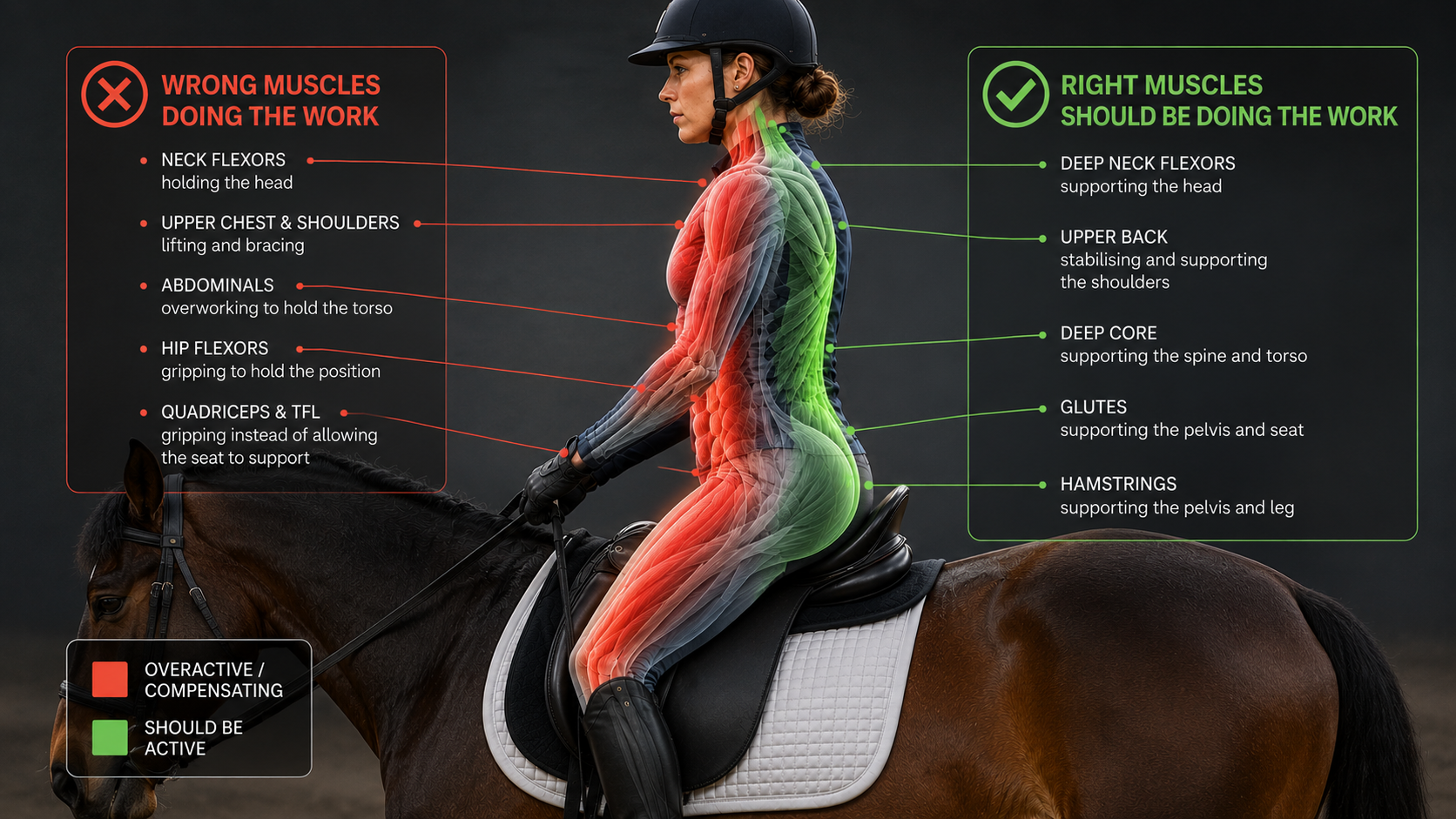
The same principle applies when you drive regularly, carry a child on one hip, push a wheelbarrow, lift water buckets or repeatedly place a haynet over the same shoulder. The task is still completed, but often by muscles that were never designed to be the primary source of support for that movement.
When a muscle is repeatedly used to perform a job it wasn’t designed to do, it is never an ideal movement pattern. The body accepts it because the task has been completed, not because it is the most efficient or mechanically correct solution.
Unfortunately, these changes rarely remain isolated to one muscle. As one area begins taking on a role it wasn’t designed for, other muscles and joints have to adapt around it. This creates a ripple of compensation throughout the body as each area adjusts to accommodate the original change. Initially, you may notice nothing more than stiffness, tightness or feeling slightly uneven. Over months and years, however, these altered movement strategies can contribute to overload and, ultimately, injury.
Familiar Movement Is Not Always Balanced Movement
Once a movement strategy has been repeated often enough, it no longer feels unusual. It simply becomes your body’s normal way of moving.
That doesn’t mean it’s balanced, adaptable or appropriate for the demands of riding. It simply means it’s familiar.
For example, you may feel as though you’re standing evenly through both feet while naturally placing more weight through one leg. You may believe your shoulders are level, yet your ribcage is subtly shifted to one side. You may feel relaxed through your hips, even though one side moves far more freely than the other.
Because these movement strategies have developed gradually over months or years, your brain accepts them as your normal. It stops recognising them as something different because, to you, they no longer feel different.
Because these movement strategies have developed gradually over months or years, your brain accepts them as your normal. It stops recognising them as something different because, to you, they no longer feel different.
Most everyday activities don’t challenge these patterns enough for you to notice them. Your body simply continues using the movement strategy it has practised thousands of times.
Riding is different.
Every stride asks your body to absorb movement, maintain stability and allow controlled motion through both sides simultaneously. Suddenly, the movement strategies that worked perfectly well during everyday life become much more obvious.
You may find one hip follows the horse more easily than the other. One leg feels more stable, while the opposite side struggles to stay organised. Your weight may drift to one side without you realising, or one rein may consistently feel different from the other.
The saddle hasn’t necessarily created those asymmetries.
It has simply exposed the movement strategies your body had already learned long before you climbed on your horse.
Why Riding Reveals Patterns You Do Not Notice Elsewhere
Most everyday activities allow your body to take the path of least resistance.
When you stand, you can unconsciously shift more weight onto one leg. When you bend to pick something up, you can rotate slightly to avoid a restricted hip or stiff back. When you carry a heavy object, you naturally favour your stronger side.
In everyday life, these small adjustments usually go unnoticed because the task still gets completed.
Riding places very different demands on your body.
Rather than allowing each side to work independently, riding requires both sides to work together while your horse is continuously moving beneath you. Every stride creates subtle changes in force, direction and balance that your body has to absorb, control and respond to.
Suddenly, the movement strategies that worked perfectly well during everyday life are no longer enough.
A pelvis that doesn’t move equally on both sides may become obvious during sitting trot. A ribcage that habitually shifts may make it difficult to stay centred through a circle. A shoulder that has gradually learned to stabilise differently may affect the consistency of one rein contact.
These are often the symptoms riders notice.
The movement strategy causing them is usually much bigger.
A lower leg that won’t stay still may be responding to the way the pelvis is organising itself. Uneven rein contact may reflect the way the trunk creates stability. Difficulty sitting evenly may have very little to do with the hips themselves.
The visible riding problem is rarely the whole story.
It is simply the place where the underlying movement strategy becomes impossible to hide.
Why the Same Correction Keeps Disappearing
Suppose you repeatedly collapse through your right side.
Your instructor asks you to sit straighter, lift your right shoulder or place more weight into your left seat bone. You make the correction and, for a few strides, everything feels better.
Then, almost without noticing, the collapse returns.
This doesn’t happen because you weren’t listening or because you stopped trying.
It happens because your body hasn’t changed the movement strategy that created the problem in the first place.
Over time, your body has developed a familiar way of organising your pelvis, ribcage, shoulders and weight distribution. Those areas don’t work independently; they work together as a system. When you consciously change one part, the rest of the system still defaults to the movement strategy it has practised thousands of times.
For a short time, you can override that strategy through conscious effort. But the moment your attention shifts back to riding your horse, thinking about your rein contact or planning the next movement, your body naturally returns to the pattern it knows best.
That’s why the correction disappears.
The instruction itself wasn’t wrong.
Your body simply didn’t yet have a different movement strategy available to replace the old one.
You can only hold a new position for as long as you’re consciously thinking about it. Lasting change happens when your body learns a new way of organising itself, so the improved position becomes automatic instead of something you have to constantly remember.
Previous Injuries Can Continue to Influence Movement
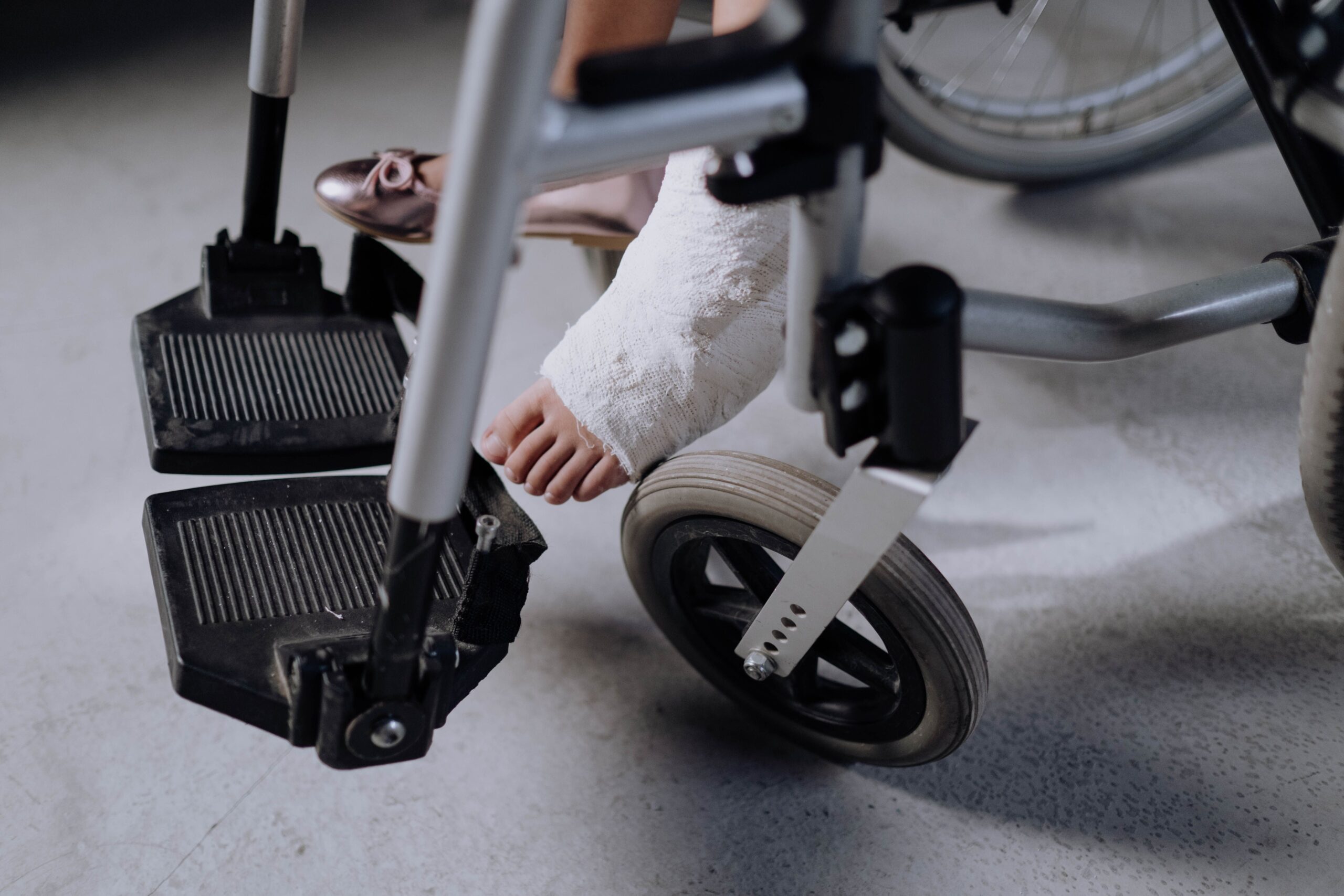
An injury does not need to remain painful to continue influencing the way you move.
Whenever something hurts, your body naturally changes how it performs a movement. You may place less weight through one leg, reduce movement through one hip or rely more heavily on the opposite side to avoid discomfort. These changes are intelligent. They allow you to keep moving while protecting the injured area during healing.
The problem is that, once the injury has healed, the protective movement strategy doesn’t always disappear automatically.
If you’ve walked, stood or moved differently for several weeks or months, your body may simply accept that new strategy as normal. The pain has gone, the tissues have recovered, but the way your body organises movement has changed.
This can help explain why an old ankle injury still seems to influence the position of your lower leg years later, or why a previous shoulder injury appears connected to uneven rein contact, despite no longer being painful.
The injury may have healed… but the movement strategy created to protect it may still be the one your body relies on.
“Many people continue protecting an injury long after the tissue itself has healed. The pain may have gone, but the protective movement strategy often remains. Over time, that continued protection creates compensations elsewhere in the body as other muscles and joints adapt to doing work they were never designed to do.”
That doesn’t mean the injured area is still the problem. In many cases, the body has simply become more familiar with the protective strategy than the movement pattern it used before the injury occurred.
Understanding What Actually Needs to Change
Once you understand how movement strategies develop, the next question becomes obvious…
How do you change them?
The first step isn’t necessarily to strengthen the area where you notice the problem. It’s to understand why that problem exists in the first place.
Take an old injury as an example.
Many people eventually decide they need to “strengthen the injury.” However, if the injury occurred several months ago and the tissues have healed, the injured area itself may no longer be the issue. In many cases, it has already regained its strength and capacity to tolerate normal loading.
The bigger problem is often everything that happened while the body was protecting it.
Over weeks or months, other muscles have taken on different roles, joints have begun moving differently and new movement strategies have developed to avoid stressing the injured area. Those compensations may now be having a far greater influence on the way you move than the original injury itself.
The same principle applies whether the movement strategy developed because of an injury or simply because of years of everyday habits.
Everything you notice in the saddle is a symptom.
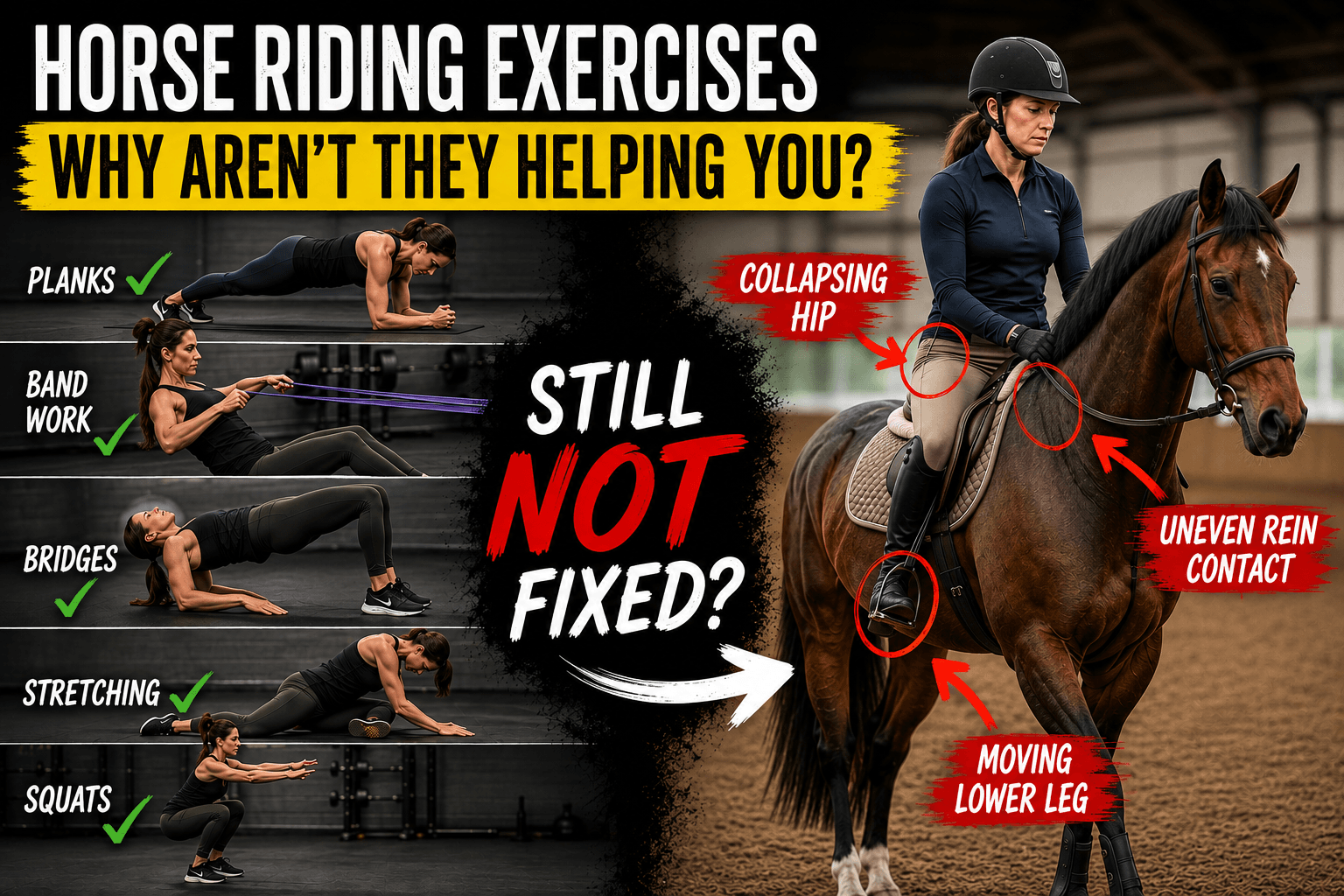
A lower leg that won’t stay still… a collapsing hip… uneven rein contact… difficulty sitting evenly…
These are all outputs of the way your body is currently organising movement.
If you only focus on correcting the symptom, without understanding what is causing it, you often end up going round and round in circles. You correct it, it improves briefly, then it returns because the underlying movement strategy remains unchanged.
Lasting improvement begins by identifying the cause of the movement strategy, not simply trying to correct the symptom it produces.
Choosing a More Effective Horse Riding Exercise
A useful horse riding exercise should do more than make a muscle feel tired.
It should help you develop movement options that are relevant to the saddle.
That may involve learning to control your pelvis without fixing your upper body, allowing your hips to move while maintaining support through the trunk or keeping your shoulders organised without pulling them backwards.
It should also help you notice differences between your two sides without immediately forcing them to appear identical.
The aim is not to manufacture a perfect shape.
It is to give your body more than one way to respond.
When your body has better movement awareness, coordination and internal support, it is less dependent on the familiar strategies that have developed through daily life.
Your riding position can then become more adaptable because it is being supported from within rather than continually corrected from the outside.
Understanding Must Come Before Correction
The patterns you experience in the saddle are not random.
They are often the logical result of everything your body has previously learned. The Right Solution Starts With the Right Question
If there’s one thing I’d like you to take away from this article, it’s this…
Most riders are trying to fix what they can see.
- A leg that won’t stay still.
- A collapsing hip.
- Uneven rein contact.
- A position that never seems to stay.
But those are often the result of the way your body has learned to organise movement, not the cause of the problem itself.
Until you understand why your body has adopted that movement strategy, it’s easy to spend months—or even years—correcting symptoms that continue to return.
The better question isn’t…
“What exercise should I do?”
It’s…
“Why has my body chosen this movement strategy in the first place?”
Once you can answer that question, you stop chasing individual faults and start improving the system that’s creating them.
And that’s where lasting change begins.
Ready to Understand Your Body?
If this article has made you realise your riding is being influenced by movement strategies you weren’t even aware of, the Rider Core Mini Course is the natural next step.
It explains how your body creates stability, how movement strategies develop and why common riding faults are often the visible result of something happening elsewhere.
Rather than simply giving you more exercises, it helps you understand what your body is actually doing, so every exercise, every lesson and every correction has a clear purpose.
Because once you understand how your body is organising itself…
You can finally start changing it.
Watch the Supporting Video
Watch the supporting RiderCise® YouTube video to explore how movement patterns develop over time and why they often become visible when you ride.

Discover the Rider Core Mini Course
The Rider Core Mini Course helps you understand what your body is doing before you begin trying to correct or strengthen it, giving you a clearer foundation for choosing the right horse riding exercise and improving the way your body supports you while riding.