by Clare | Oct 5, 2026 | SEO Blogs
You love your horse, but something in your riding isn’t quite right. You take regular lessons, you put in genuine effort, and you still feel unbalanced, stiff, or frustrated when your body won’t do what your instructor’s asking. That disconnect rarely comes from a lack of passion. It comes from how your body has learned to move and protect itself over decades of life and riding. The Rider Core Mini Course exists to bridge that gap between intention and physical execution, giving you the specific biomechanical understanding you need to actually change your position.
Why Generic Core Training Fails Equestrians
Most rider problems aren’t caused by a lack of effort or fitness. Clare, Founder of RiderCise, puts it plainly: they come from how the body has learned to stabilise, protect and cope over time. You might have strong abdominal muscles from years of Pilates or gym work, and still collapse through your upper body or lose your stirrups, because those exercises don’t replicate the unique demands of the saddle. That’s why generic strength so often fails to translate into better equitation.
The Difference Between Gym Abs and Riding Stability
Traditional core training chases force production and visible muscle definition. Riding asks for something else entirely: subtle neuromuscular control and dissociation. A six-pack doesn’t guarantee an independent seat. Isolating your pelvis from your ribcage while absorbing movement is a completely different skill from holding a plank. Your horse responds to tension and bracing just as fast as weakness, so building the wrong kind of strength can leave your position more rigid, not less.
How Protective Patterns Limit Your Position
Your nervous system prioritises safety over perfect posture. That creates protective patterns which feel entirely normal to you, but restrict your movement in the saddle. These learned responses often show up as chronic tightness or instability that no amount of stretching or strengthening seems to fix for good. Until you understand your own learned habits and protective responses, no amount of riding or generic exercise will fully resolve position issues or pain.
What Is the Rider Core Mini Course?
The Rider Core Mini Course is a short online educational course designed to help you understand what is happening within your body before you try to change it.
If you keep following instructions or trying different exercises without fully understanding what is happening within your body, you may simply keep working on the visible problem rather than addressing what is causing it.
This course gives you the foundational knowledge to recognise the physical factors that may be influencing your position, stability and movement in the saddle. So instead of simply trying harder to correct what you can see or feel, you can begin to understand why certain riding difficulties keep appearing and what may need to be addressed before progressing to more advanced training.
Course Structure and Time Commitment
The Rider Core Mini Course is designed to give you meaningful education without demanding hours of your time. Each module breaks down the “why” behind common riding difficulties, helping you connect what you feel and experience in the saddle with how your body is functioning.
Rather than giving you another list of exercises to follow, the course helps you build the understanding you need to make more informed decisions about your training. You’ll work through the material at your own pace, fitting the modules around riding, work and everyday life, with lifetime access so there’s no pressure to rush through it.
Understanding Before Intervention
It’s tempting to jump straight into exercises when something isn’t working in your riding. But if you don’t understand why your body is responding the way it is, you may simply reinforce the same patterns you’re trying to change.
The Rider Core Mini Course helps you build that understanding first. You’ll learn how posture, stability, movement and your body’s learned responses can influence what happens in the saddle, giving you a clearer foundation from which to approach your training.
Instead of simply adding more strength, more exercises or more effort, you’ll begin to understand what your body may actually need — and why understanding the problem should come before trying to fix it.
Identifying Your Specific Riding Blockers
Many riders find themselves hearing the same instructions again and again: “relax your leg”, “sit taller”, “stop gripping”, “keep your stirrup” or “don’t collapse.”
You may understand exactly what your instructor is asking you to do, yet still struggle to maintain the correction once your horse starts moving.
That doesn’t necessarily mean you aren’t trying hard enough. What you see or feel in the saddle can be the end result of how your body is organising itself to create stability, manage movement and respond to the forces produced by the horse.
Understanding that gives you somewhere more useful to start.
Gripping, Bracing, and Collapsing
Gripping, bracing and collapsing are often treated as individual problems that need to be corrected separately. But your body doesn’t work as a collection of separate parts.
If your body is struggling to create or maintain stability, other areas may compensate. A leg may grip, your upper body may stiffen or your position may change as your body finds another way to keep you secure in the saddle.
That is why repeatedly correcting the part you can see doesn’t always produce lasting change.
The Rider Core Mini Course helps you understand the role of stability, posture and coordinated movement so you can begin looking beyond the visible symptom.
When Willpower Cannot Fix Physical Habits
Being told to “sit taller” or “relax your leg” can make perfect sense, but understanding an instruction doesn’t automatically mean your body can maintain it.
Your current position and movement are influenced by the strategies your body has learned and repeatedly used. You may consciously make a correction, only to find yourself returning to the same position moments later.
Rather than assuming you simply need to concentrate harder, it is worth asking why your body keeps returning to that pattern.
If you want to improve your riding position off the horse, understanding what may be influencing your position gives you a much better starting point than repeatedly trying to correct the outcome.
Building a Sustainable Foundation for Rider Fitness
Rider fitness isn’t simply about becoming stronger or fitter. Your body also needs to coordinate movement, create stability and respond effectively to the changing demands of the horse beneath you.
That is why understanding how your body functions should come before simply increasing the difficulty or intensity of your training.
The Rider Core Mini Course provides that educational foundation. It helps you understand the principles behind posture, stability, movement and the rider’s core so that the training you choose afterwards has greater purpose.
Moving From Symptom Management to Root Cause
It is very easy to focus on the place where you notice a problem.
A tight hip, aching back, dropping shoulder, gripping leg or uneven feeling may naturally draw your attention to that particular area. But where you experience the symptom isn’t necessarily where the whole story begins.
Rather than immediately trying to fix an individual area, the course encourages you to consider how different parts of the body work together and how changes in one area can influence another.
Even when using resources such as Exercises to reduce back pain, understanding the wider physical picture can help you make more informed choices about your training rather than simply moving from one exercise to the next.
Preparing the Body for Advanced Work
Strength and fitness have an important role in riding, but adding more load or intensity isn’t always the best place to begin.
First, it helps to understand what stability actually means, how your core system works, how posture can influence movement and why your body may have developed the patterns you currently experience.
With that knowledge in place, you have a clearer foundation from which to approach further rider-specific training.
Who Is the Rider Core Mini Course For?
The Rider Core Mini Course is for riders who want to understand more about the body behind their riding.
It may be particularly useful if you keep receiving the same corrections in your lessons, notice the same physical difficulties returning, or have tried exercises and workouts without really understanding why you are doing them or what you are trying to change.
It is also suitable for riders returning after a break, riders who have noticed their body or riding changing over time, and those who simply want to become better educated about their own physical contribution in the saddle.
You don’t need an advanced knowledge of anatomy or exercise science. The course is designed to make these concepts understandable and relevant to riders, giving you knowledge you can take forward into your riding and future training.
Turning Understanding Into Practical Application
Learning about your body is only useful if you can begin connecting that knowledge to what you actually experience.
Throughout the course, you’ll start to understand concepts such as stability, posture, proprioception and movement patterns, and how they can influence what happens when you ride.
Instead of simply being given another set of exercises to complete, you are learning how to think differently about the problems you experience.
Understanding Before Intensity
More effort isn’t always the answer.
If you don’t understand why a movement or position is difficult in the first place, simply adding more repetitions, resistance or intensity may not address what is actually happening.
Education gives you context. It allows you to understand what you are training, why it matters and what you may need to consider before progressing.
That is the purpose of the Rider Core Mini Course: not to push you harder, but to help you understand your body better.
Combining Education With Practical Application
The course combines education with practical ways to explore the concepts you are learning.
Rather than completing exercises simply because you have been told they are “good for riders”, you begin to understand the purpose behind them and how they relate to stability, posture and movement.
That knowledge can then inform the choices you make about your future training.
Taking the Next Step in Your Riding Journey
The way your body moves, stabilises and responds matters when you ride. Understanding it gives you the opportunity to stop guessing and start making more informed decisions about your training.
The Rider Core Mini Course gives you the foundational education to understand what may be happening behind the difficulties you experience in the saddle — before you simply try another correction or another exercise.
Because before you can make meaningful changes to how your body functions, you first need to understand what you’re asking it to change.
And when you’re ready to put that understanding into practice, you can progress into RiderCise’s rider-specific workout bundles with a much clearer understanding of what you are training and why.
by Clare | Sep 28, 2026 | SEO Blogs
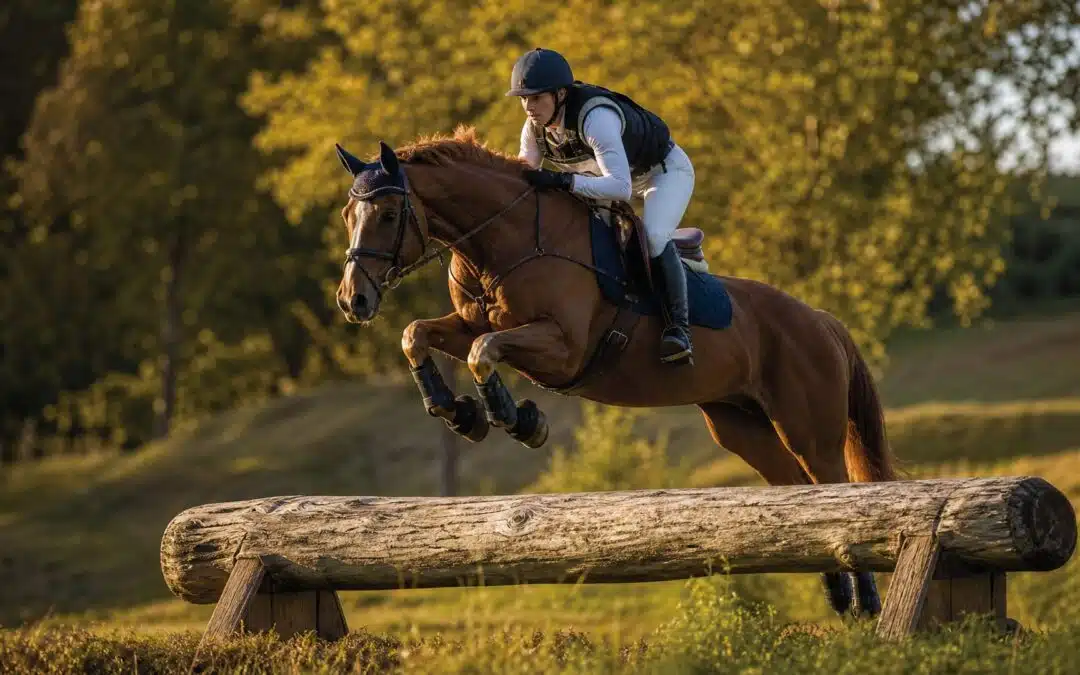
Eventing asks your body to do things no other equestrian discipline demands in quite the same way. You’re not just holding a position. You’re managing kinetic energy across three phases while absorbing ground reaction forces that change every second. Fitness for eventing riders isn’t about how far you can run or how much you can lift. It’s about whether your body can organise itself efficiently under fatigue and impact. If you’ve ever felt secure in the warm-up arena only to collapse over a fence combination halfway round the cross country course, the issue is rarely your courage or your horse’s scope.
Most rider problems aren’t caused by lack of effort or fitness. They come from how the body has learned to stabilise, protect, and cope over time.
Why Cross Country Fitness Demands More Than Just Riding
Cross country fitness requires different conditioning than dressage or showjumping, because the variables are uncontrolled and the consequences of physical failure are immediate. In dressage, you work in a contained environment where the aids are subtle and the floor is predictable. Showjumping adds height and speed but still happens on prepared ground with known distances. Cross country brings uneven terrain, fixed obstacles, variable light, and fatigue that builds with every minute you spend in two-point or landing positions. Your body has to process proprioceptive data at speed while generating force asymmetrically, often when one side is already working harder than the other to compensate for a turn, a slope, or a previous imbalance.
The Unique Physical Load of Eventing
The load profile of cross country is intermittent and high-impact. You alternate between relative ease and moments of extreme demand: galloping uphill, braking before a drop fence, stabilising after an awkward landing. These spikes need anaerobic capacity and eccentric strength that steady-state riding never builds. When your muscles fatigue during these peaks, your nervous system defaults to whatever movement pattern feels safest, usually the one you’ve used most often, even if it’s biomechanically inefficient. That’s why you might feel fine hacking but lose your lower leg over a ditch. The specific demand exceeded your trained capacity, and your body reverted to protection rather than performance.
Identifying Your Personal Stability Leaks
You need to tell the difference between genuine cardiovascular fatigue and protective bracing that masquerades as tiredness. Protective patterns show up when your brain perceives instability, and muscles tighten restrictively rather than engage dynamically. If your back aches after twenty minutes of cross country but disappears the moment you dismount, or your shoulders round despite conscious correction, you’re likely guarding rather than lacking endurance. You need to understand your body’s protective responses before strength training will do any good. Without that awareness, exercises reinforce compensation instead of correcting it. Pay attention to when discomfort arises relative to specific movements or terrain features. That timing reveals the real deficit.
Strength Training for Eventers: Stability Over Bulk
Functional strength for eventing looks nothing like bodybuilding or generic gym work, because the goal is integrated stability, not muscle size. Eventers build strength without bulk by prioritising neuromuscular control and multi-planar loading over hypertrophy. Bulky muscles come from high-volume isolation work designed to maximise cross-sectional area. Rider strength comes from teaching existing muscle tissue to coordinate under load. A bicep curl builds arm size. A single-leg Romanian deadlift with rotation teaches your posterior chain, adductors, and core to cooperate in a pattern that mirrors catching your balance after a stumble.
Functional Strength vs General Gym Work
If a rugby player trained like a golfer, they’d get hurt. Eventers training with generic yoga or Pilates miss the specific impact and stabilisation demands of cross country in the same way. Traditional gym programmes often lean on bilateral, sagittal-plane movements like squats and presses that don’t replicate the rotational, asymmetrical, reactive nature of riding. Yoga improves flexibility and mind-body connection but rarely gives you the progressive overload needed to strengthen connective tissue against impact. Pilates builds deep core awareness but typically lacks the dynamic, weight-bearing component landing forces demand. Your strength work has to bridge that gap by combining stability challenges with loads that prepare your joints for the reality of cross country.
Targeting the Posterior Chain and Adductors
Your posterior chain and adductors are the primary shock absorbers and stabilisers during cross country, yet they’re frequently undertrained or poorly coordinated. The glutes, hamstrings, and spinal erectors have to work together to decelerate your upper body over fences, while your adductors hold medial-lateral stability in the saddle. Weakness or inhibition anywhere in that chain forces other structures to compensate, which is how you end up with lower back pain, knee pinching, or collapsing through the inside shoulder. Strengthening these areas means exercises that demand simultaneous engagement rather than isolation, such as lateral lunges with overhead reaches or hinge patterns with anti-rotation components. Without that integration, strength stays theoretical. It doesn’t transfer when you need it most.
Building Stamina for Eventing Through HIIT
HIIT beats steady-state cardio for cross country stamina because the sport itself is interval-based, not continuous. A five-minute cross country course contains multiple anaerobic bursts interspersed with active recovery, which mirrors the structure of high-intensity interval training far more closely than a thirty-minute jog does. Steady-state cardio builds aerobic base capacity, valuable for general health and recovery, but it doesn’t train your body to buffer lactate, recover quickly between efforts, or hold technical precision while your heart rate swings. When you approach a complex combination after a long gallop, whether you can think clearly and react precisely depends on how well your system handles repeated intensity spikes, not your resting VO2 max.
Why Steady-State Cardio Falls Short
Long-distance running or cycling builds endurance in a linear, predictable context that lacks the cognitive and stabilisation demands of riding. You can be aerobically fit yet completely unprepared for the metabolic chaos of cross country, because your body has never practised recovering while processing spatial information and holding postural integrity at the same time. Steady-state work also tends to reinforce forward-flexed, repetitive movement patterns that can make the very postural issues eventers struggle with in the saddle worse. Base fitness still matters. But relying only on traditional cardio leaves you exposed at exactly the moments events are won or lost.
Structuring Intervals Around XC Demands
Effective HIIT workouts for equestrians replicate the work-to-rest ratios and movement patterns of actual cross country courses rather than arbitrary timer intervals. That means exercises that challenge balance, coordination, and decision-making during high-output phases, followed by active recovery that keeps you engaged without asking for maximal effort. The HIIT Workout Bundle is built to replicate the interval demands of cross country specifically, so it builds match-fitness rather than general endurance. Sessions should progress from shorter, simpler intervals to longer, more cognitively demanding ones as your capacity improves. Movement quality always comes before raw output.
Off-Horse Fitness Training That Transfers to the Saddle
Off-horse work only transfers if it mimics the neuromuscular demands of riding. Otherwise it builds fitness that disappears the moment you mount. Generic core planks or leg raises might strengthen abdominal muscles in isolation, but they don’t teach your body to stabilise while absorbing motion, shifting weight, or responding to unpredictable stimuli. Transfer happens when exercises replicate the sensory and motor challenges of riding closely enough that your nervous system recognises the pattern as relevant. That’s why improving riding position off the horse demands specificity, not volume.
The Rider Core Mini Course is the foundational first step to improving how your body works in the saddle, because before you can effectively change your riding, you need to understand what is actually creating the challenges you experience. The course teaches you how posture, stability, your core system and learned movement patterns influence the way you balance, move and respond to your horse — helping you understand why issues such as gripping, bracing, collapsing, losing your stirrups, inconsistent contact or struggling to maintain your position can keep returning despite more lessons or trying harder. By giving you the knowledge to recognise what your body is doing, why it is doing it and what needs to change, the course removes much of the guesswork from improving your riding. Instead of repeatedly trying to correct the symptom you feel in the saddle, you can begin addressing the underlying patterns that are producing it — giving you a much stronger foundation from which to improve your stability, control, coordination and ultimately your effectiveness as a rider.
Common Fitness Mistakes That Hold Eventers Back
Pushing through pain or fatigue without understanding its source reinforces the very patterns holding your riding back. Struggle is rarely about insufficient effort. It almost always signals an unaddressed physical coping mechanism your body uses to create artificial stability. When you ignore these signals and train harder, you strengthen the compensation instead of resolving the dysfunction underneath it. That’s particularly dangerous for eventers, because the margin for error on cross country is so narrow, and protective patterns that work in the gym fail catastrophically under competitive pressure.
Ignoring Protective Movement Patterns
Protective bracing often shows up as chronic tension, restricted range of motion, or recurring discomfort that improves temporarily with stretching or manual therapy but returns as soon as you ride. If you consistently get tight hip flexors, a stiff thoracic spine, or gripping knees despite regular mobility work, your body is using that tension to substitute for missing stability elsewhere. Fixing it means identifying what the protection is guarding against, whether that’s weak glutes, poor foot grounding, or inadequate rotational control. Specific exercises to reduce back pain target these root causes rather than just easing symptoms.
Overtraining Without Biomechanical Awareness
More training doesn’t equal better riding if the training reinforces faulty mechanics. Eventers who pile on mileage, reps, or sessions without assessing movement quality accumulate fatigue while embedding inefficient patterns deeper into their neuromuscular system. That leads to plateaus, injuries, and frustration, because the body gets better and better at doing the wrong thing. Sustainable progress needs regular checkpoints where you ask whether your training is improving movement efficiency or just increasing your tolerance for poor movement. Sometimes the most useful session is the one where you stop, reassess, and rebuild a fundamental pattern properly.
Creating a Sustainable Rider Endurance Training Plan
Sustainability comes from clarity and understanding, not punishment or excessive volume. Your training plan should reflect your competition calendar, your current physical capacity, and your horse’s feedback, not arbitrary benchmarks or whatever’s trending on social media. An off-season plan and a competition-season plan differ fundamentally in emphasis. Off-season work addresses foundational weaknesses, builds general capacity, and experiments with new movement patterns. Competition-season work maintains gains, sharpens sport-specific readiness, and prioritises recovery. Trying to peak year-round guarantees burnout or injury, because adaptation needs variation.
Periodising Around the Competition Season
Structure your annual training into distinct phases that match your competitive goals and your personal life. Base preparation focuses on correcting imbalances and building work capacity through controlled, progressive loading. Pre-competition shifts towards sport-specific intervals and integrated strength that mirrors cross country demands. During competition season, volume drops significantly while intensity stays high but infrequent, so you’re fresh for events. Active recovery periods follow major competitions to allow a physiological and psychological reset. This cyclical approach respects your body’s need for stimulus and rest, and it prevents the staleness that comes from monotonous training.
Listening to Feedback From Your Horse
Your horse gives you a real-time, honest read on your physical effectiveness that no mirror or coach can match. Changes in his way of going, his willingness to accept contact, or his consistency over fences often reflect shifts in your balance, symmetry, or fatigue management before you notice them yourself. If he starts drifting left over combinations or gets resistant to transitions late in a schooling session, look at your own physical state before you pin it entirely on him. This feedback loop keeps your training grounded in outcomes that actually matter, rather than abstract metrics, so your fitness work serves the partnership instead of becoming an end in itself.
Choosing the Right Programme for Your Eventing Goals
Which programme is right depends on your current level of self-awareness and your specific cross country challenges. If you know your stamina fails before your strength does, the HIIT Bundle gives you structured interval protocols built for equestrian demands. If positional insecurity is undermining both your confidence and your horse’s performance, start with foundational core work before you add intensity. For riders who want strength, stamina, and mobility resources in one place, the comprehensive rider fitness library covers the full spectrum of rider-specific programming. Honest assessment of where you actually are, not where you wish you were, is what determines which path gets you results fastest.
Be the rider your horse deserves.
by Clare | Sep 23, 2026 | SEO Blogs
You can spend years perfecting your dressage test, only to find the limiting factor isn’t your horse’s training. It’s your own physical capacity to stay balanced and effective. The best exercises for dressage riders target the specific biomechanical demands of an independent seat, addressing the hidden tension and asymmetry that no amount of arena time can fix alone. If you truly love your horse, prove it by becoming the athlete they deserve beneath them.
Most rider problems aren’t caused by lack of effort or fitness. They come from how the body has learned to stabilise, protect, and cope over time. Riders frequently struggle with gripping, bracing, collapsing, losing stirrups, or inconsistent contact, despite regular lessons and genuine effort. This article breaks down why standard gym routines often fail equestrians, and offers a clearer path toward dressage rider fitness that actually translates to the saddle.
Why Generic Fitness Fails the Dressage Rider
If a rugby player trained like a golfer, they’d get hurt. Dressage riders need the same logic applied to them: biomechanically specific conditioning, not generic fitness. Your sport demands sustained isometric endurance and fine neuromuscular control, not maximal force production or cardiovascular output. A general core class might make your abdominals burn, but if those muscles are learning to brace rather than absorb motion, you are actively training your body to block your horse’s back.
The Difference Between Gym Strength and Saddle Stability
Gym strength typically focuses on concentric muscle actions, where fibres shorten to produce movement against resistance. Dressage asks for something else: eccentric control and isometric stability, where muscles lengthen under load or hold tension without changing length, so your pelvis can follow the horse’s motion. Train exclusively for aesthetic abdominal definition and you teach your torso to go rigid. That directly contradicts the suppleness a following seat needs.
Standard crunches and planks often reinforce protective guarding patterns in the lumbar spine and hip flexors that prevent true pelvic independence. You might feel stronger on the mat, yet still collapse at the waist or grip with your knees when your horse transitions, because your nervous system hasn’t learned to dissociate your upper body from your lower body. Once you understand the physical system behind these faults, you can stop treating each one as an isolated problem and start finding a direct route to balance.
Dressage Posture Exercises to Unlock Hip Alignment
You cannot achieve a deep seat if your anterior chain is locked in a shortened position from hours spent at a desk or driving to the yard. Opening the front of the body is non-negotiable if you want true vertical alignment, without forcing your shoulders back or tucking your pelvis under artificially.
Releasing Protective Tension in the Hip Flexors
Tight hip flexors pull your pelvis into an anterior tilt, creating a rounded back that makes sitting trot physically impossible wihthout feeling like you are going to fall off. How does that tension specifically stop a deep, following seat? It mechanically restricts femoral extension, forcing your thigh forward so you perch on the pommel instead of wrapping your leg around the barrel. Targeted release work and active mobility drills fix this far more effectively than passive stretching, which often triggers a stretch reflex that makes the muscle tighten further.
Mobilising the Thoracic Spine for Upright Balance
Your thoracic spine must extend and rotate independently of your lumbar spine so you can stay upright while your hips absorb shock. Desk-bound riders often stiffen through this region and compensate with excessive lower back arching, which leads to fatigue and injury. Mobilisation exercises that segmentally articulate the vertebrae restore the natural curvature you need to carry yourself effortlessly. They also help reduce back pain from riding by distributing load correctly through the axial skeleton.
Core Strength Dressage: Stability Over Six-Pack Abs
Functional rider core strength is the ability to absorb motion while holding neutral spine alignment. It has nothing to do with visible muscle or how long you can hold a plank. Your core is a transmission system between your horse’s power and your aids. It needs to respond and adapt, not lock rigid.
Building Core Strength for Dressage Without Bracing
Why do standard gym ab exercises often leave dressage riders stiffer rather than more effective? They prioritise global rectus abdominis engagement over the deep stabilisers, like the transverse abdominis and multifidus, that control segmental spinal stability. Train these deeper layers through breathing-integrated movement and you teach your body to stabilise from the inside out, leaving your outer muscles supple and available for precise aid application. This is the distinction behind dressage posture exercises that create lightness rather than heaviness in the seat.
Bracing creates a fixed point your horse has to work around. True core integration lets you move with the horse while keeping your own centre of gravity. You need exercises that challenge your stability in multiple planes of motion, mimicking the rotational and lateral forces you feel in shoulder-in or half-pass. This is how you build a riders core that supports collection without restricting expression.
Correcting Asymmetry: Best Exercises for Dressage Riders Seeking Straightness
Straightness in the saddle is a neurological skill. Overwriting old motor patterns takes targeted repetition off the horse, not just conscious correction during lessons. Can off-horse exercises genuinely fix asymmetries your instructor has flagged but never resolved? Yes, because removing the moving horse from the equation lets your brain focus entirely on re-mapping proprioceptive errors and setting new baseline alignments.
Unilateral Training to Expose Weak Links
Bilateral exercises like squats and deadlifts let your dominant side compensate for your weaker side, masking imbalances that show up as crookedness in the arena. Single-leg and offset loading exercises reveal these hidden deficits immediately, forcing each limb to carry its fair share of the load. What separates muscular strength from the neuromuscular control straightness actually requires? Strength is the capacity to produce force. Control is the ability to coordinate that force symmetrically across both sides of the body under dynamic conditions.
Neuromuscular Reprogramming for Crooked Hips
Your brain prefers familiar patterns even when they’re dysfunctional, so correcting asymmetry takes high-frequency, low-load practice to build new neural pathways. Slow, deliberate movements with external feedback help your nervous system recognise what true centred alignment feels like, as opposed to what merely feels normal. This reprogramming takes consistent practice over weeks and months, but it addresses the root cause of crookedness instead of managing its symptoms indefinitely. You can understand your body’s protective patterns through structured assessment before you attempt advanced corrective work.
Seat Improvement Through Off-Horse Proprioception
Balance drills on stable and unstable surfaces sharpen body awareness and reaction time, without the unpredictable variable of a living animal beneath you. Better ground proprioception translates directly to a quieter, more effective seat aid, because your brain learns to process spatial information faster and more accurately.
These drills train your vestibular and somatosensory systems to hold equilibrium through micro-adjustments rather than large, disruptive corrections. When your body can self-correct efficiently on the ground, it carries that efficiency into the saddle. Staying balanced takes less thought, so you can focus on communication instead. This groundwork underpins every other piece of seat improvement dressage riders chase, and it makes your arena time far more productive.
Integrating Rider Fitness Into Your Dressage Training Plan
You don’t need to add hours of gym time to your week to see meaningful changes in your riding. Consistency matters far more than volume, and strategic scheduling makes sure your fitness work adds to your performance rather than taking from it.
Frequency and Recovery for Amateur Riders
How should an amateur dressage rider schedule fitness work without turning up fatigued to a lesson? Put higher-intensity or novel movement sessions at least 24 hours before important rides, so your nervous system has time to recover and integrate what it’s learned. Shorter, mobility-focused sessions can happen daily, or even right before riding as preparation, while strength work needs more space between sessions for the tissue to adapt. Listen to your body honestly. Pushing through exhaustion reinforces poor movement quality and raises your injury risk, and that serves neither you nor your horse.
Moving From Understanding to Application
Knowledge alone doesn’t change physical habits. Structured application does. Many riders understand intellectually what they need to do, but lack the progressive framework to put it into practice safely alongside everything else going on in their week. A structured postural workout bundle gives you the scaffolding to bridge that gap, turning theory into embodied skill through sequenced programming. If you want broader context on improving riding position off the horse, weaving these principles into your weekly routine builds change that lasts, and it shows up in every transition and lateral movement you ride.
Be the rider your horse deserves.
by Clare | Sep 16, 2026 | SEO Blogs
You love your horse. But deep down, you know your body is the limiting factor in your partnership right now. No amount of schooling fixes a crooked seat if your muscles have forgotten how to support it, and no instructor can shout away a protective tension pattern living in your nervous system. Working with a rider fitness coach riders trust means stopping the cycle of frustration and finally dealing with the physical root cause of your riding struggles.
This isn’t about six-pack abs or running marathons. It’s about becoming the athlete your horse deserves. You need specific, targeted work that translates directly to saddle stability and confidence.
Why Generic Fitness Fails Equestrians
Standard personal training misses the mark for equestrians because it prioritises general muscle mass over the neuromuscular habits riding actually demands. A rugby player trains for explosive power. A golfer trains for rotational torque. You need a blend of isometric strength, dynamic mobility, and independent limb control that generic gym routines don’t touch. Train like a bodybuilder and you may build strength that works against your position, creating stiffness where you need suppleness.
The Difference Between Gym Strength and Saddle Stability
Gym strength is usually linear and bilateral: you move heavy loads through a fixed range of motion. Saddle stability is different. Your body has to make thousands of micro-adjustments a second to stay balanced on a moving animal. You might squat twice your bodyweight and still collapse through your left hip in canter, because your brain hasn’t learned to fold that strength into a functional riding pattern. A proper equestrian personal trainer bridges this gap by retraining your nervous system to access strength in the specific postures and alignments equitation demands.
Identifying Protective Movement Patterns
Most rider problems come down to how the body has learned to stabilise and protect itself over time. Fitness alone can’t fix that without first addressing the neuromuscular habit underneath it. When you feel insecure or unbalanced, your body instinctively grips with the knees, braces the lower back, or stiffens the shoulders as a safety mechanism, and these patterns become hardwired long after the original fear has passed. Clare’s approach is built around identifying these protective patterns and learned habits rather than prescribing generic strength drills, which is why she works as a specialist in rider biomechanics, not a generalist trainer.
Until you release these hidden brakes, adding more load only reinforces the dysfunction.
What Bespoke Coaching for Riders Actually Involves
Bespoke coaching for riders goes well beyond sending you a PDF of exercises. It’s a collaborative investigation into your biomechanics and riding history. You deserve a programme that adapts to your body’s feedback week by week, so every minute you spend exercising off the horse actually shows up when you get back on.
Comprehensive Movement and Postural Assessment
Your journey starts with a deep-dive assessment covering posture, joint mobility, and movement quality, both static and dynamic, to uncover the asymmetries sabotaging your riding. This isn’t a standard fitness test. It’s a forensic look at how your daily life, past injuries, and riding habits have shaped your current physical capabilities. We identify exactly where you’re compensating and why, which gives us the baseline to build a strategy around your specific limitations instead of guessing at what might work.
Personalised Riding Fitness Plan Design
A personalised riding fitness plan is built entirely around your assessment findings, your riding goals, and the realistic constraints of your schedule. Instead of forcing you into a pre-written template, we design exercises that directly counteract your identified imbalances while respecting your current fitness level and any chronic pain points. You never waste energy on movements that don’t serve your time in the saddle. Every session has a job to do.
Ongoing Accountability and Technique Refinement
Progress stalls when form degrades or motivation wanes. That’s why ongoing check-ins and video feedback are built into the bespoke experience. You get expert eyes on your movement to make sure you’re performing exercises correctly and safely, which stops new compensations forming as you build strength. This loop lets us adjust your programming in real time based on how your body responds, keeping you accountable and moving toward your goals.
Fast-Track vs Standard Bespoke Programmes
Choosing between intensive and standard support comes down to your timeline, your budget, and how much hand-holding you need to feel confident in your progress. Both pathways use the same biomechanical principles. They differ in how often we’re in contact and how fast we’re aiming to get you results.
Choosing the Right Level of Support
Standard bespoke coaching is a sustainable, longer-term framework, ideal if you want to build lasting habits alongside your daily life and work commitments. Fast-Track intensive coaching, on the other hand, condenses the transformation into a shorter, higher-touch period, with more frequent sessions and direct access for rapid problem-solving. Be honest with yourself: do you have the bandwidth for an intensive sprint right now, or does a steady marathon suit your life better?
Who Benefits Most from Intensive Guidance
Intensive guidance tends to suit competitive riders prepping for a specific season, riders recovering from injury who need close supervision, or anyone who knows they thrive under high accountability. If you’ve tried self-guided methods repeatedly without success, the immersive nature of fast-track support breaks through plateaus by removing the guesswork and giving you constant course correction. That intensity demands commitment and availability, though, so it’s not the right fit for everyone, even with its faster results.
Riders often come to Clare with gripping, bracing, or losing stirrups that persist despite regular riding lessons. That’s because the root cause is a physical compensation pattern, and it needs off-horse correction to shift.
Addressing Common Rider Struggles Through Personalised Training
Your physical discomfort isn’t just an annoyance. It’s your body telling you something in your alignment or strength balance is off. Ignore those signals and you end up with chronic pain and less joy in the saddle. Targeted work turns them into actionable data instead.
Correcting Asymmetry and Crookedness
Every rider has a dominant side. But when that dominance means you sit heavier on one seat bone or carry one shoulder higher, it confuses your horse and caps your performance. Off-horse work lets us isolate and strengthen the weaker side while lengthening the tighter side, something nearly impossible to do while you’re also managing a 500kg+ animal. Address these asymmetries systematically on the ground, and a neutral pelvis and aligned spine make straightness in the saddle feel natural instead of forced.
Rebuilding Confidence After Injury or Setbacks
Physical setbacks often leave mental scars, tension and hesitation that outlast the injury itself, long after the tissue has healed. A supportive equestrian personal trainer helps you rebuild trust in your body through graded exposure and controlled movement that proves to your nervous system you’re safe again. That psychological safety is the foundation everything else is built on, so you go back to the saddle with real assurance instead of brittle bravado.
For many riders, this includes specific exercises to reduce back pain that target the core and glutes to take pressure off the lumbar spine.
Integrating Off-Horse Work with Your Riding Schedule
You’re already busy, and adding another commitment feels like a lot. But effective rider fitness doesn’t need hours of daily grinding. Quality of movement beats volume every time for equestrians. Two focused twenty-minute sessions often beat three hours of unfocused repetition.
The goal is to enhance your riding, not exhaust you before you even reach the yard.
We build your bespoke coaching around your existing lessons and yard routine: demanding strength work on lighter riding days, mobility or recovery work on heavy schooling days. This kind of periodisation prevents burnout, so your off-horse efforts amplify your saddle time instead of competing with it. Focus on improving riding position off the horse efficiently, and you protect your energy for what actually matters with your horse.
Is a Horse Rider PT Right for You?
Investing in specialist support is a big decision, and it matters that you recognise when you’ve hit the limit of what self-guided learning can do. Not every rider needs 1-2-1 coaching forever. But almost every dedicated rider benefits from it at some pivotal point.
Signs You Need Specialist Support
You probably need expert help if you’ve plateaued despite consistent lessons, if you get recurring pain that physio fixes temporarily but never for good, or if you feel disconnected from your body when riding. These point to a neuromuscular issue rather than a technical one, and that calls for a specialist who understands where human biomechanics meets equine movement. Push through these barriers alone and you rarely get anywhere. Often you just entrench the patterns you’re trying to change.
Next Steps to Start Your Journey
If you’re ready to stop guessing and start progressing, booking a discovery call lets us talk through your specific situation and work out whether bespoke coaching programmes are right for you. If you’d rather understand your own body mechanics before committing to full 1-2-1 support, the Rider Core Mini Course is a foundational introduction to our methodology at a lower entry point. RiderCise also offers lifetime-access workout bundles alongside bespoke coaching, so you can keep your personalised riding fitness plan going on your own once your 1-2-1 programme ends.
Take the first step today. Prove to yourself that you can become the rider your horse needs.
by Clare | Sep 8, 2026 | SEO Blogs
This Is What's Actually Happening When You Ride
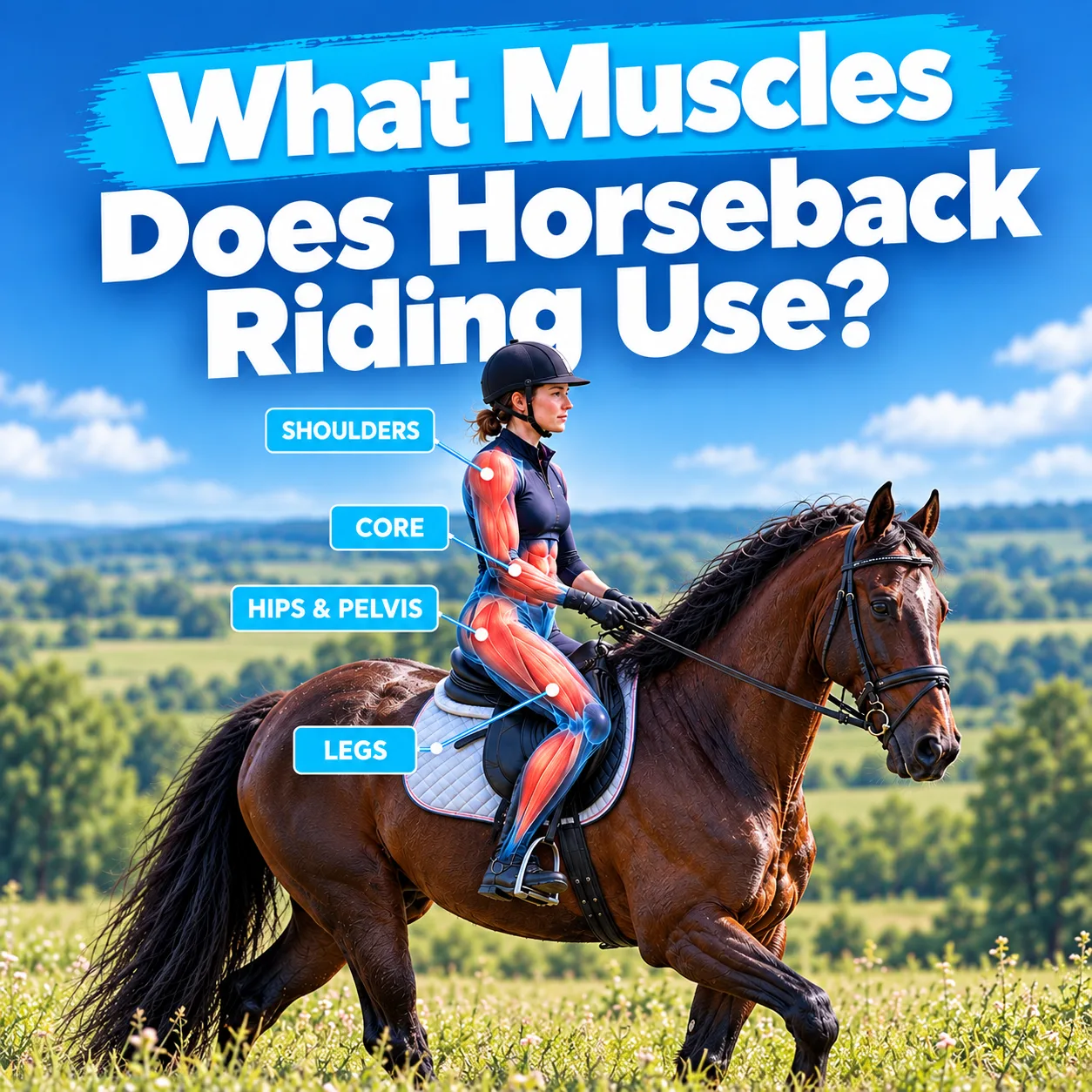
What Muscles Does Horseback Riding Use? the short answer, all of them! But there is a misconception about how your muscles should work and what is actually required for true stability.
Sit on a horse and stay still, and you will not stay still for long.
The moment the horse walks on, your body is already working: absorbing, adjusting, recovering, absorbing again. It happens so quickly, and so far below conscious awareness, that most riders never think of riding as work in this sense at all. They think of it as sitting on something that moves, and of their own job as staying balanced on top of it.
In reality, what’s happening underneath that description is far more active than it looks.
Riders searching for what muscles does horseback riding use are usually trying to answer a much bigger question than they realise.
What Muscles Does Horseback Riding Use?
There isn’t one “riding muscle.”
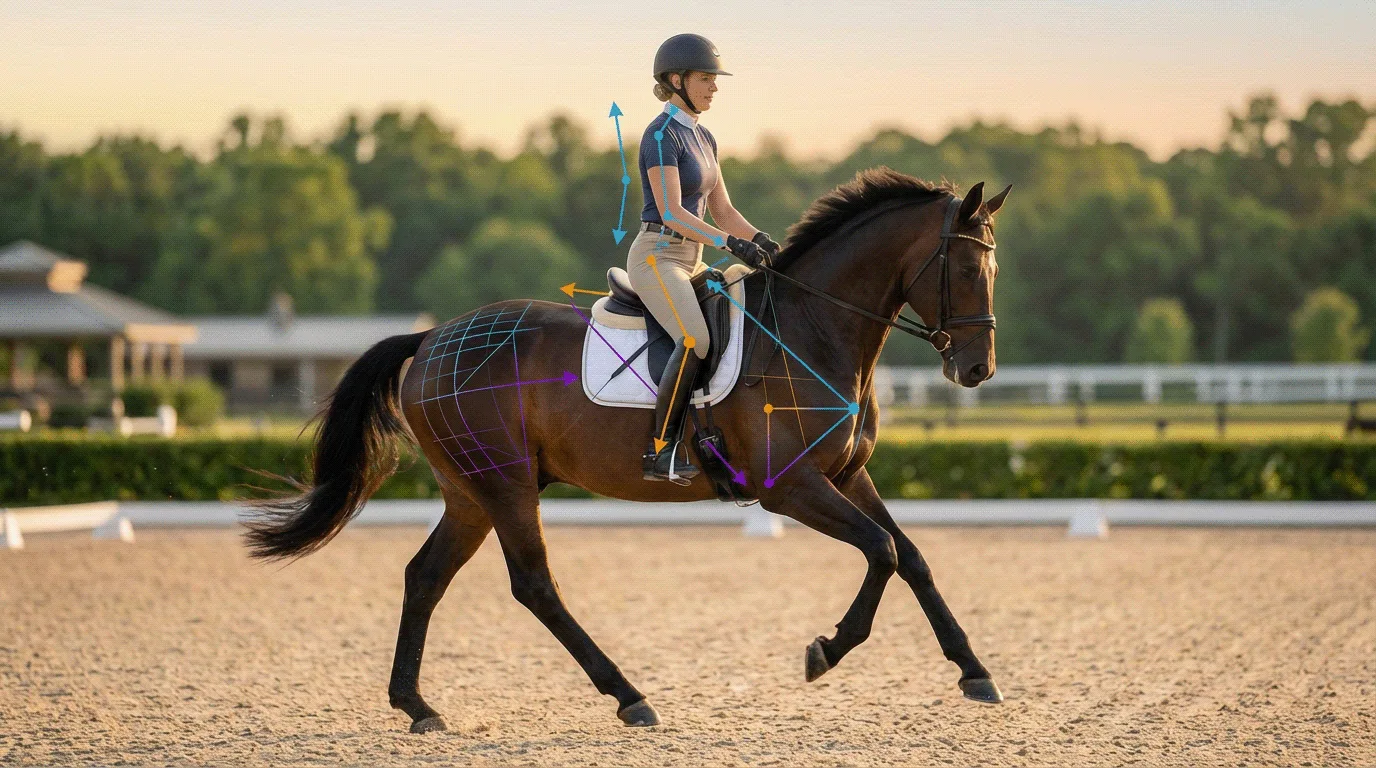
Every stride a horse takes sends a wave of force up through the saddle and into the rider. The hindquarters push, the back lifts and rounds, the shoulders swing, the head and neck oscillate, and all of that movement has to go somewhere. It goes into you. Your pelvis feels it first, then your spine, then your ribcage, shoulders and head, each absorbing a slightly different version of the same wave a fraction of a second apart.
Riding asks multiple areas of your body, legs, pelvis, spine, trunk and shoulders, to coordinate simultaneously rather than any single muscle group doing the work alone. None of this is optional, and none of it is happening once. It’s happening again on the very next stride, differently, because no two strides deliver exactly the same force in exactly the same way.
Riding is not a static position that you find and then hold. It is a continuous negotiation with force that never actually stops.
What looks, from the ground, like a rider sitting quietly in the saddle is, from the inside, a body making hundreds of small adjustments a minute to stay with a horse that is never entirely still. The quiet is the output. The work is what produces it.
Anyone asking what muscles does horseback riding use has to start here.
The first job your body has, every stride, is to absorb what the horse is generating underneath you.
Think of what happens when you land from a small jump, or step off a kerb without expecting it: something in your legs and torso softens on impact rather than transmitting the full jolt straight up through you. Riding asks your body to do a version of that continuously, at speed, in a seated position, without you consciously deciding to do it stride by stride.
Your joints, particularly through the pelvis, hips and lower spine, need to be able to give slightly and then recover, over and over, for the movement to pass through you rather than jar you.
When that absorption isn’t happening well, riders usually feel it as bounce, as a jolt through the seat that doesn’t quite settle, or as a sense of being thrown upward rather than carried.
It’s tempting to interpret that as a technique problem, something to fix by trying to sit differently. Often, though, it’s closer to the body not currently having an efficient way of taking in that force, so the force goes somewhere else instead, usually straight up through a rider who is gripping or bracing in an attempt to control it.
Absorbing force is only half of the answer to what muscles does horseback riding use. Immediately after, your body has to stabilise, holding you in a workable position relative to the horse even as the ground beneath you, the saddle, effectively, keeps moving.
This is different from being still. A rider who is genuinely stable can allow quite a lot of movement to happen through their body while their position over the horse’s centre of gravity barely changes. A rider without that stability tends to either grip hard to manufacture a feeling of security, or lose their position gradually over a few strides and have to reset it.
Stabilising well requires more than one part of the body to be doing something at once. The deep muscles around the spine and pelvis are working to keep your torso organised over a moving base, your legs are doing something related but distinct to stay connected to the horse’s sides, and your upper body is managing its own weight so it doesn’t add extra, unhelpful movement into the system.
None of these are working in isolation. They’re coordinating.
What Muscles Does Horseback Riding Use to Stay Coordinated?
Riders are told to “use their core,” or to “sit up,” as though there is one area of the body responsible for control and the rest is passive.
In practice, staying with a moving horse asks several regions of the body to work together in a specific, changing sequence: legs responding to the horse’s rhythm, the pelvis translating that into the torso, the upper body staying quiet enough not to interfere, and all of it adjusting according to what the horse does next.
Riding a transition, a change of direction, or simply a horse that speeds up slightly asks that whole coordinated system to reorganise itself, sometimes within a single stride.
A rider can be perfectly capable of holding a strong position on the ground and still feel unstable on a horse.
This is why isolated strength doesn’t automatically transfer into better riding. The saddle is asking for coordination between multiple areas under continuously changing conditions, not strength in any one area held still. It’s a considerably more complex demand than it looks from the ground, and considerably more complex than most riders have ever been told.
Reorganisation, Every Single Stride
The final piece is the one most explanations of what muscles does horseback riding use leave out entirely: this whole process, absorption, stabilisation and coordination, has to happen again on the next stride, because the next stride is never quite identical to the last one.
The horse shifts its balance, changes tempo fractionally, meets uneven ground, spooks slightly at something in the hedge. Your body has to reorganise its response accordingly, continuously, for as long as you’re moving.
This explains something riders often experience but rarely name. The sense of “just about holding it together,” of feeling secure for a few strides and then losing that feeling for no obvious reason, isn’t usually a concentration lapse.
It’s what happens when a body that can manage a certain amount of reorganisation meets a moment that asks for slightly more than it currently has readily available. The horse changed the demand. The rider’s system had to find a new answer to it, on the spot, and on that particular stride it didn’t quite manage to.
None of this is presented to riders very often, and its absence leaves a strange gap in how riding is usually taught, and in how what muscles does horseback riding use is usually answered.
Riders are given positions to hold and told to try harder to hold them, without ever being shown what their body is actually being asked to do underneath that instruction. Once you see riding as this continuous cycle, force coming in, the body absorbing it, stabilising against it, coordinating a response, and then doing all of it again on the next stride, a lot of familiar frustrations stop looking like personal failings and start looking like exactly what you’d expect from a genuinely complex physical task.
It also reframes what “improving” actually means.
It isn’t about finding the right position and gripping onto it more successfully.
It’s about the body becoming more efficient at this whole cycle: absorbing more smoothly, stabilising with less effort, coordinating more readily, and reorganising faster when the horse changes what it’s asking.
That’s a different kind of progress to the one most riders have been chasing, and it’s a considerably more honest description of what’s happening every time they get on.
Ready to Understand Your Body?
If this article has made you realise how much your body is actually doing every stride, without you ever consciously directing it, and you want a proper answer to what muscles does horseback riding use, the Rider Core Mini Course is the natural next step.
It explains how your body creates stability, how it coordinates across multiple areas at once, and why the sensations you feel in the saddle, bounce, gripping, losing your position, are the visible result of exactly the process described above.
Rather than simply giving you more exercises, it helps you understand what your body is actually doing, so every exercise, every lesson and every correction has a clear purpose.
Because once you understand how your body is organising itself…
You can finally start changing it.
Watch the Supporting Video
Watch the supporting RiderCise® YouTube video to find out more about the muscles used in the saddle and what creates true stability.
Discover the Rider Core Mini Course
The Rider Core Mini Course helps you understand what your body is doing before you begin trying to correct or strengthen it, giving you a clearer foundation for choosing the right horse riding exercise and improving the way your body supports you while riding.
by Clare | Sep 2, 2026 | SEO Blogs
If you’ve searched for an online fitness program for horse riders, you’ve probably already tried the generic route. A yoga app. A Pilates subscription. Maybe a gym plan a personal trainer built for someone who’s never sat on a horse. You’re still gripping with your knees. Still collapsing on one side. Still sore after a hack that shouldn’t hurt at all.
That’s not a you problem. That’s a program problem. RiderCise was built to fix it, with rider-specific workouts, a lifetime access model, and no monthly fees eating into your motivation. If you’re ready to buy rather than browse, here’s exactly what you need to know.
Why Riders Need an Online Fitness Program for Horse Riders (Not a Generic App)
Riding isn’t symmetrical. You brace more on one side, grip more with one leg, and collapse through one hip without even noticing. A generic fitness app has no idea any of that is happening. It just gives you the same squat-and-stretch routine it gives everyone else.
An online fitness program for horse riders has to train your body the way riding actually demands: asymmetry correction, core stability that holds under movement, and the ability to release your grip instead of clamping down harder when you feel unsteady. That’s a completely different job from general fitness.
Clare, founder of RiderCise, built the brand into the UK’s leading platform for rider-specific fitness. Her argument is simple. Most rider problems come from how your body has learned to stabilise and protect itself. It’s not a lack of effort. It’s a pattern that needs retraining, off the horse, before it can change on the horse.
What Makes an Equestrian Fitness Programme Different From a Regular Workout Programme
A regular workout programme builds general strength and general mobility. An equestrian fitness programme builds strength that transfers directly into your position: an independent seat, a stable core through transitions, hips that follow the horse’s movement instead of fighting it.
That’s the anti-fitness argument RiderCise makes. You don’t need to be “fit” in the generic sense. You need to be riding-fit. Those aren’t the same thing. Treating them as interchangeable is why so many riders plateau despite doing everything “right” at the gym.
Lifetime Access vs Subscription: The RiderCise Model
Most fitness programmes run on subscriptions. You pay monthly, and the fees keep rolling for as long as you access the programme, or forget to cancel it. RiderCise works differently. It sells one-time purchase, lifetime-access workout bundles, so you pay once and keep the program for good.
How a Lifetime Access Fitness Bundle Saves Money Over Time
Think about a typical monthly fitness programme subscription, or attending Pilates sessions online or in-person. Individually, the fee looks small. But it never stops. Month after month, year after year, it keeps adding up for as long as you’re subscribed.
A one-off lifetime access fitness bundle flips that. You pay once. No recurring charge chipping away at your bank account every month.
Why RiderCise Chose One-Time Purchase Over Monthly Fees
RiderCise chose the one-time model because riders don’t need another bill to remember. Busy professional riders, competition riders, and amateurs juggling jobs and family don’t want a subscription they have to actively manage or cancel.
A lifetime access fitness bundle means no ongoing commitment, no auto-renewal surprise, and no guilt about paying for something you’re not using that month. You buy it. It’s yours. You can return to it whenever your riding needs a reset.
Inside the RiderCise Riding Fitness Plan Online: The Bundles Explained
RiderCise sells one-time purchase, lifetime-access workout bundles, Postural, Signature, HIIT and the all-inclusive Vault, rather than a recurring subscription. Each one targets a different part of your riding fitness, so you’re not stuck doing a generic plan that only half-fits your goals.
Postural, Signature, HIIT and the Vault
- Postural, for riders who need to correct asymmetry, fix a collapsed hip, or stop bracing in the saddle.
- Signature, RiderCise’s core riding fitness plan online, built around strength and stability for the seat and position.
- HIIT, for cardio conditioning and stamina, so you’re not gasping by the second lap of the arena.
- The Vault, the all-inclusive bundle for riders who want every program in one place, with lifetime access to the full library.
Who Each Bundle Suits Best
If posture and asymmetry are your biggest frustration, start with Postural. If you want an all-round strength foundation for your seat and position, Signature is the core plan. If stamina and cardio fitness are holding you back in competition or long hacks, HIIT is built for that.
If you’d rather stop overthinking which bundle to pick and just get everything, the Vault gives you lifetime access to the complete RiderCise library in one purchase.
Rider Core Strength: The Foundation of Every RiderCise Program
Every RiderCise bundle comes back to one thing: rider core strength. A strong, stable core lets you sit tall through a spook, absorb a bad stride at a fence, and stay balanced through a downward transition without grabbing the reins for support.
Without it, your body compensates. You grip with your knees. You brace through your lower back. You collapse a hip to feel “secure.” Your horse reads all of that tension as noise, not communication.
Off-horse core training breaks that cycle. It teaches your body to stabilise through movement instead of locking up, so the gripping, bracing and collapsing patterns start to fade. That’s exactly why the Rider Core Mini Course exists. It helps riders understand the biomechanics behind those patterns before they take on a full workout bundle. If you’re not sure where to start, it’s the lowest-commitment entry point into the RiderCise method.
How to Buy a Rider Workout Program: What to Check Before You Choose
If you’re comparing options for a rider workout program riders can actually rely on, don’t just look at price. Check whether someone actually designed the program for riding, or adapted it from something else. Their credentials, experience (with real riders), knowledge and skill sets. And do they ride or have they ridden for majority of their life….real saddle experience matters.
Before you buy, check that the program:
🐴 Is built specifically for riders, not repurposed general fitness content
🔑 Offers lifetime access rather than a recurring subscription
🧠 Comes from a credible, riding-literate source, not just a generic personal trainer
💬 Has real testimonials from riders with your kind of goals, level or discipline
🎯 Maps clearly to a specific problem you have, like posture, stamina or core stability
Signs an Equestrian Fitness Program Is Worth the Investment
A program worth your money explains why it does what it does. It doesn’t just hand you a list of exercises. It connects what you do off the horse to what changes in the saddle.
Many RiderCise clients are adult amateur riders in their 40s to 60s who’ve already tried generic Pilates or yoga programs without seeing lasting improvement in their position. That’s a pattern worth paying attention to. If general fitness hasn’t fixed your riding, a generic program probably won’t either.
RiderCise is designed for riders of that profile, competitive and leisure, across disciplines, who are serious enough about their riding to invest in their own body, not just their horse’s training.
Getting Started With RiderCise
You already know the excuses. “I’ll start after the season.” “I’ll do it once things calm down.” Things don’t calm down. Your horse needs you fit now, not eventually.
If you want a full solution, choose the bundle that matches your goal, Postural, Signature, HIIT, or get everything in one go with the Vault. If you’d rather ease in first, start with the Rider Core Mini Course and build from there.
Every option comes with lifetime access. No subscription, no recurring fee, no reason to keep putting it off. Pick your bundle, buy it once, and become the rider your horse actually needs.