You’ve heard the instruction a thousand times, yet your knees still clamp against the saddle the moment your horse spooks or transitions. Learning how to stop gripping with your knees when riding is rarely about willpower, and it’s not about trying harder to relax during your lesson. Your body isn’t being disobedient. It’s protecting you from a perceived fall by locking onto the only anchor point it can find.
Most rider problems aren’t caused by lack of effort or fitness. They come from how the body has learned to stabilise, protect, and cope over time. You retrain this protective reflex through specific strength and understanding, not frustration.
Gripping With the Knees When Riding: Why It Happens and How to Stop
You’ve heard the instruction a thousand times: “Stop gripping with your knees!”
You relax your legs, allow your knees to soften against the saddle, and for a few strides, everything feels better. Then your horse makes a transition, increases the pace or loses balance, and before you realise it, your knees are gripping again.
Gripping with the knees when riding isn’t always a conscious habit. Often, it’s how your body is attempting to create stability when it cannot adequately manage the movement beneath you.
And that’s an important distinction, because if gripping is helping you feel secure, simply telling yourself to stop doesn’t address why you’re doing it in the first place.
To change the behaviour, you need to understand what your knees are doing, why your body is relying on them, and how to develop a more effective way of maintaining your balance in the saddle.
Why You Grip: Understanding the Protective Response
When you’re riding, your body is constantly responding to movement from your horse. Every stride creates forces that travel through your pelvis, trunk and legs, requiring small, coordinated adjustments to keep you balanced.
Most of these adjustments happen automatically. You don’t consciously tell individual muscles when to contract or relax. Your body organises the movement based on what it has learned and what it can physically manage.
But what happens when that movement becomes more demanding than your body can comfortably control?
Imagine you’re riding in walk, feeling relaxed and balanced. Your horse suddenly moves into trot, and you instinctively tighten your knees against the saddle.
That gripping may be your body’s attempt to create an additional point of security.
Rather than allowing movement to be absorbed and managed through your seat, pelvis and the rest of your body, you’re using pressure through your knees to help hold yourself in position.
The problem is that the strategy you’re using to feel secure may actually be making it harder to maintain your balance.
The Difference Between Stability and Tension
Stability and tension are not the same thing.
To remain balanced on a moving horse, your muscles must continually work together, adjusting their activity as the movement changes.
Good stability allows those adjustments to happen without unnecessary restriction.
Gripping with your knees, however, can create excessive tension through your thighs and restrict how freely your pelvis and hips respond to the horse’s movement.
Think about what happens when you clamp your knees against the saddle.
Instead of your legs maintaining relatively independent contact with the horse, your knees become a fixed point. This can interfere with the movement of your pelvis, alter your seat and make it harder to absorb the horse’s motion.
You may even find yourself bouncing more in trot or losing your stirrups because your lower leg is no longer able to remain comfortably positioned beneath you.
The harder you grip, the more difficult it can become to move with your horse.
You don’t need to eliminate muscular activity to ride effectively. You need the right muscles working together, at the right time, without unnecessary tension.
How Daily Habits Reinforce Saddle Faults
The way your body moves in the saddle doesn’t develop independently of everything else you do.
Your everyday activities, previous injuries, exercise habits and the positions you spend most of your time in can all influence your available movement and the strategies you use to maintain stability.
For example, someone who spends much of their day sitting may have developed different levels of strength, mobility and movement control from someone who regularly performs varied physical activities.
But that doesn’t automatically mean their hip flexors are tight, their glutes are weak or that they will grip with their knees.
The important question is how those physical qualities influence their ability to respond to movement.
If your body has become accustomed to creating stability through excessive muscular tension, you may find yourself using a similar strategy when riding.
Recognising these patterns is useful, but understanding which physical qualities need improving is what allows you to make meaningful changes.
Tight Hips: Are They Really the Cause of Knee Clamping?
Tight hips are frequently blamed for problems with a rider’s leg position, including gripping with the knees.
But gripping with the knees when riding does not automatically mean you have tight hip flexors.
In fact, hip flexor weakness can also influence a rider’s ability to control their leg, although that doesn’t mean weak hip flexors are responsible for knee gripping either.
Your hip is a complex joint supported by several muscle groups, each contributing to different movements and stabilising functions.
Some riders genuinely have restrictions in their available hip movement. Others have sufficient mobility but struggle to control that movement effectively.
And some have perfectly adequate hip mobility and strength but still grip with their knees when riding because of an established movement habit or an attempt to maintain balance.
These are different problems, and they don’t all require the same solution.
Hip Flexor Tightness Riders Overlook
It’s easy to assume that because a muscle feels tight, it must be short and need stretching.
However, a sensation of tightness doesn’t necessarily mean the muscle lacks length.
Muscles can feel tight when they’re working excessively, when they’re fatigued or when they’re contributing to a stabilising strategy that your body relies upon.
This is particularly relevant for riders who experience tension around their hips and thighs.
You might notice that your thighs feel constantly active during sitting trot, or that you struggle to allow your legs to relax after a demanding transition.
That doesn’t tell us whether your hip flexors are short, weak, overactive or simply responding to the demands of riding.
And stretching them without understanding their function may not change the gripping at all.
Testing Your Own Hip Mobility Off-Horse
Before deciding that your hips need stretching, it’s useful to explore how comfortably you can move them independently of the rest of your body.
For example, when lying on your back, can you bring one knee towards your chest without significantly changing the position of your pelvis?
Can you move your thigh out to the side without twisting your trunk to create the movement?
And when standing, can you lift one knee towards your chest without leaning backwards or shifting your weight excessively?
These movements can help you notice how your body organises movement around your hips.
However, they aren’t diagnostic tests. Difficulty performing them doesn’t automatically identify tight hip flexors, weak muscles or a specific joint restriction.
What they can reveal is that the movement you’re trying to achieve may involve more of your body than you realise.
And that’s worth investigating before deciding which exercises you need.
Loosening Your Legs in the Saddle Through Targeted Strength
If your knees are gripping because your body is relying on them for stability, the solution isn’t simply to make your legs stronger.
You need to develop the ability to remain balanced while allowing your pelvis, hips and legs to respond appropriately to the horse’s movement.
That requires coordination, movement control and sufficient muscular capacity.
Consider what happens during sitting trot.
Your pelvis needs to respond to the movement coming through the saddle, while your trunk helps maintain your balance and your legs remain available to communicate with the horse.
If you restrict your pelvis by gripping through your knees, you can interfere with that coordination.
But if you simply release your knees without having another effective way to manage the movement, you may feel even less secure.
This is why the answer isn’t always to relax more.
You need to develop the physical control that allows your knees to stop doing a job they shouldn’t have to do.
Why Stretching Alone Fails to Fix Position
Stretching can be useful when a genuine restriction in muscle length or available movement is contributing to a problem.
But stretching doesn’t automatically improve your ability to coordinate movement or maintain stability.
Imagine a rider who has sufficient hip mobility but grips their knees every time their horse transitions into trot.
Increasing their hip flexibility isn’t necessarily going to change that response.
The rider may need to improve how they manage the movement through their pelvis, trunk and legs, rather than increasing the range available at their hips.
This is why selecting exercises based purely on where you feel tension can be misleading.
You need to understand what is happening before deciding whether mobility, strength or movement control should be the priority.
Building Active Range of Motion for Riders
Active range of motion refers to the movement you can produce and control using your own muscular activity.
For riders, having movement available is only part of the picture.
You also need to be able to control that movement while the rest of your body is responding to changing forces.
For example, you might be able to move your hip comfortably while lying on the floor, but struggle to maintain the same freedom of movement when balancing on one leg.
That difference provides useful information.
It suggests that the challenge may not simply be how far your hip can move, but how effectively you can control the movement when stability becomes more demanding.
Developing that control away from the horse can help build the physical foundation needed for more coordinated movement in the saddle.
Corrective Exercises Off-Horse for Leg Position Problems
Off-horse exercises can be valuable because they allow you to develop specific physical abilities without simultaneously managing your horse’s movement.
However, there isn’t one exercise that automatically stops every rider from gripping with their knees.
The appropriate exercises depend on what’s contributing to the gripping.
A rider who lacks adequate pelvic control may need a different approach from someone with a genuine mobility restriction or an established habit of squeezing through their thighs.
The objective is to identify which physical abilities need improving and develop them progressively.
Activating the Posterior Chain for Better Alignment
The glutes, hamstrings and muscles supporting your trunk all contribute to how you organise movement and maintain stability.
Exercises such as glute bridges, controlled squats and single-leg balance movements can help develop strength and coordination in these areas.
But it’s important not to assume that simply strengthening your glutes will stop you gripping with your knees.
For example, during a glute bridge, notice whether you can lift your pelvis smoothly without excessively arching your lower back or pushing through your thighs.
When performing a controlled squat, can you lower and raise your body without shifting excessively to one side or losing control of your pelvis?
These observations tell you more about how you’re performing the movement than simply counting repetitions.
The aim isn’t just to strengthen individual muscles. It’s to improve how different parts of your body work together.
Integrating Movement Patterns into Weekly Training
Improving movement control requires regular, accurate practice.
A short, structured session performed consistently can be more useful than occasionally completing a long workout without paying attention to how you’re moving.
Begin with movements you can perform comfortably and with good control.
Once those movements become reliable, gradually increase the challenge through balance, coordination, range or resistance.
The important thing is that you’re developing a better movement strategy rather than repeatedly practising the same compensations.
You can improve your riding position off the horse by developing the physical abilities that support your riding, rather than relying exclusively on corrections during lessons.
Improving Riding Posture Beyond the Arena
Your riding position depends on more than where your shoulders, hips and heels appear to be.
It depends on how effectively your body maintains balance and responds to movement.
When you grip with your knees, the resulting tension can influence other areas of your body.
Your pelvis may become less mobile, your trunk may begin to brace, or your lower leg may move away from its intended position.
Trying to correct each of these visible problems separately can become frustrating, particularly when they return as soon as the horse’s movement changes.
Instead, consider whether they’re connected through the way your body is managing stability.
This is where developing postural support and movement control away from the horse becomes valuable.
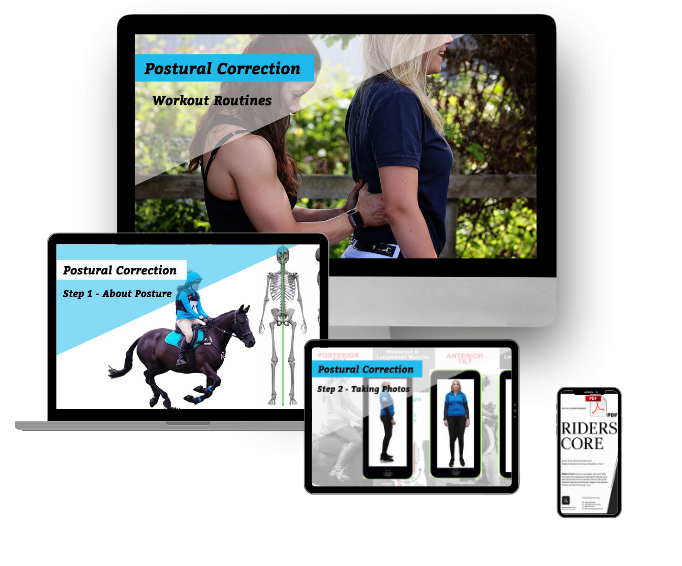
The RiderCise structured postural workouts are designed to help riders address postural imbalances and progressively improve the muscular support needed for better alignment and control.
Rather than concentrating exclusively on the position of your knees, you’re developing the physical foundation that supports the rest of your riding position.
Reducing Riding-Related Pain by Releasing the Knee
Excessive knee gripping can contribute to discomfort because it changes how forces and movement are managed through your body.
When your knees remain tightly pressed against the saddle, the surrounding muscles may work harder than necessary, while other areas have to accommodate the resulting restriction.
Some riders experience discomfort around their knees or thighs. Others notice increased tension through their hips or lower back.
However, it’s important not to assume that knee gripping is responsible for every episode of riding-related pain.
Pain can have several contributing factors, including injuries, joint conditions, training demands and other physical limitations.
If discomfort is persistent, worsening or unexplained, it should be assessed by an appropriate healthcare professional.
For riders whose discomfort is associated with muscular tension or movement control, improving how the body manages stability may help reduce unnecessary physical strain.
You can also explore exercises to reduce back pain as part of understanding how movement, muscular support and physical conditioning can influence comfort in the saddle.
The objective isn’t simply to release your knees and hope the discomfort disappears.
It’s to understand why your body is creating unnecessary tension and whether improving the underlying movement strategy can help.
Moving From Awareness to Lasting Change
The next time you notice yourself gripping with your knees, rather than immediately forcing your legs to relax, pay attention to what was happening just before the gripping started.
Were you comfortable in walk but began gripping during the transition into trot?
Did the gripping increase when your horse became more forward?
Could you release your knees while maintaining your balance, or did you immediately feel less secure?
These observations can help you recognise when your body is relying on gripping and whether the behaviour changes as the demands of riding increase.
You can then begin exploring the physical abilities that might be contributing to that response.
Perhaps you need better pelvic control, improved coordination between your trunk and legs, or greater confidence in your ability to absorb movement without bracing.
Or perhaps the gripping has become such a familiar movement habit that you need to practise a different response repeatedly before it becomes more automatic.
The important thing is that you don’t just remove the gripping. You develop the ability that makes gripping less necessary.
Understanding how your body creates stability is an important starting point.
If you want to explore that further, Understand the physical system behind your riding through the RiderCise® Rider Core Mini Course.
The course explains how your body’s stability system works, how posture and movement influence your riding, and why familiar corrections don’t always produce lasting change.
Because when you understand what your body is doing and why, you can begin making more informed decisions about what actually needs improving.
And that is how you move beyond repeatedly telling yourself to stop gripping with your knees and start developing a more balanced, coordinated and secure position in the saddle.