You’ve probably spent years perfecting your riding technique. Lessons, clinics, better tack. You’ve invested in all of it. And you still feel like something physical is holding you back.
Here’s the truth: being told to “sit taller” or “relax your leg” when your body simply won’t comply isn’t a failure of willpower or a lack of love for your horse. Rider fitness isn’t about how much you can lift or how far you can run. It’s the specific physical capacity to hold balance, symmetry, and independent aids under a dynamic, moving load. Until you address how your body stabilises itself, generic exercise just reinforces the patterns making riding hard for you.
What Rider Fitness Actually Means
People assume rider fitness is general athleticism applied to horses. It isn’t. It’s a distinct discipline that demands neuromuscular precision standard gym work can’t give you. Equestrian-specific fitness gets measured by your effectiveness in the saddle, not your personal best on a treadmill or how far you can stretch on a yoga mat. Your body adapts to the specific demands you put on it. If those demands don’t mimic the sensory experience of riding, the gains won’t transfer to the saddle.
Defining equestrian-specific fitness
Equestrian fitness is the ability to absorb movement through a supple spine while keeping an independent seat and steady contact, whatever the horse does beneath you. It takes eccentric strength to control your descent into the saddle, proprioception to catch subtle shifts in balance, and motor control to isolate limb movement from trunk stability. General cardio builds your endurance. It doesn’t teach your nervous system to stop bracing against the horse’s motion.
The difference between general athleticism and saddle readiness
If a rugby player trained like a golfer, they’d get hurt. The movement patterns and force vectors don’t match. It’s the same for you: excellent general fitness doesn’t stop you collapsing in the trot or gripping in the canter, because athletic training teaches your body to brace against ground reaction forces, not absorb equine locomotion. Saddle readiness asks your core to work as a shock absorber and a stabiliser at the same time, a job traditional ab training was never built for.
Why Generic Gym and Yoga Programmes Fail Riders
Most rider problems aren’t caused by lack of effort or fitness. They come from how your body has learned to stabilise, protect, and cope over time. Apply generic fitness solutions to those deeply ingrained protective strategies and you often strengthen the dysfunction instead of resolving it. You end up fitter, and still unbalanced in the saddle.
The mismatch between floor-based stability and mounted movement
Planks and crunches train your body to create rigidity against a stable surface. That translates directly into stiffness the moment you mount a moving animal. Your horse needs you stable yet yielding, holding your posture without locking your joints or holding your breath against the motion. Floor-based stability doesn’t offer the three-dimensional perturbation of riding, so your brain never learns to tell the difference between necessary support and restrictive tension.
When flexibility becomes instability in the saddle
Excessive mobility work without motor control alongside it can leave you feeling loose on the mat and utterly unsupported the moment you pick up the reins. Flexibility without strength at end-range creates a vulnerability your nervous system reads as unsafe, and that triggers the exact gripping and bracing you’re trying to eliminate. You might touch your toes with ease, but if you can’t stabilise your pelvis while your legs hang free in the stirrups, that flexibility does nothing for your riding.
This kind of training doesn’t fix chronic pain or resolve deep-seated asymmetries. It targets symptoms, not the neurological root causes behind your position faults.
The Biomechanics of Riding-Related Struggles
Riders frequently struggle with repetitive issues like gripping, collapsing, or losing stirrups, despite being told to “sit taller” or “use your core” in lesson after lesson. These aren’t bad habits born of laziness. They’re intelligent safety responses your body has developed to manage instability or past discomfort it perceives as real.
Gripping and bracing as protective mechanisms
When your brain senses your base of support is insecure, it automatically recruits larger muscle groups to clamp onto the saddle, prioritising safety over elegance or correct biomechanics. That gripping is a symptom of instability elsewhere, the foot, the hip, the thoracic spine, and no amount of conscious relaxation overrides a survival reflex. Understanding the physical system behind your riding faults comes before any real intervention; skip that step and you end up treating symptoms as if they were isolated errors.
Asymmetry and its impact on horse and rider
Every rider carries lateral dominance and old compensations into the saddle, creating uneven loading that confuses the horse and limits your own range of effective motion. If your right hip is chronically tighter than your left, your horse gets conflicting aids and can develop musculoskeletal issues of their own in response to your imbalance. Fixing this takes targeted off-horse training that exposes and retrains those blind spots. More saddle time alone won’t even things out.
Why effort alone cannot fix physical patterns
Willpower lives in the prefrontal cortex. Protective movement patterns live in the brainstem and spinal cord, out of reach of sheer determination or a verbal instruction from your instructor. You can’t think your way out of a neuromuscular habit that sits below conscious thought, which is why positive thinking and harder work so often fail to produce lasting change. Real improvement comes from giving your nervous system new sensory information and safer movement options, not from forcing compliance through mental grit.
Core Pillars of Effective Equestrian Training
Effective equestrian training rebuilds your physical foundation from the ground up, targeting the attributes that actually serve partnership with a thousand-pound athlete. These pillars aren’t optional if you want to move beyond survival mode and into real, functional harmony with your horse.
Functional core stability versus abdominal strength
Your core has to resist extension, rotation, and lateral flexion while letting your pelvis follow the horse’s gait without restriction. That’s fundamentally different from visible abs or holding a plank for two minutes; it needs dynamic responsiveness, not static endurance. Functional core stability means your torso works as a conduit for energy, not a barrier, giving you finer aids and more comfort for both of you.
Symmetry and proprioception off the horse
You can’t build straightness on a crooked foundation. Off-horse assessment and correction are essential for long-term progress. Proprioceptive training builds an internal map of where your body actually is in space, closing the gap between what you feel you’re doing and what you’re actually doing. That self-awareness is the bedrock of independent aids, letting you adjust your position moment by moment without waiting for someone to shout a correction from the ground.
Mobility with control for independent aids
True riding mobility means accessing a joint’s range of motion actively and under load, not just passively with gravity doing the work. You need hips that open and close with strength at end-range, ankles that dorsiflex under pressure, and shoulders that stay stable while your arms move independently. Specific balance exercises help build this controlled mobility into patterns that survive the chaos of an actual ride.
Translating Off-Horse Work to Saddle Performance
The real test of any rider fitness programme is whether it changes how you feel and perform the next time your foot goes in the stirrup. Off-horse training isn’t a separate hobby. It’s a direct investment in your partnership, giving your body the physical vocabulary it needs to express your intentions clearly.
Recognising transferable gains in your ride
You’ll know your off-horse work is transferring when transitions get smoother, your half-halts take less effort, and you finish rides energised instead of depleted. That happens because your body has stopped fighting the horse’s movement and started working within it, cutting friction and fatigue. Better position off the horse creates a feedback loop: better alignment leads to clearer communication, which builds mutual trust and willingness.
Building confidence through physical competence
Anxiety in the saddle often comes from a legitimate lack of physical preparedness. Your nervous system has correctly worked out that you don’t have the tools to handle a surprise safely. When you know your body can absorb a spook, hold balance over a fence, or sit a big trot without collapsing, confidence follows as a natural result of physical competence. Addressing riding-related back pain or other discomfort strips away the anticipation of suffering that undermines your enjoyment and focus.
Confidence built on physical capability holds up. Confidence built on positive affirmation or avoiding hard situations doesn’t.
Who Needs Rider-Specific Fitness Programming
There’s a persistent myth that specialised fitness is only for elite competitors chasing podium finishes. Not true. Adult amateurs, leisure riders, and anyone returning after injury or a long break often benefit most from structured equestrian fitness, because they don’t have the daily conditioning professional riders build up through sheer volume in the saddle.
Age isn’t a barrier to meaningful physical change, and neither is your current fitness level or riding discipline. Every rider owes their horse the best balance, suppleness, and strength they can build, so their own physical limits don’t become the horse’s burden. Whether you hack on weekends or compete at affiliated level, your body is your primary piece of kit. Maintaining it is part of riding well.
Structuring Your Rider Fitness Journey with RiderCise
Jumping into advanced workouts without understanding your own movement patterns is a recipe for reinforcing the compensations you already have, and wasting training time you don’t get back. A sustainable rider fitness journey starts with assessment and education, so every exercise that follows serves a clear purpose in your development.
Starting with understanding before intervention
Before you commit to a full training programme, you need to know whether your struggles come from mobility restrictions, stability deficits, or protective neurological guarding. The Rider Core Mini Course gives you that diagnostic foundation, helping you understand your body’s patterns first so the work you do afterwards is targeted and actually works. It stops you falling into the common trap of trying random exercises that feel good for a moment but never create lasting structural change.
Progressing through targeted workout bundles
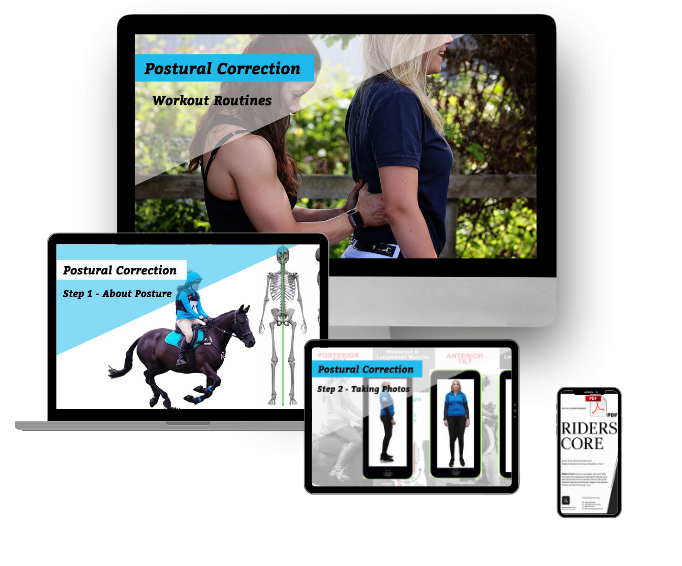
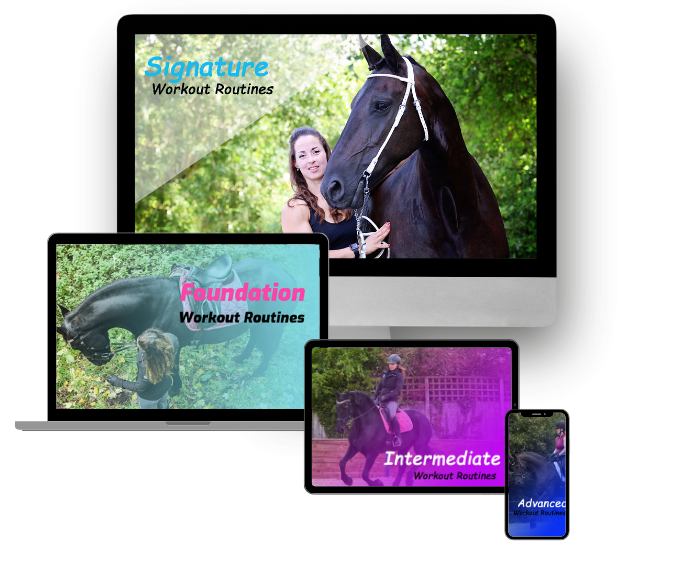
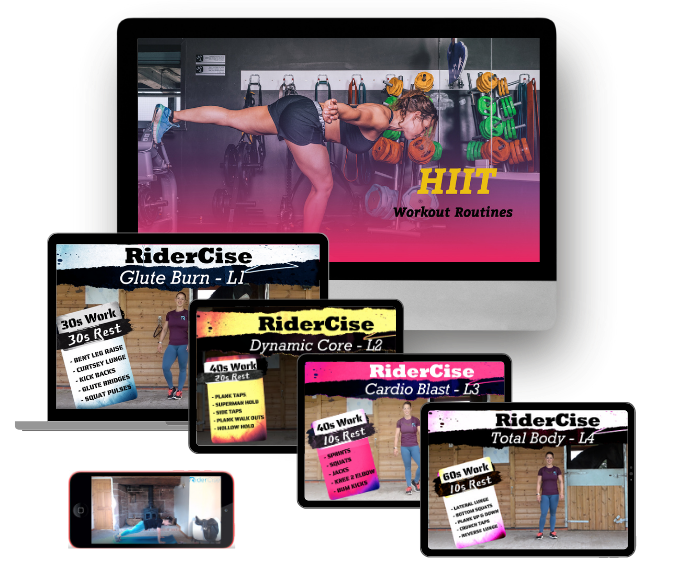
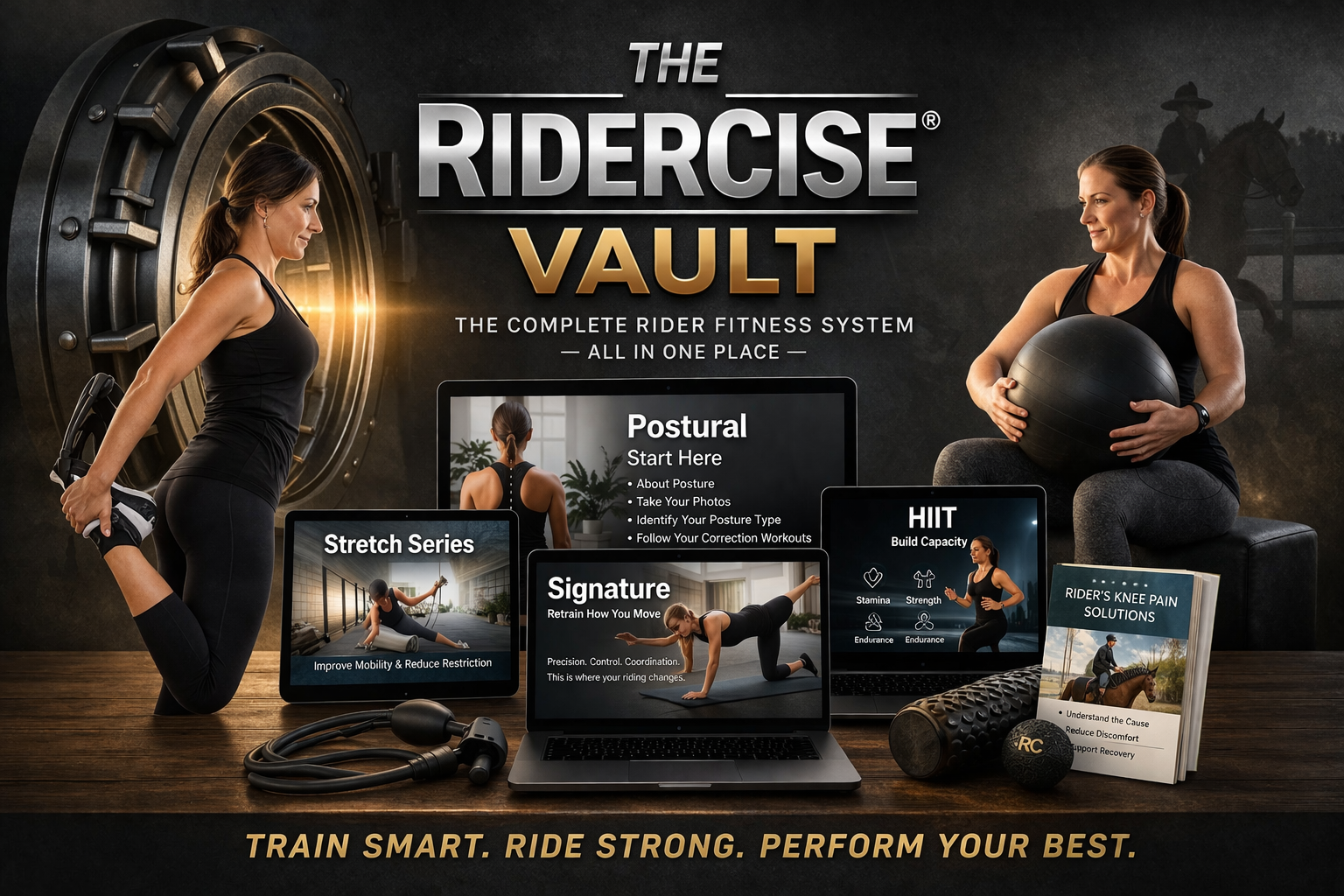
Once you understand your baseline, structured online fitness programmes let you address specific needs through progressive, riding-specific protocols. Whether you choose postural correction, high-intensity conditioning, or a comprehensive bundle, each programme builds on the foundational awareness you got from the mini course. This is how your fitness evolves alongside your riding skills, so the partnership keeps paying off for years to come.