You can spend years perfecting your dressage test, only to find the limiting factor isn’t your horse’s training. It’s your own physical capacity to stay balanced and effective. The best exercises for dressage riders target the specific biomechanical demands of an independent seat, addressing the hidden tension and asymmetry that no amount of arena time can fix alone. If you truly love your horse, prove it by becoming the athlete they deserve beneath them.
Most rider problems aren’t caused by lack of effort or fitness. They come from how the body has learned to stabilise, protect, and cope over time. Riders frequently struggle with gripping, bracing, collapsing, losing stirrups, or inconsistent contact, despite regular lessons and genuine effort. This article breaks down why standard gym routines often fail equestrians, and offers a clearer path toward dressage rider fitness that actually translates to the saddle.
Why Generic Fitness Fails the Dressage Rider
If a rugby player trained like a golfer, they’d get hurt. Dressage riders need the same logic applied to them: biomechanically specific conditioning, not generic fitness. Your sport demands sustained isometric endurance and fine neuromuscular control, not maximal force production or cardiovascular output. A general core class might make your abdominals burn, but if those muscles are learning to brace rather than absorb motion, you are actively training your body to block your horse’s back.
The Difference Between Gym Strength and Saddle Stability
Gym strength typically focuses on concentric muscle actions, where fibres shorten to produce movement against resistance. Dressage asks for something else: eccentric control and isometric stability, where muscles lengthen under load or hold tension without changing length, so your pelvis can follow the horse’s motion. Train exclusively for aesthetic abdominal definition and you teach your torso to go rigid. That directly contradicts the suppleness a following seat needs.
Standard crunches and planks often reinforce protective guarding patterns in the lumbar spine and hip flexors that prevent true pelvic independence. You might feel stronger on the mat, yet still collapse at the waist or grip with your knees when your horse transitions, because your nervous system hasn’t learned to dissociate your upper body from your lower body. Once you understand the physical system behind these faults, you can stop treating each one as an isolated problem and start finding a direct route to balance.
Dressage Posture Exercises to Unlock Hip Alignment
You cannot achieve a deep seat if your anterior chain is locked in a shortened position from hours spent at a desk or driving to the yard. Opening the front of the body is non-negotiable if you want true vertical alignment, without forcing your shoulders back or tucking your pelvis under artificially.
Releasing Protective Tension in the Hip Flexors
Tight hip flexors pull your pelvis into an anterior tilt, creating a rounded back that makes sitting trot physically impossible wihthout feeling like you are going to fall off. How does that tension specifically stop a deep, following seat? It mechanically restricts femoral extension, forcing your thigh forward so you perch on the pommel instead of wrapping your leg around the barrel. Targeted release work and active mobility drills fix this far more effectively than passive stretching, which often triggers a stretch reflex that makes the muscle tighten further.
Mobilising the Thoracic Spine for Upright Balance
Your thoracic spine must extend and rotate independently of your lumbar spine so you can stay upright while your hips absorb shock. Desk-bound riders often stiffen through this region and compensate with excessive lower back arching, which leads to fatigue and injury. Mobilisation exercises that segmentally articulate the vertebrae restore the natural curvature you need to carry yourself effortlessly. They also help reduce back pain from riding by distributing load correctly through the axial skeleton.
Core Strength Dressage: Stability Over Six-Pack Abs
Functional rider core strength is the ability to absorb motion while holding neutral spine alignment. It has nothing to do with visible muscle or how long you can hold a plank. Your core is a transmission system between your horse’s power and your aids. It needs to respond and adapt, not lock rigid.
Building Core Strength for Dressage Without Bracing
Why do standard gym ab exercises often leave dressage riders stiffer rather than more effective? They prioritise global rectus abdominis engagement over the deep stabilisers, like the transverse abdominis and multifidus, that control segmental spinal stability. Train these deeper layers through breathing-integrated movement and you teach your body to stabilise from the inside out, leaving your outer muscles supple and available for precise aid application. This is the distinction behind dressage posture exercises that create lightness rather than heaviness in the seat.
Bracing creates a fixed point your horse has to work around. True core integration lets you move with the horse while keeping your own centre of gravity. You need exercises that challenge your stability in multiple planes of motion, mimicking the rotational and lateral forces you feel in shoulder-in or half-pass. This is how you build a riders core that supports collection without restricting expression.
Correcting Asymmetry: Best Exercises for Dressage Riders Seeking Straightness
Straightness in the saddle is a neurological skill. Overwriting old motor patterns takes targeted repetition off the horse, not just conscious correction during lessons. Can off-horse exercises genuinely fix asymmetries your instructor has flagged but never resolved? Yes, because removing the moving horse from the equation lets your brain focus entirely on re-mapping proprioceptive errors and setting new baseline alignments.
Unilateral Training to Expose Weak Links
Bilateral exercises like squats and deadlifts let your dominant side compensate for your weaker side, masking imbalances that show up as crookedness in the arena. Single-leg and offset loading exercises reveal these hidden deficits immediately, forcing each limb to carry its fair share of the load. What separates muscular strength from the neuromuscular control straightness actually requires? Strength is the capacity to produce force. Control is the ability to coordinate that force symmetrically across both sides of the body under dynamic conditions.
Neuromuscular Reprogramming for Crooked Hips
Your brain prefers familiar patterns even when they’re dysfunctional, so correcting asymmetry takes high-frequency, low-load practice to build new neural pathways. Slow, deliberate movements with external feedback help your nervous system recognise what true centred alignment feels like, as opposed to what merely feels normal. This reprogramming takes consistent practice over weeks and months, but it addresses the root cause of crookedness instead of managing its symptoms indefinitely. You can understand your body’s protective patterns through structured assessment before you attempt advanced corrective work.
Seat Improvement Through Off-Horse Proprioception
Balance drills on stable and unstable surfaces sharpen body awareness and reaction time, without the unpredictable variable of a living animal beneath you. Better ground proprioception translates directly to a quieter, more effective seat aid, because your brain learns to process spatial information faster and more accurately.
These drills train your vestibular and somatosensory systems to hold equilibrium through micro-adjustments rather than large, disruptive corrections. When your body can self-correct efficiently on the ground, it carries that efficiency into the saddle. Staying balanced takes less thought, so you can focus on communication instead. This groundwork underpins every other piece of seat improvement dressage riders chase, and it makes your arena time far more productive.
Integrating Rider Fitness Into Your Dressage Training Plan
You don’t need to add hours of gym time to your week to see meaningful changes in your riding. Consistency matters far more than volume, and strategic scheduling makes sure your fitness work adds to your performance rather than taking from it.
Frequency and Recovery for Amateur Riders
How should an amateur dressage rider schedule fitness work without turning up fatigued to a lesson? Put higher-intensity or novel movement sessions at least 24 hours before important rides, so your nervous system has time to recover and integrate what it’s learned. Shorter, mobility-focused sessions can happen daily, or even right before riding as preparation, while strength work needs more space between sessions for the tissue to adapt. Listen to your body honestly. Pushing through exhaustion reinforces poor movement quality and raises your injury risk, and that serves neither you nor your horse.
Moving From Understanding to Application
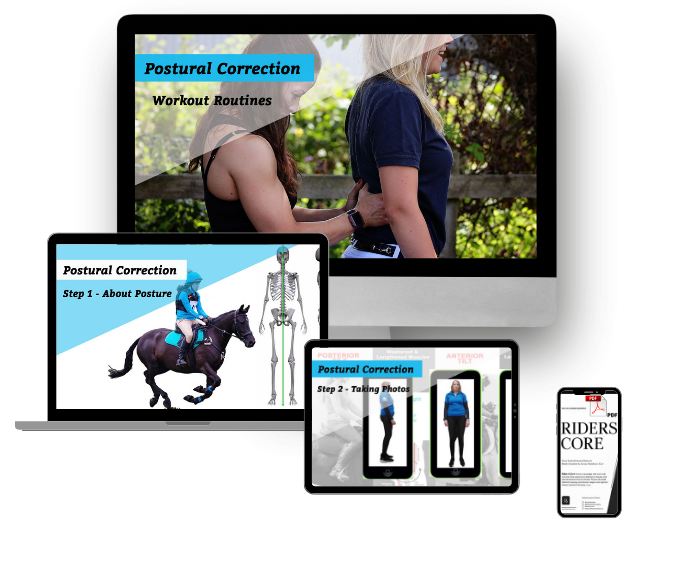
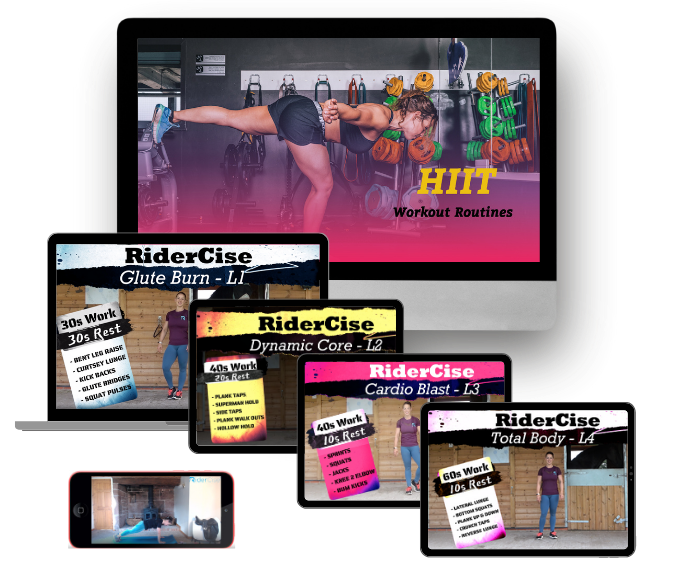
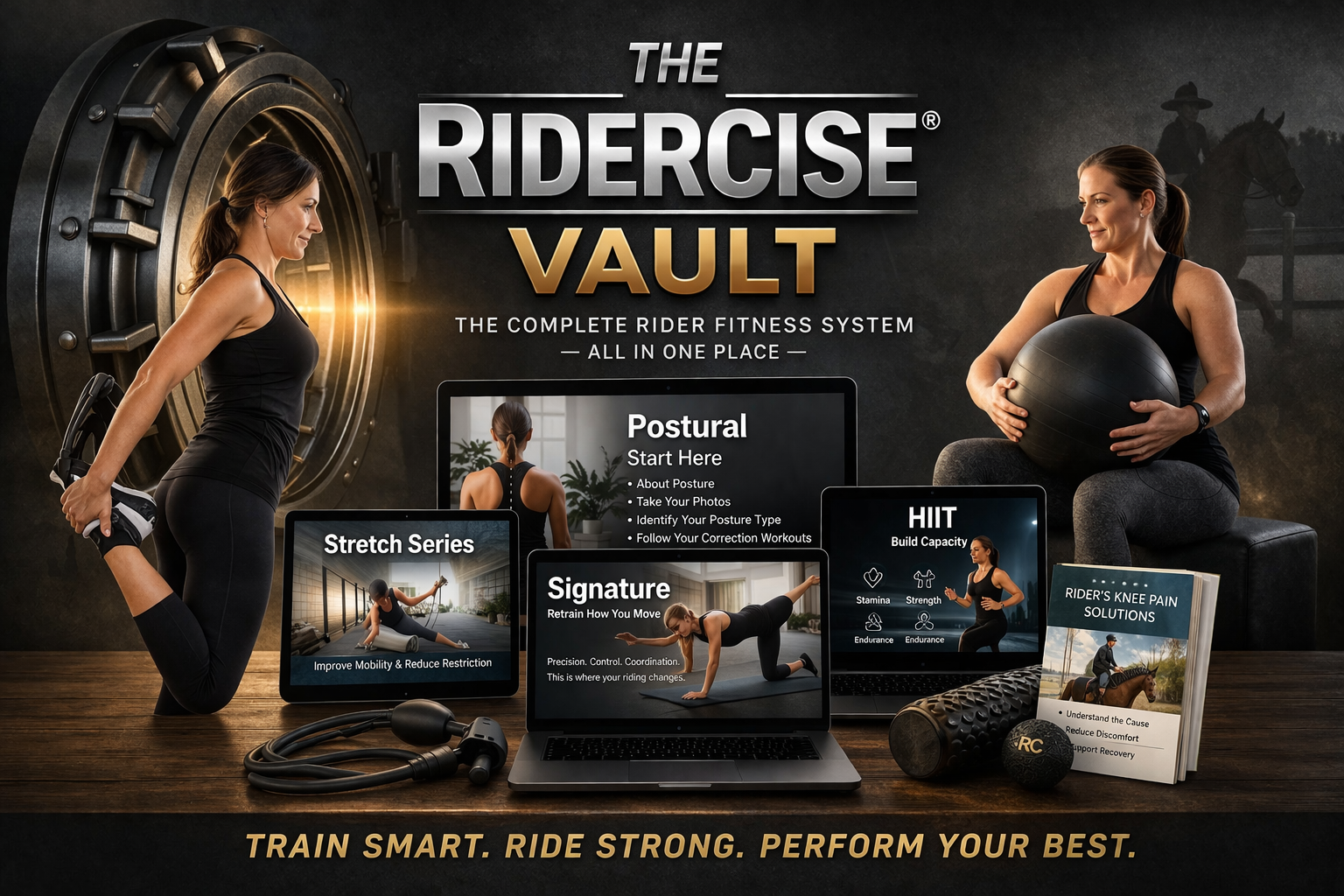
Knowledge alone doesn’t change physical habits. Structured application does. Many riders understand intellectually what they need to do, but lack the progressive framework to put it into practice safely alongside everything else going on in their week. A structured postural workout bundle gives you the scaffolding to bridge that gap, turning theory into embodied skill through sequenced programming. If you want broader context on improving riding position off the horse, weaving these principles into your weekly routine builds change that lasts, and it shows up in every transition and lateral movement you ride.
Be the rider your horse deserves.