
Search “horse riding fitness workout” and you’ll get the same list every time: planks, squats, lunges, maybe a resistance band thrown in. Fine for general health. But none of it accounts for what actually happens in the saddle. The asymmetries. The tiny stabilising corrections. The way your hips need to move independently from your shoulders. Generic fitness advice treats you like any other gym-goer. Riding doesn’t work that way.
Why Generic Fitness Advice Fails Horse Riders
A standard bodyweight circuit builds general strength. It won’t teach your body to absorb the movement of a horse. It won’t help you hold a stable core through a downward transition. It won’t stop your knee gripping when you get nervous over a fence. Those are rider-specific problems. They need rider-specific solutions.
This is the gap most “get fit for riding” content ignores. It’s also why so many capable, fit-looking riders still struggle with position faults their instructor keeps repeating lesson after lesson.
What Makes Rider-Specific Exercise Different
Rider-specific exercise trains the exact muscle groups and movement patterns riding demands. It doesn’t chase general fitness markers like how much you can bench or how far you can run. It focuses on:
🎯 Symmetry, correcting the left-right imbalances every rider carries
🎯 Independent seat control, training hips, core and legs to move separately from arms and shoulders
🎯 Postural endurance, holding correct alignment for a full lesson, hack or test, not just a few reps
🎯 Balance under load, staying stable when the horse, not you, controls the tempo
Instructors and physiotherapists who work in equestrian performance keep making the same point: riding itself doesn’t build the strength needed to ride well. Time in the saddle refines feel and timing. It rarely fixes an underlying strength or stability deficit. Targeted off-horse training closes that gap.
The Core Muscles Every Equestrian Should Train
Four muscle groups do most of the work of keeping you balanced, aligned and effective on a horse: the deep core, the glutes, the hip flexors, and the back stabilisers.
The deep core isn’t just the visible six-pack muscles. It includes the deeper transverse abdominis and obliques, and it keeps your torso upright and absorbs movement without collapsing forward or bracing back. Your glutes stabilise the pelvis and support an independent seat. Strong, flexible hip flexors let your leg hang long instead of creeping up your horse’s side. Back stabilisers hold your spine in a neutral, tall position through hours of riding, transitions and jumps.
Core Strength and Its Link to Balance in the Saddle
Balance in the saddle isn’t about gripping harder. It’s about a strong, controlled core reacting to movement before you consciously notice it. A rider with a weak deep core tends to brace through the shoulders or grip with the knees to compensate. Both work against the horse rather than with it.
Build genuine core strength off the horse, and that reactive balance starts to show up on the horse, often within a few weeks of consistent training.
Common Position Faults Caused by Weak Muscles
Most of the position faults an instructor calls out repeatedly trace back to a specific weakness, not a technique problem:
🚫 Collapsing hip, often a sign of weak obliques and glute medius
🚫 Gripping knee, usually compensating for a weak or unstable core
🚫 Lower leg swinging back, frequently linked to tight or overactive hip flexors
🚫 Rounded shoulders and collapsed chest, often driven by weak upper back stabilisers
A dressage rider fighting a collapsing hip, or a jumping rider losing their lower leg over a fence, are both classic examples. The fix usually isn’t more lessons. It’s targeted strength and stability work done off the horse.
Comparing the RiderCise Workout Bundles
RiderCise’s bundles are built around four distinct outcomes rather than one generic “rider fitness” programme. Each one reflects years of coaching riders across disciplines, and maps to a specific goal rather than a vague promise of “getting fitter for riding.”
Postural, Signature and HIIT: Which Suits Your Goals
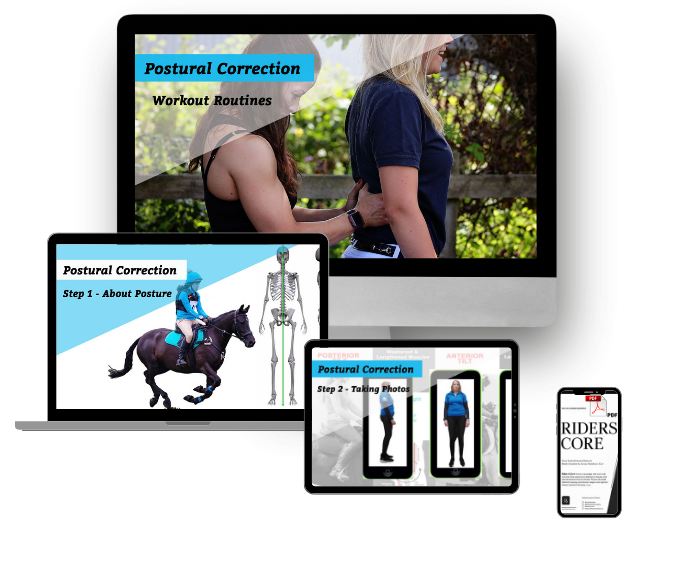
Postural is built for riders whose instructor keeps repeating the same correction: collapsing hip, tipping shoulders, uneven weight in the stirrups. It targets alignment and symmetry directly.
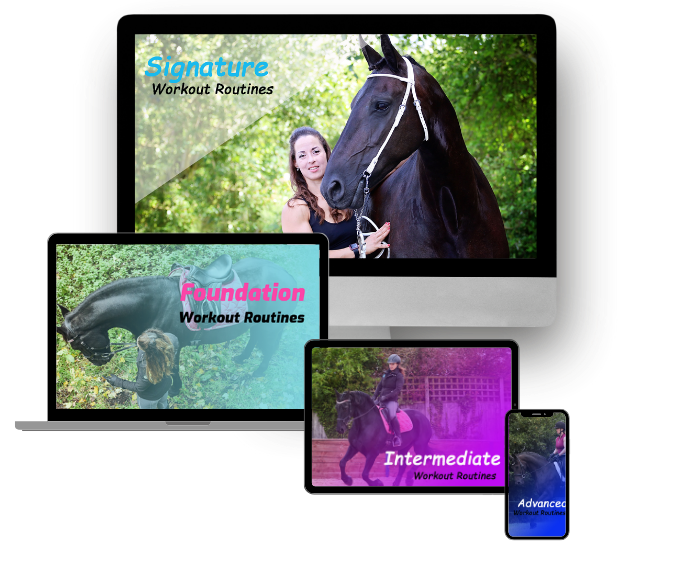
Signature is the foundational rider strength programme. It’s the best starting point if you want a well-rounded base across the core, glutes and back stabilisers before specialising further.
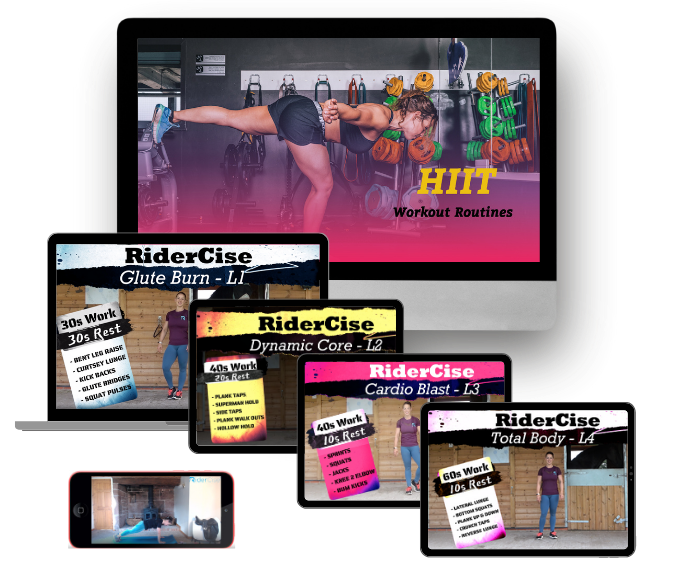
HIIT is built for riders who want cardiovascular fitness and power alongside rider-specific strength. Useful for eventers, competitive jumpers, or anyone whose discipline demands stamina as much as stability.
Think of it this way: Postural fixes what’s going wrong right now, Signature builds the base every rider needs, and HIIT adds fitness and power on top of that base.
The Vault: The All-Inclusive Option
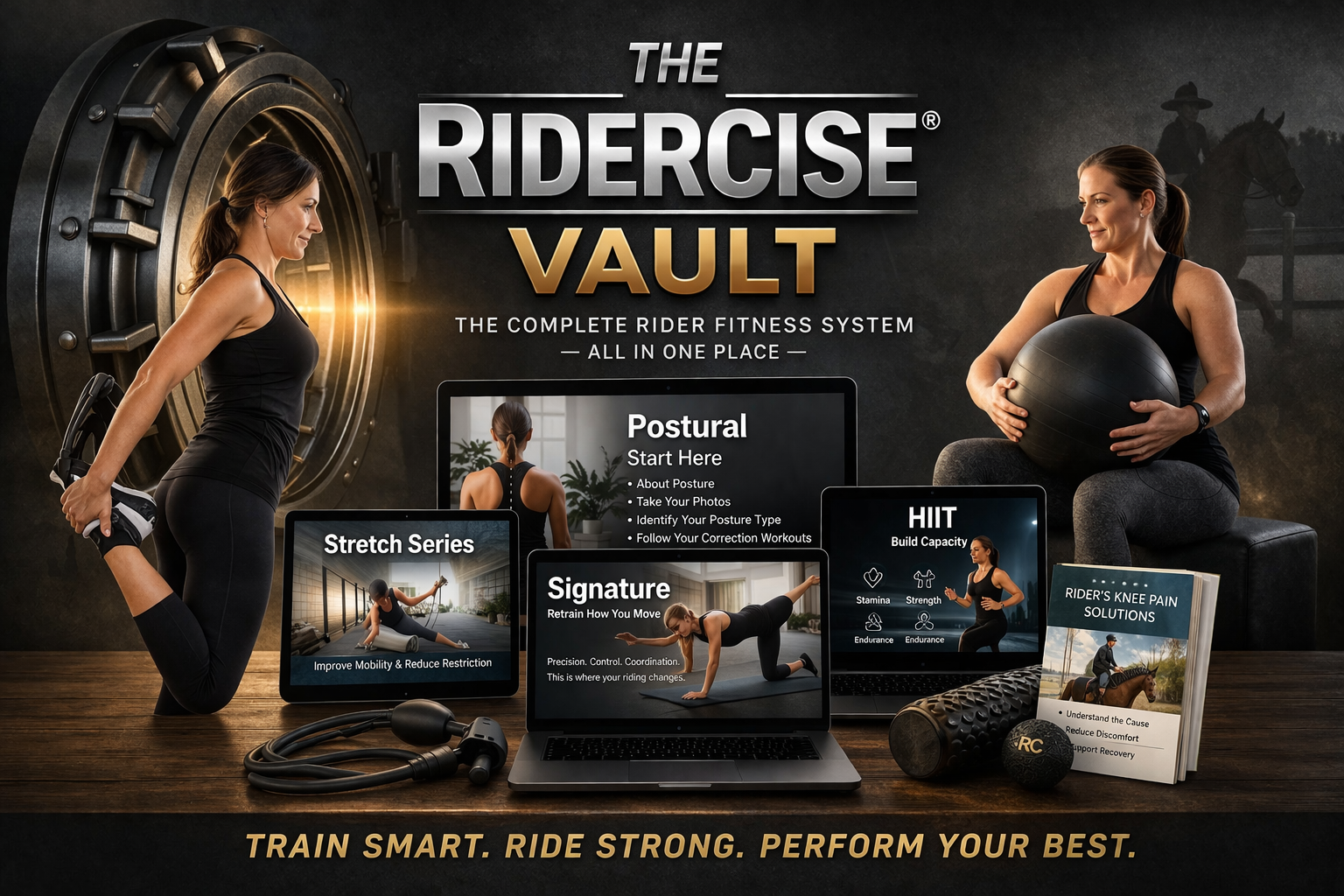
The Vault brings all of RiderCise’s programming together in one place, for riders who want the full range rather than choosing a single focus. Every bundle, including the Vault, is sold as a one-time purchase with lifetime access, not a subscription you need to keep paying to keep. Buy once, train at your own pace, and revisit the sessions whenever your goals shift.
For time-poor riders, that lifetime-access model matters more than it might first appear.
There’s no clock running, no monthly fee ticking over during a quiet season, and no pressure to “use it or lose it.”
Building an Off-Horse Training Routine That Fits Your Week
The best workout for horse riding fitness is the one you’ll actually do consistently. That’s usually a short, focused, rider-specific session two or three times a week, not an hour-long generic gym circuit you dread and skip.
Structure sessions around your existing riding schedule rather than fighting it. A short core and glute session the day before a lesson primes the muscles you’ll need. A gentler mobility-focused session after a competition helps you recover without losing momentum.
How Often Riders Should Train Off the Horse
Most riders see real improvement training off the horse two to three times a week, with sessions of 20 to 30 minutes. That’s enough to build strength and stability without crowding out riding time, work or family life.
RiderCise bundles are self-paced and accessed online, so you can train early in the morning, late at night, or split a session across a lunch break. There’s no class schedule to work around, which matters when your week already revolves around yard visits and lessons.
Starting Small: The Rider Core Mini Course and Bespoke Coaching
If a full bundle feels like a big first step, the Rider Core Mini Course is a lower-commitment way in. It focuses specifically on helping you to understand what the core is and how your body organises itself to stay balanced, stable and in the correct position, Knowlege is key to real progress after all.
Many riders who start with the mini course move on to Postural or Signature once they have a deeper understanding of how their body works, because then the actual work doesn’t feel as overwhelming.
For riders who want more personalised progression, bespoke coaching is also available. It’s tailored to your discipline, goals and current position faults rather than a one-size-fits-all plan.
Whichever entry point suits you, the goal is the same: build the strength and stability your riding actually needs, at your own pace, without paying for it more than once.
Frequently Asked Questions About Fitness for Horse Riders
Your content goes here. Edit or remove this text inline or in the module Content settings. You can also style every aspect of this content in the module Design settings and even apply custom CSS to this text in the module Advanced settings.
What is the best workout for horse riding fitness?
The best workout for horse riding fitness targets the deep core, glutes, hip flexors and back stabilisers with rider-specific movement patterns, not general bodyweight circuits. A structured programme like Postural, Signature or HIIT will get you further than a generic fitness plan.
How is rider-specific fitness training different from general gym workouts?
Rider-specific training focuses on symmetry, independent seat control and postural endurance, all built around the actual demands of sitting on and moving with a horse. General gym workouts build strength and fitness but rarely address these riding-specific patterns.
Which muscles matter most for horse riding balance and posture?
The deep core, glutes, hip flexors and back stabilisers matter most. Weakness in any of these commonly shows up as position faults like a collapsing hip or a gripping knee.
How often should equestrians do off-horse training?
Two to three short sessions a week, of around 20 to 30 minutes, is enough for most riders to see meaningful improvement without disrupting a busy riding and work schedule.
What's the difference between the Postural, Signature, HIIT and Vault bundles?
Postural targets alignment and position faults. Signature builds foundational rider strength. HIIT adds cardiovascular fitness and power. The Vault includes all of RiderCise’s programming in one all-inclusive package.
Do you need equipment to do horse riding fitness workouts at home?
No. RiderCise’s workout for equestrians is designed to be done at home with little to no equipment, so you can train without a gym membership or specialist kit.
Is a one-off lifetime-access fitness bundle better value than a subscription?
For most riders, yes. A one-time purchase with lifetime access means you pay once and keep the programme for good, rather than paying monthly for as long as you want access. Useful for anyone whose training time varies through the season.
Do You Need Equipment for Rider-Specific Workouts?
You don’t need a gym, a horse or specialist equipment to start rider-specific training. RiderCise’s off-horse training is built to work in your living room, using bodyweight and simple, minimal kit. That’s the point: you should be able to open a session and start straight away, whenever you have twenty spare minutes.
If you’ve been putting off fitness for horse riders because you don’t have time for the gym, that’s exactly the problem these bundles are built to solve. Pick the outcome that matches where you are right now, Postural, Signature, HIIT or the Vault, or start smaller with the Rider Core Mini Course, and build the strength your riding has been waiting for.