HIIT Workouts for Equestrians: Get Match-Fit for the Saddle

HIIT Workouts for Equestrians: Get Match-Fit for the Saddle

Search online for a HIIT workout for equestrians and you’ll mostly find generic bootcamp circuits with a horse graphic slapped on top. That’s the gap RiderCise built its programme to fill. Riding is already an interval sport. Your training should match that, not fight it.

Why a HIIT Workout for Equestrians Is Different from Generic HIIT

Most HIIT plans are built for runners, footballers, or gym-goers chasing a general fitness boost. None of them are built for the specific way a rider’s body works under saddle. That’s the problem. Riding doesn’t ask for constant, steady effort. It asks for short, sharp bursts of control, followed by recovery, repeated again and again.

RiderCise is built specifically around the physical demands of riding. It draws on founder Clare Henry’s work with adult amateur and competitive riders who’ve struggled to translate generic gym fitness into saddle performance. That’s the difference between HIIT for riders and HIIT for everyone else.

What Riding Actually Demands from Your Cardiovascular System

Think about what actually happens in the saddle. A dressage test asks for sustained control with sudden bursts of collection and extension. A cross-country round demands repeated surges of power between fences. You get only seconds to recover before the next effort. Show jumping is a string of intense bursts, jump to jump, turn to turn.

Your heart rate spikes, drops, and spikes again. That’s interval training, whether you’ve labelled it that or not. Cardio for horse riders needs to train that exact pattern, not a flat, steady-state jog.

Where Standard Gym HIIT Falls Short for Riders

Generic HIIT often loads you up with high-impact jumping, heavy overhead pressing, or movements that have nothing to do with staying balanced on a moving animal. It builds general fitness, sure. But it doesn’t teach your body to stabilise your core while your legs and hips do something completely different. That’s exactly what riding demands.

Most rider problems aren’t caused by a lack of effort or fitness. They come from how the body has learned to stabilise, protect, and cope over time. That’s why generic cardio plans so often miss the mark for riders, and why a dedicated approach matters.

The Benefits of Cardio for Horse Riders

Cardiovascular fitness isn’t a nice-to-have for riders. It’s the thing standing between you and a strong final centre line, a clean last three fences, or a confident gallop to the finish flags.

Stamina for Longer Sessions and Competition Days

Longer schooling sessions, back-to-back lessons, or a full day at a show all draw on the same tank. Riders with better cardiovascular fitness commonly report feeling fresher through the second half of a session, rather than running on empty by the last ten minutes.

That matters for competition days especially. You’re not just riding one test or one round. You’re managing warm-up, the main event, and often a second class, all on the same reserve of energy.

Faster Recovery Between Efforts (Dressage Tests, XC Rounds, Jump-Offs)

Faster recovery between efforts is where cardio fitness really earns its keep. If your position collapses in the final minutes of a dressage test or show jumping round, that’s often fatigue, not a technical fault. It’s a sign that cardiovascular stamina, not just core strength, needs attention.

The same goes for cross-country. A rider preparing for a cross-country round faces the same stop-start effort pattern as a HIIT interval: short bursts of intense effort followed by brief recovery, repeated over several minutes. Train that pattern off the horse, and you’ll feel the difference on it.

Rider Stamina Training: Building Fitness for Eventing and Endurance

Fitness training for eventing has to account for three very different disciplines in one day. Dressage asks for control and precision. Show jumping asks for sharp bursts of power. Cross-country asks for sustained effort across multiple minutes, with obstacles thrown in throughout.

Rider stamina training built around this reality gives you an edge that generic gym fitness simply can’t.

Interval Structures That Mimic Cross-Country and Show Jumping Efforts

Effective rider stamina training uses interval lengths that mirror the sport itself. Short, sharp 20-30 second bursts followed by brief recovery reflect a show jumping round. Longer efforts of one to two minutes, with shorter recovery windows, mirror the sustained demand of a cross-country course.

The point isn’t to exhaust you for the sake of it. It’s to condition your body to recover quickly between efforts, so you’re ready for the next fence, the next combination, the next transition.

Progressing Safely as an Amateur Rider

If you’re an adult amateur returning to fitness after time off, or you’ve never followed a structured programme before, safe progression matters more than intensity. Start with shorter work intervals and longer recovery. Build up gradually as your fitness and confidence improve.

HIIT can absolutely work for older or amateur riders. The key is scaling the intensity and impact to your current level, not comparing yourself to an elite eventer’s programme. That’s exactly what a structured, rider-specific programme should do for you.

Quick Workouts for Riders: Fitting HIIT Around Yard Life

You’ve got a horse to feed, a yard to muck out, and a job that eats most of your day. Quick workouts for riders need to fit around that reality, not compete with it.

This is where HIIT genuinely earns its place in a busy rider’s week. A focused 15 to 20 minute session, done before or after a yard visit, delivers real cardiovascular benefit without demanding a gym membership or an hour you don’t have.

No equipment, no commute, no excuses. Just a small patch of floor and a timer. That’s quick workouts for riders done properly, and it’s exactly the model RiderCise builds on.

Sample HIIT for Riders Session You Can Try Today

Want a taste of what HIIT for riders looks like in practice? Try this simple circuit. Work for 30 seconds, rest for 15, and complete three to four rounds.

  • Squats, builds the leg strength you need for standing in stirrups and absorbing movement
  • Mountain climbers, trains core stability under a raised heart rate
  • Plank holds, builds the deep core control riders rely on for a still, secure position
  • High knees, conditions the cardiovascular surge you feel galloping to a fence

This is a taster, not a full programme. It gives you a feel for the interval structure, not the progression, sequencing, or rider-specific movement patterns a proper plan builds in over time.

Warm-Up and Cool-Down Essentials for Riders

Never skip the warm-up. Five minutes of light movement, gentle hip circles, and dynamic stretches prepare your joints and raise your heart rate gradually, rather than shocking your system straight into work.

Cool down with slower movement and static stretching for your hips, hamstrings, and lower back. These are the areas riders load most. They’re also the ones that stiffen up fastest without proper attention.

Getting Match-Fit for the Saddle with RiderCise

A single sample circuit can show you the principle. It can’t give you the full progression, the variety, or the rider-specific focus that actually gets you match-fit for the saddle.

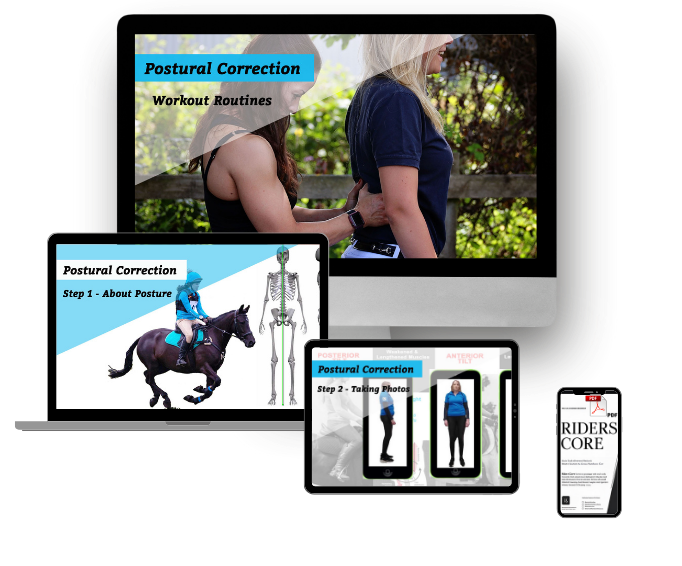
That’s what the RiderCise HIIT Workout Bundle is built for. It takes everything covered here, interval structures that mirror eventing and dressage demands, safe progression for amateur riders, and quick sessions that fit around yard life, and turns it into a ready-made programme with lifetime access.

If you already know your position tends to collapse under fatigue, pairing cardio work with improving your riding position off the horse will get you further, faster. The Postural Workout Bundle is built for exactly that.

And if you want the full picture, strength, posture, and cardio working together, take a look at the full range of RiderCise workout bundles and build the system that gets you, and your horse, where you both deserve to be.

You’ve read the theory. Now take the first step. Sign up, commit to the process, and become the rider your horse needs.

How to Improve Your Riding Position off the Horse

How to Improve Your Riding Position off the Horse

You’ve had the lesson. Your instructor said “sit taller,” “stop gripping,” “use your core”, again. For a stride or two, it worked. Then your body did what it always does, and you were back to bracing, tipping, or losing a stirrup.

If that sounds familiar, you’re not failing at riding. You’re missing the piece that no lesson, on its own, can give you: strength and control built off the horse.

Why Coaching Alone Often Can’t Fix Riding Position Problems

Good coaching matters. A sharp instructor can spot the moment your shoulder drops or your hip collapses, and call it before you even feel it. But spotting a fault isn’t the same as fixing it.

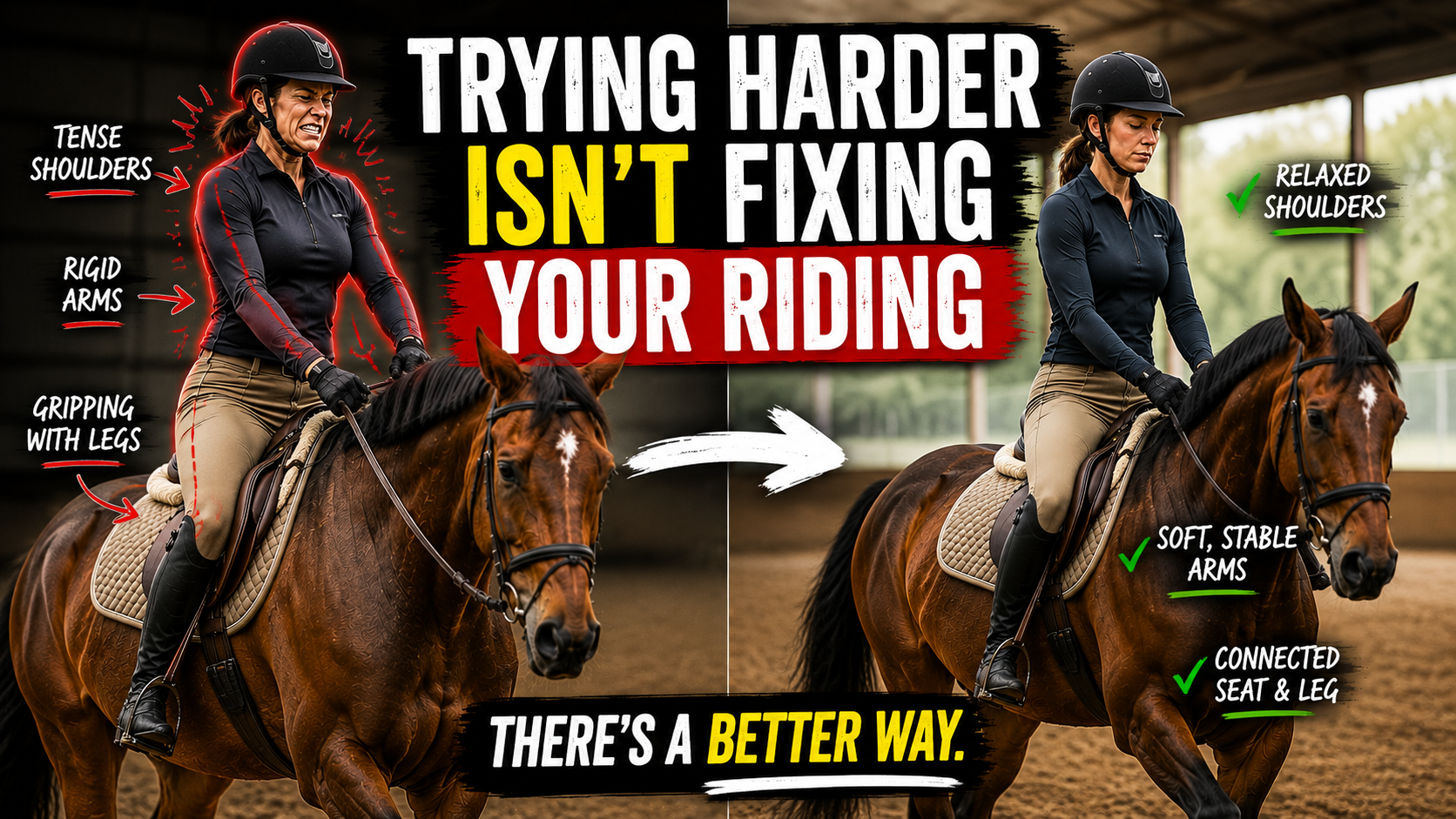
Correcting position purely through lesson-time cues asks your body to do something it hasn’t been trained to do. Gripping, bracing, collapsing, these are often the way your body has learned to cope with a strength or stability gap. Tell it to stop without addressing that gap, and it will simply revert once your concentration slips.

That’s why so many capable, committed riders feel stuck. They’re doing the work in lessons. They’re listening. They’re trying. The problem isn’t effort.

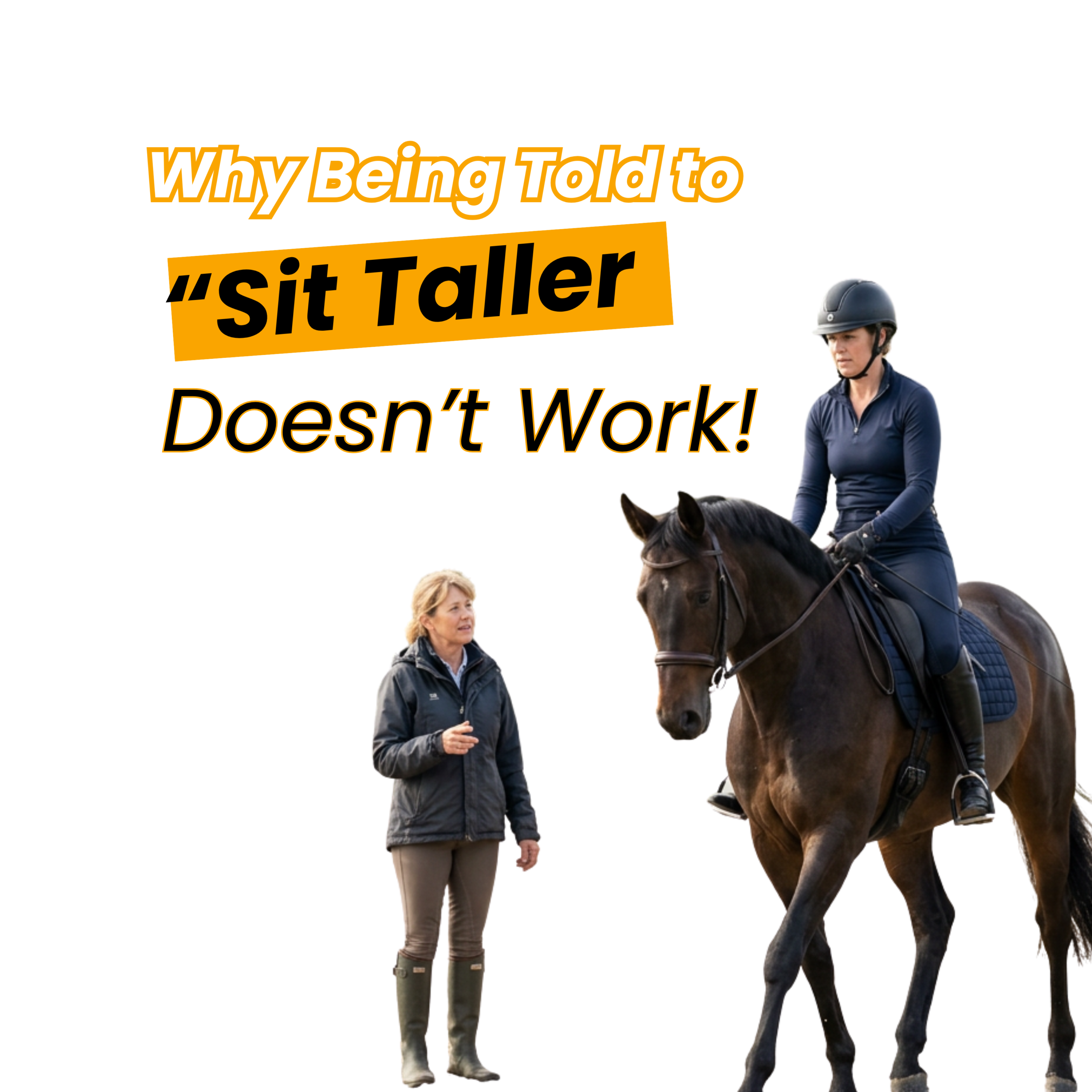
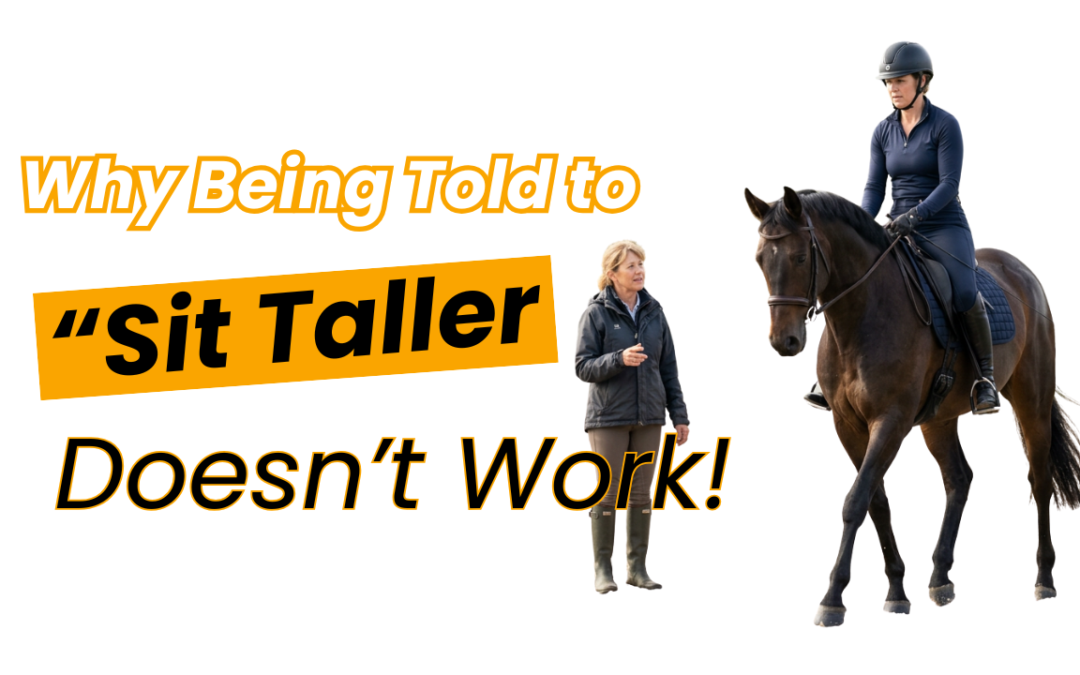
The Limits of ‘Sit Taller’ and ‘Use Your Core’ Cues

“Sit taller” assumes your postural muscles can hold that taller position for a whole session. For many riders, they can’t. Not yet. “Use your core” assumes you know which muscles that means, and that they’re strong enough to fire on demand at trot, canter, or over a fence.

Most rider position problems aren’t caused by lack of effort or fitness. They come from how your body has learned to stabilise and protect itself over time. That’s why coaching corrections alone often don’t stick. Your instructor can give you the cue. Only consistent, targeted training off the horse builds the capacity to actually hold it.

What’s Really Behind Common Riding Position Problems

To fix riding position for good, you need to understand what’s driving it in the first place. Position faults are rarely random. They’re your body’s best attempt at managing a weakness, an old injury, or a habit built up over years of sitting, driving, and desk work.

Gripping, Collapsing, and Losing Stirrups Explained

Gripping with the knee usually means the deeper stabilising muscles of the hip and thigh aren’t doing their job, so you clamp with whatever muscle is available instead. Collapsing through one hip is often a sign of asymmetric strength or an old injury that never fully resolved. Losing a stirrup repeatedly can point to weak ankle and calf stability, or a seat that isn’t independent of the leg.

A rider who grips with the knee, collapses through one hip, or loses a stirrup repeatedly is usually compensating for a strength or mobility limitation. Not “not concentrating.” These aren’t character flaws. They’re physical patterns, and physical patterns respond to physical training.

How the Body Learns to Compensate in the Saddle

Your body is efficient. If a muscle group is weak, it recruits another to get the job done, even if that’s the wrong muscle for the task. Over months and years in the saddle, that compensation becomes automatic.

Add in a desk job, an old fall, or simply years without targeted strength work, and it’s easy to see why so many riders develop the same handful of faults. This is the real story behind rider posture correction: it’s a strength and movement issue first, a discipline issue second.

How to Improve Riding Position With Off-Horse Strength Training

This is the gap most position advice skips entirely. Coaches teach you what correct looks like. Almost none of them give you a plan to build the strength to hold it. That’s where a dedicated off-horse routine comes in. It’s genuinely how you improve riding position for the long term, not just for one lesson.

Core and Postural Exercises for Riders

Riders don’t need a generic six-pack workout. You need deep core activation, the stabilising muscles that hold your trunk upright without you thinking about it, stride after stride.

You also need glute and hip stability work, so one side of your pelvis stops doing more than the other. And you need targeted postural exercises for riders that train your back and shoulders to stay open and tall under load, rather than rounding forward as you tire.

Done consistently, this combination is what lets “sit taller” finally become something your body can sustain. Not just something you’re told.

Mobility Work for a More Independent Seat

Strength without mobility only gets you halfway. Tight hips lock you out of a deep, following seat. A stiff thoracic spine keeps your shoulders rounded no matter how many times you’re told to open your chest.

Mobility work through the hips, spine, and ankles frees up the range of motion your body needs to absorb movement rather than resist it. That’s the foundation of a truly independent seat, one that doesn’t rely on gripping to stay in place.

Building a Simple Off-Horse Fitness Routine to Fix Your Riding Position

You don’t need hours in a gym. You need consistency, and a plan built around what riding actually demands of your body.

Short, focused sessions a few times a week will do more for your position than an extra lesson alone. Combine core activation, hip and glute stability, and mobility work. The key is progression: as one pattern becomes easier, the exercises should ask a little more of you, so your body keeps adapting rather than plateauing.

This is also where consistency compounds. A single strong session won’t undo years of compensation. A structured, repeated routine will. And it will show up in your riding faster than you’d expect, because you’re finally training the cause, not just correcting the symptom in the saddle.

If you want a broader view of how different training options fit together, it’s worth exploring RiderCise’s full range of rider fitness bundles to see where your own routine could start.

When to Get Structured Support for Rider Posture Correction

Trying to piece together your own programme from articles and old memories of Pilates class is exhausting, and it rarely targets the exact patterns riding creates. Riders who try generic Pilates or yoga programmes often report little lasting change in the saddle. Those programmes aren’t built around the specific muscle patterns and asymmetries riding creates.

Signs You’d Benefit From a Dedicated Programme

You’ll likely benefit from a structured, riding-specific programme if:

🐴 Your instructor gives you the same correction lesson after lesson, with no lasting change
🐴 You know your position isn’t symmetrical, but you’re not sure why
🐴 You’ve tried general fitness classes and seen little translate to the saddle
🐴 You lose your stirrup, grip, or collapse under fatigue rather than from day one
🐴 You want to feel stronger and more in control, not just “less told off” in lessons

RiderCise built its Rider Core Mini Course specifically for riders who’ve heard “sit taller” or “use your core” over and over in lessons, with no lasting change. It’s a widespread pattern, not an individual failing. If that’s you, the Rider Core Mini Course is a focused way to start.

For riders ready to build strength and postural control together, RiderCise structures its Postural Workout Bundle around the specific stabiliser muscles and postural habits riders need off the horse to translate into a straighter, more balanced seat on the horse. Explore the Postural Workout Bundle if you recognise your own position problems in this article.

If your position issues are longstanding, tied to an old injury, or feel more complex than a self-paced programme can address, a bespoke coaching programme gives you personalised guidance built around your body specifically.

Frequently Asked Questions About Improving Your Riding Position

Why does my riding position keep breaking down even though I take regular lessons?
Lessons correct what your instructor sees in the moment, but they can’t build the strength and stability your body needs to hold that correction on its own. Without off-horse training, the old compensation pattern simply returns once you tire or stop concentrating.

What off-horse exercises actually improve riding position and equitation?
Exercises that target deep core activation, glute and hip stability, and thoracic and hip mobility make the biggest difference. These build the specific strength and range of motion riding demands, rather than general fitness alone.

How is fixing riding position different from general fitness like Pilates or yoga?
General Pilates or yoga programmes build overall strength and flexibility, but they aren’t designed around the specific asymmetries and compensation patterns riding creates. Riding-specific training targets those patterns directly, which is why it tends to translate into the saddle faster.

How often should I do postural exercises to see a change in the saddle?
Consistency matters more than intensity. Short, focused sessions done several times a week, with progression built in over time, tend to produce steadier, longer-lasting change than occasional long workouts.

Can poor riding position be corrected at any age or riding level?
Yes. You can train strength, stability, and mobility regardless of age or experience. The key is a programme built around your current body, not a generic one-size-fits-all routine.

What are the most common riding position problems and what causes them?
Gripping with the knee, collapsing through one hip, and losing stirrups are among the most common issues. Weak stabilising muscles, old asymmetries or injuries, and years of compensation usually cause them, not a lack of effort or focus.

Your instructor can see what’s wrong. Off-horse strength training is how you actually fix it. For good, not just for one lesson at a time.

Core Exercises for Horse Riders: Build Saddle Stability

Core Exercises for Horse Riders: Build Saddle Stability

You’ve done the crunches. You’ve held the plank until your arms shook. And yet the moment your horse spooks sideways or drops his shoulder into a canter transition, you’re grabbing mane and hoping for the best. Sound familiar?

That gap between “fit” and “secure in the saddle” is exactly why generic ab workouts let riders down. This article walks through core exercises for horse riders that actually translate to the saddle, why they work, and how to build them into a week that already feels too full.

Why Generic Ab Workouts Don’t Fix Your Riding Stability

Most fitness advice for riders is just fitness advice with a horse photo slapped on top. Sit-ups, standard planks, a few crunches. None of it accounts for the fact that your core needs to react to movement it can’t predict.

A horse doesn’t move like a gym floor. It shifts weight, changes rhythm, and occasionally does something neither of you planned. Your core’s job isn’t to look good on a beach. It’s to keep your pelvis and spine stable while the ground underneath you keeps changing.

Most rider problems aren’t down to lack of effort or fitness. They come from how your body has learned to stabilise and protect itself over time. That’s why isolated ab exercises rarely translate to a more secure seat.

What Rider Core Strength Actually Means in the Saddle

Rider core strength isn’t about visible abs. It’s your deep stabilising muscles firing automatically, without you thinking about it, to keep you centred over the horse’s centre of gravity.

This is also where the difference between core strength and balance matters. Balance is your ability to sense and correct a shift in position. Core strength is what gives your body something solid to correct with. You can have great balance instincts and still get pulled off centre if the muscles supporting your spine and pelvis aren’t strong enough to hold the correction.

Build both, and you stop bracing with your hands, gripping with your knees, or collapsing through one hip every time the ride gets unpredictable.

The 6 Best Core Exercises for Horse Riders

These aren’t generic gym moves borrowed from a fitness magazine. Each one targets a specific stability pattern you need in the saddle. Every cue below is written with a real riding moment in mind.

Stability Exercises for Riding an Unpredictable Horse

1. Dead bug
Lie on your back, knees bent at 90 degrees, arms reaching towards the ceiling. Slowly lower one arm and the opposite leg towards the floor without letting your lower back arch off the mat. This trains the anti-extension control you need when your horse drops his head or lurches forward unexpectedly.

2. Glute bridge
Lie on your back, feet flat, and lift your hips until your body forms a straight line from knees to shoulders. Squeeze your glutes at the top rather than pushing through your lower back. Strong glutes work with your core to stabilise your pelvis in sitting trot. A weak connection here shows up as bouncing rather than absorbing.

3. Bird dog
From all fours, extend one arm and the opposite leg until they’re in line with your spine, keeping your hips level throughout. This is one of the best stability exercises for riding because it trains your body to stay square when a horse spooks or bulges sideways under you. That’s exactly the moment riders lose their seat.

Anti-Rotation and Deep Core Moves for Balance

4. Side plank
Prop yourself on one forearm with your body in a straight diagonal line, hips lifted and stacked. Hold, then switch sides. This builds the lateral stability that stops you collapsing through one hip during sitting trot or a leg-yield. It’s a pattern that shows up again and again in rider assessments.

5. Anti-rotation press
Using a resistance band anchored to your side, press it straight out in front of you while resisting the pull that wants to twist your torso. This mirrors what your core does every time your horse twists, bucks, or changes direction faster than you expect.

6. Plank with shoulder taps
Hold a forearm or high plank, then lift one hand to tap the opposite shoulder without letting your hips rock. This builds the same anti-rotation control as the band press, without needing equipment. Useful for canter transitions, where your upper body wants to twist ahead of your seat.

Together, these six moves build the deep core stability that generic sit-ups never reach.

How to Build a Core Workout for Riders Around Your Riding Week

A core workout for riders only works if it fits around the rest of your life: yard time, lessons, actual work, family. So keep it simple.

Pick three sessions a week. Each one takes fifteen to twenty minutes. Rotate through the six exercises above, two or three per session, building up reps and hold times as you get stronger. That’s it. No two-hour gym commitment, no separate ab day bolted onto an already packed schedule.

How Often Should Equestrians Train Their Core?

Riders typically only need three focused fifteen-to-twenty-minute core sessions a week to see a noticeable improvement in saddle stability. That makes it realistic for time-poor amateur and competitive riders alike.

Progression matters more than volume. Add a few seconds to your side plank hold. Slow down your dead bug tempo. Increase the band resistance on your anti-rotation press. Small, steady increases beat cramming in extra sessions you’ll resent and eventually skip.

Consistency over a few weeks does more for your seat than one exhausting session ever will.

Common Mistakes When Training Abs for Equestrians

The biggest mistake riders make when training abs for equestrians is holding their breath. If you’re clenching through every rep, you’re bracing rather than stabilising. Bracing is exactly the habit that makes you rigid and reactive in the saddle instead of soft and adjustable. Breathe through the movement, every rep.

The second mistake is training the core in isolation from the hips and glutes. Your seat doesn’t work as a set of separate muscle groups. It works as a chain, from your feet through your hips to your spine. A strong core sitting on top of weak or disengaged glutes will still let your pelvis tip and your lower back take the strain.

The third, and often the most overlooked, is ignoring the protective habits your body has already learned. A rider who collapses through one hip in sitting trot is often compensating with their lower back rather than using deep core stabilisers. Doing more crunches won’t undo that pattern. It needs retraining, not just strengthening around.

This is where a biomechanics-first approach matters more than a bigger rep count. If postural collapse is part of your pattern, the Postural Workout Bundle is built to address it directly, rather than layering more ab work on top of a habit that’s still working against you.

When Off-Horse Core Work Isn’t Enough: The Rider Core Mini Course

A list of exercises can get you started. But real, lasting saddle stability comes from a structured plan that progresses in the right order, at the right pace, for your body specifically.

That’s the gap between doing exercises and doing a programme.

What’s Inside the Rider Core Mini Course

The Rider Core Mini Course was built around the pelvis and spine stability patterns riders need for sitting trot, canter transitions, and unexpected spooks. It’s not a generic ab routine with a horsey theme.

It gives you a clear progression instead of a random list, so every session builds on the last one, with cues designed for what actually happens in the saddle, not just what looks good in a gym mirror.

If you’re ready to stop guessing which exercises matter and start training with a plan, this is your next step. If you finish it and want to build further, the Signature Workout Bundle takes your strength and stability further still.

And if you want to see how core work fits alongside posture, mobility, and strength training as a rider, the full range of RiderCise workout bundles shows you the whole picture.

You already know your core matters. Now stop guessing and start training it the right way, for the rider your horse actually needs.

Horse Riding Fitness Workout: The RiderCise Bundles

Horse Riding Fitness Workout: The RiderCise Bundles

Search “horse riding fitness workout” and you’ll get the same list every time: planks, squats, lunges, maybe a resistance band thrown in. Fine for general health. But none of it accounts for what actually happens in the saddle. The asymmetries. The tiny stabilising corrections. The way your hips need to move independently from your shoulders. Generic fitness advice treats you like any other gym-goer. Riding doesn’t work that way.

Why Generic Fitness Advice Fails Horse Riders

A standard bodyweight circuit builds general strength. It won’t teach your body to absorb the movement of a horse. It won’t help you hold a stable core through a downward transition. It won’t stop your knee gripping when you get nervous over a fence. Those are rider-specific problems. They need rider-specific solutions.

This is the gap most “get fit for riding” content ignores. It’s also why so many capable, fit-looking riders still struggle with position faults their instructor keeps repeating lesson after lesson.

What Makes Rider-Specific Exercise Different

Rider-specific exercise trains the exact muscle groups and movement patterns riding demands. It doesn’t chase general fitness markers like how much you can bench or how far you can run. It focuses on:

🎯 Symmetry, correcting the left-right imbalances every rider carries

🎯 Independent seat control, training hips, core and legs to move separately from arms and shoulders

🎯 Postural endurance, holding correct alignment for a full lesson, hack or test, not just a few reps

🎯 Balance under load, staying stable when the horse, not you, controls the tempo

Instructors and physiotherapists who work in equestrian performance keep making the same point: riding itself doesn’t build the strength needed to ride well. Time in the saddle refines feel and timing. It rarely fixes an underlying strength or stability deficit. Targeted off-horse training closes that gap.

The Core Muscles Every Equestrian Should Train

Four muscle groups do most of the work of keeping you balanced, aligned and effective on a horse: the deep core, the glutes, the hip flexors, and the back stabilisers.

The deep core isn’t just the visible six-pack muscles. It includes the deeper transverse abdominis and obliques, and it keeps your torso upright and absorbs movement without collapsing forward or bracing back. Your glutes stabilise the pelvis and support an independent seat. Strong, flexible hip flexors let your leg hang long instead of creeping up your horse’s side. Back stabilisers hold your spine in a neutral, tall position through hours of riding, transitions and jumps.

Core Strength and Its Link to Balance in the Saddle

Balance in the saddle isn’t about gripping harder. It’s about a strong, controlled core reacting to movement before you consciously notice it. A rider with a weak deep core tends to brace through the shoulders or grip with the knees to compensate. Both work against the horse rather than with it.

Build genuine core strength off the horse, and that reactive balance starts to show up on the horse, often within a few weeks of consistent training.

Common Position Faults Caused by Weak Muscles

Most of the position faults an instructor calls out repeatedly trace back to a specific weakness, not a technique problem:

🚫 Collapsing hip, often a sign of weak obliques and glute medius

🚫 Gripping knee, usually compensating for a weak or unstable core

🚫 Lower leg swinging back, frequently linked to tight or overactive hip flexors

🚫 Rounded shoulders and collapsed chest, often driven by weak upper back stabilisers

A dressage rider fighting a collapsing hip, or a jumping rider losing their lower leg over a fence, are both classic examples. The fix usually isn’t more lessons. It’s targeted strength and stability work done off the horse.

Comparing the RiderCise Workout Bundles

RiderCise’s bundles are built around four distinct outcomes rather than one generic “rider fitness” programme. Each one reflects years of coaching riders across disciplines, and maps to a specific goal rather than a vague promise of “getting fitter for riding.”

Postural, Signature and HIIT: Which Suits Your Goals

Postural is built for riders whose instructor keeps repeating the same correction: collapsing hip, tipping shoulders, uneven weight in the stirrups. It targets alignment and symmetry directly.

Signature is the foundational rider strength programme. It’s the best starting point if you want a well-rounded base across the core, glutes and back stabilisers before specialising further.

HIIT is built for riders who want cardiovascular fitness and power alongside rider-specific strength. Useful for eventers, competitive jumpers, or anyone whose discipline demands stamina as much as stability.

Think of it this way: Postural fixes what’s going wrong right now, Signature builds the base every rider needs, and HIIT adds fitness and power on top of that base.

The Vault: The All-Inclusive Option

The Vault brings all of RiderCise’s programming together in one place, for riders who want the full range rather than choosing a single focus. Every bundle, including the Vault, is sold as a one-time purchase with lifetime access, not a subscription you need to keep paying to keep. Buy once, train at your own pace, and revisit the sessions whenever your goals shift.

For time-poor riders, that lifetime-access model matters more than it might first appear.

There’s no clock running, no monthly fee ticking over during a quiet season, and no pressure to “use it or lose it.”

Building an Off-Horse Training Routine That Fits Your Week


The best workout for horse riding fitness is the one you’ll actually do consistently. That’s usually a short, focused, rider-specific session two or three times a week, not an hour-long generic gym circuit you dread and skip.

Structure sessions around your existing riding schedule rather than fighting it. A short core and glute session the day before a lesson primes the muscles you’ll need. A gentler mobility-focused session after a competition helps you recover without losing momentum.

How Often Riders Should Train Off the Horse

Most riders see real improvement training off the horse two to three times a week, with sessions of 20 to 30 minutes. That’s enough to build strength and stability without crowding out riding time, work or family life.

RiderCise bundles are self-paced and accessed online, so you can train early in the morning, late at night, or split a session across a lunch break. There’s no class schedule to work around, which matters when your week already revolves around yard visits and lessons.

Starting Small: The Rider Core Mini Course and Bespoke Coaching

If a full bundle feels like a big first step, the Rider Core Mini Course is a lower-commitment way in. It focuses specifically on helping you to understand what the core is and how your body organises itself to stay balanced, stable and in the correct position, Knowlege is key to real progress after all.

Many riders who start with the mini course move on to Postural or Signature once they have a deeper understanding of how their body works, because then the actual work doesn’t feel as overwhelming.  

For riders who want more personalised progression, bespoke coaching is also available. It’s tailored to your discipline, goals and current position faults rather than a one-size-fits-all plan.

Whichever entry point suits you, the goal is the same: build the strength and stability your riding actually needs, at your own pace, without paying for it more than once.

Frequently Asked Questions About Fitness for Horse Riders

Your content goes here. Edit or remove this text inline or in the module Content settings. You can also style every aspect of this content in the module Design settings and even apply custom CSS to this text in the module Advanced settings.

What is the best workout for horse riding fitness?

The best workout for horse riding fitness targets the deep core, glutes, hip flexors and back stabilisers with rider-specific movement patterns, not general bodyweight circuits. A structured programme like Postural, Signature or HIIT will get you further than a generic fitness plan.

How is rider-specific fitness training different from general gym workouts?
Rider-specific training focuses on symmetry, independent seat control and postural endurance, all built around the actual demands of sitting on and moving with a horse. General gym workouts build strength and fitness but rarely address these riding-specific patterns.

Which muscles matter most for horse riding balance and posture?
The deep core, glutes, hip flexors and back stabilisers matter most. Weakness in any of these commonly shows up as position faults like a collapsing hip or a gripping knee.

How often should equestrians do off-horse training?
Two to three short sessions a week, of around 20 to 30 minutes, is enough for most riders to see meaningful improvement without disrupting a busy riding and work schedule.

What's the difference between the Postural, Signature, HIIT and Vault bundles?

Postural targets alignment and position faults. Signature builds foundational rider strength. HIIT adds cardiovascular fitness and power. The Vault includes all of RiderCise’s programming in one all-inclusive package.

Do you need equipment to do horse riding fitness workouts at home?
No. RiderCise’s workout for equestrians is designed to be done at home with little to no equipment, so you can train without a gym membership or specialist kit.

Is a one-off lifetime-access fitness bundle better value than a subscription?
For most riders, yes. A one-time purchase with lifetime access means you pay once and keep the programme for good, rather than paying monthly for as long as you want access. Useful for anyone whose training time varies through the season.

Do You Need Equipment for Rider-Specific Workouts?

You don’t need a gym, a horse or specialist equipment to start rider-specific training. RiderCise’s off-horse training is built to work in your living room, using bodyweight and simple, minimal kit. That’s the point: you should be able to open a session and start straight away, whenever you have twenty spare minutes.

If you’ve been putting off fitness for horse riders because you don’t have time for the gym, that’s exactly the problem these bundles are built to solve. Pick the outcome that matches where you are right now, Postural, Signature, HIIT or the Vault, or start smaller with the Rider Core Mini Course, and build the strength your riding has been waiting for.

Horse Riding Exercises | Why Aren’t They Helping You?

Horse Riding Exercises | Why Aren’t They Helping You?

Your Body Has Adapted More Than You Realise

Your Body Has Adapted More Than You Realise - The way you hold yourself in the saddle is related to how everyday life

Have you ever noticed that one side of your body seems easier to organise than the other when you ride?

Perhaps one hip always feels tighter. One leg naturally sits differently. One hand feels less stable, or you repeatedly collapse through the same side no matter how often you correct it.

You may be able to change your position briefly when your instructor draws your attention to it. Yet, as soon as your focus moves back to your horse, the same pattern returns.

It can feel as though your body simply refuses to cooperate.

But the way you move in the saddle did not begin when you put your foot in the stirrup.

Long before you started searching for horse riding exercises to improve your position, your body had already been shaped by the physical demands of everyday life. Every position you hold, every repetitive movement you perform and every injury you recover from influences the way your body learns to create movement and stability, often without you ever realising it.

Those experiences have gradually shaped the movement strategies your body now relies on automatically.

Your Body Is Constantly Learning From What You Do

Your body responds to repetition.

When you perform the same movement regularly, remain in the same position for long periods or repeatedly load one side more than the other, your body becomes more efficient at managing that particular demand.

This is useful. It allows you to complete familiar tasks without consciously planning every movement.

However, efficiency does not necessarily mean your body is using the muscles best designed for the job.

Imagine someone who spends several hours each day sitting at a desk. At first glance, that might seem beneficial for riding because the hips are held in a similar position. However, the position itself isn’t the important part.

What matters is how the body is maintaining that position.

Ideally, the muscles responsible for supporting the pelvis, trunk and spine would provide the stability needed to sit efficiently for prolonged periods. In reality, it is far more common for those muscles to lack the strength, endurance or function to do this effectively.

Rather than allowing you to collapse, the body simply recruits other muscles to take over. To the outside observer, the person is still sitting upright, but internally the movement pattern has changed.

Image showing the wrong muscles riders use vs the right muscles that should be used

The same principle applies when you drive regularly, carry a child on one hip, push a wheelbarrow, lift water buckets or repeatedly place a haynet over the same shoulder. The task is still completed, but often by muscles that were never designed to be the primary source of support for that movement.

When a muscle is repeatedly used to perform a job it wasn’t designed to do, it is never an ideal movement pattern. The body accepts it because the task has been completed, not because it is the most efficient or mechanically correct solution.

Unfortunately, these changes rarely remain isolated to one muscle. As one area begins taking on a role it wasn’t designed for, other muscles and joints have to adapt around it. This creates a ripple of compensation throughout the body as each area adjusts to accommodate the original change. Initially, you may notice nothing more than stiffness, tightness or feeling slightly uneven. Over months and years, however, these altered movement strategies can contribute to overload and, ultimately, injury.

Familiar Movement Is Not Always Balanced Movement

Once a movement strategy has been repeated often enough, it no longer feels unusual. It simply becomes your body’s normal way of moving.

That doesn’t mean it’s balanced, adaptable or appropriate for the demands of riding. It simply means it’s familiar.

For example, you may feel as though you’re standing evenly through both feet while naturally placing more weight through one leg. You may believe your shoulders are level, yet your ribcage is subtly shifted to one side. You may feel relaxed through your hips, even though one side moves far more freely than the other.

Because these movement strategies have developed gradually over months or years, your brain accepts them as your normal. It stops recognising them as something different because, to you, they no longer feel different.

Because these movement strategies have developed gradually over months or years, your brain accepts them as your normal. It stops recognising them as something different because, to you, they no longer feel different.

Most everyday activities don’t challenge these patterns enough for you to notice them. Your body simply continues using the movement strategy it has practised thousands of times.

Riding is different.

Every stride asks your body to absorb movement, maintain stability and allow controlled motion through both sides simultaneously. Suddenly, the movement strategies that worked perfectly well during everyday life become much more obvious.

You may find one hip follows the horse more easily than the other. One leg feels more stable, while the opposite side struggles to stay organised. Your weight may drift to one side without you realising, or one rein may consistently feel different from the other.

The saddle hasn’t necessarily created those asymmetries.

It has simply exposed the movement strategies your body had already learned long before you climbed on your horse.

Why Riding Reveals Patterns You Do Not Notice Elsewhere

Most everyday activities allow your body to take the path of least resistance.

When you stand, you can unconsciously shift more weight onto one leg. When you bend to pick something up, you can rotate slightly to avoid a restricted hip or stiff back. When you carry a heavy object, you naturally favour your stronger side.

In everyday life, these small adjustments usually go unnoticed because the task still gets completed.

Riding places very different demands on your body.

Rather than allowing each side to work independently, riding requires both sides to work together while your horse is continuously moving beneath you. Every stride creates subtle changes in force, direction and balance that your body has to absorb, control and respond to.

Suddenly, the movement strategies that worked perfectly well during everyday life are no longer enough.

A pelvis that doesn’t move equally on both sides may become obvious during sitting trot. A ribcage that habitually shifts may make it difficult to stay centred through a circle. A shoulder that has gradually learned to stabilise differently may affect the consistency of one rein contact.

These are often the symptoms riders notice.

The movement strategy causing them is usually much bigger.

A lower leg that won’t stay still may be responding to the way the pelvis is organising itself. Uneven rein contact may reflect the way the trunk creates stability. Difficulty sitting evenly may have very little to do with the hips themselves.

The visible riding problem is rarely the whole story.

It is simply the place where the underlying movement strategy becomes impossible to hide.

Why the Same Correction Keeps Disappearing

Suppose you repeatedly collapse through your right side.

Your instructor asks you to sit straighter, lift your right shoulder or place more weight into your left seat bone. You make the correction and, for a few strides, everything feels better.

Then, almost without noticing, the collapse returns.

This doesn’t happen because you weren’t listening or because you stopped trying.

It happens because your body hasn’t changed the movement strategy that created the problem in the first place.

Over time, your body has developed a familiar way of organising your pelvis, ribcage, shoulders and weight distribution. Those areas don’t work independently; they work together as a system. When you consciously change one part, the rest of the system still defaults to the movement strategy it has practised thousands of times.

For a short time, you can override that strategy through conscious effort. But the moment your attention shifts back to riding your horse, thinking about your rein contact or planning the next movement, your body naturally returns to the pattern it knows best.

That’s why the correction disappears.

The instruction itself wasn’t wrong.

Your body simply didn’t yet have a different movement strategy available to replace the old one.

You can only hold a new position for as long as you’re consciously thinking about it. Lasting change happens when your body learns a new way of organising itself, so the improved position becomes automatic instead of something you have to constantly remember.

Previous Injuries Can Continue to Influence Movement

An injury does not need to remain painful to continue influencing the way you move.

Whenever something hurts, your body naturally changes how it performs a movement. You may place less weight through one leg, reduce movement through one hip or rely more heavily on the opposite side to avoid discomfort. These changes are intelligent. They allow you to keep moving while protecting the injured area during healing.

The problem is that, once the injury has healed, the protective movement strategy doesn’t always disappear automatically.

If you’ve walked, stood or moved differently for several weeks or months, your body may simply accept that new strategy as normal. The pain has gone, the tissues have recovered, but the way your body organises movement has changed.

This can help explain why an old ankle injury still seems to influence the position of your lower leg years later, or why a previous shoulder injury appears connected to uneven rein contact, despite no longer being painful.


The injury may have healed… but the movement strategy created to protect it may still be the one your body relies on.

“Many people continue protecting an injury long after the tissue itself has healed. The pain may have gone, but the protective movement strategy often remains. Over time, that continued protection creates compensations elsewhere in the body as other muscles and joints adapt to doing work they were never designed to do.”

That doesn’t mean the injured area is still the problem. In many cases, the body has simply become more familiar with the protective strategy than the movement pattern it used before the injury occurred.

Understanding What Actually Needs to Change

Once you understand how movement strategies develop, the next question becomes obvious…

How do you change them?

The first step isn’t necessarily to strengthen the area where you notice the problem. It’s to understand why that problem exists in the first place.

Take an old injury as an example.

Many people eventually decide they need to “strengthen the injury.” However, if the injury occurred several months ago and the tissues have healed, the injured area itself may no longer be the issue. In many cases, it has already regained its strength and capacity to tolerate normal loading.

The bigger problem is often everything that happened while the body was protecting it.

Over weeks or months, other muscles have taken on different roles, joints have begun moving differently and new movement strategies have developed to avoid stressing the injured area. Those compensations may now be having a far greater influence on the way you move than the original injury itself.

The same principle applies whether the movement strategy developed because of an injury or simply because of years of everyday habits.

Everything you notice in the saddle is a symptom.

A lower leg that won’t stay still… a collapsing hip… uneven rein contact… difficulty sitting evenly…

These are all outputs of the way your body is currently organising movement.

If you only focus on correcting the symptom, without understanding what is causing it, you often end up going round and round in circles. You correct it, it improves briefly, then it returns because the underlying movement strategy remains unchanged.

Lasting improvement begins by identifying the cause of the movement strategy, not simply trying to correct the symptom it produces.

Choosing a More Effective Horse Riding Exercise

A useful horse riding exercise should do more than make a muscle feel tired.

It should help you develop movement options that are relevant to the saddle.

That may involve learning to control your pelvis without fixing your upper body, allowing your hips to move while maintaining support through the trunk or keeping your shoulders organised without pulling them backwards.

It should also help you notice differences between your two sides without immediately forcing them to appear identical.

The aim is not to manufacture a perfect shape.

It is to give your body more than one way to respond.

When your body has better movement awareness, coordination and internal support, it is less dependent on the familiar strategies that have developed through daily life.

Your riding position can then become more adaptable because it is being supported from within rather than continually corrected from the outside.

Understanding Must Come Before Correction

The patterns you experience in the saddle are not random.

They are often the logical result of everything your body has previously learned. The Right Solution Starts With the Right Question

If there’s one thing I’d like you to take away from this article, it’s this…

Most riders are trying to fix what they can see.

  • A leg that won’t stay still.
  • A collapsing hip.
  • Uneven rein contact.
  • A position that never seems to stay.

But those are often the result of the way your body has learned to organise movement, not the cause of the problem itself.

Until you understand why your body has adopted that movement strategy, it’s easy to spend months—or even years—correcting symptoms that continue to return.

The better question isn’t…

What exercise should I do?”

It’s…

“Why has my body chosen this movement strategy in the first place?”

Once you can answer that question, you stop chasing individual faults and start improving the system that’s creating them.

And that’s where lasting change begins.

Ready to Understand Your Body?

If this article has made you realise your riding is being influenced by movement strategies you weren’t even aware of, the Rider Core Mini Course is the natural next step.

It explains how your body creates stability, how movement strategies develop and why common riding faults are often the visible result of something happening elsewhere.

Rather than simply giving you more exercises, it helps you understand what your body is actually doing, so every exercise, every lesson and every correction has a clear purpose.

Because once you understand how your body is organising itself…

You can finally start changing it.

Watch the Supporting Video

Watch the supporting RiderCise® YouTube video to explore how movement patterns develop over time and why they often become visible when you ride.

Discover the Rider Core Mini Course

The Rider Core Mini Course helps you understand what your body is doing before you begin trying to correct or strengthen it, giving you a clearer foundation for choosing the right horse riding exercise and improving the way your body supports you while riding.

Mongol Derby Training: Chloe’s 18-Month Comeback

Mongol Derby Training: Chloe’s 18-Month Comeback

What Is the Mongol Derby?

The Mongol Derby is regarded as one of the toughest equestrian endurance races in the world. Riders spend around ten days crossing the Mongolian steppe, changing horses every 40 kilometres and covering up to 100 miles a day on semi-feral horses. It is physically demanding, mentally exhausting and completely unpredictable. It isn’t simply a horse race; it is an expedition that tests every aspect of your body and mind.

The Decision That Nearly Ended Chloe's Mongol Derby Before It Began

When I first met Chloe in January 2025, the objective was clear. She was due to compete in the Mongol Derby in August that same year.

Like many riders preparing for something of this scale, Chloe assumed much of the preparation would revolve around riding. My view was very different. Long before we worried about horses, I was assessing whether her body would actually be capable of coping with what the Derby would demand of it.

Then, only weeks after we started working together, everything changed.

In February, Chloe suffered a serious fall, dislocating and fracturing her shoulder.
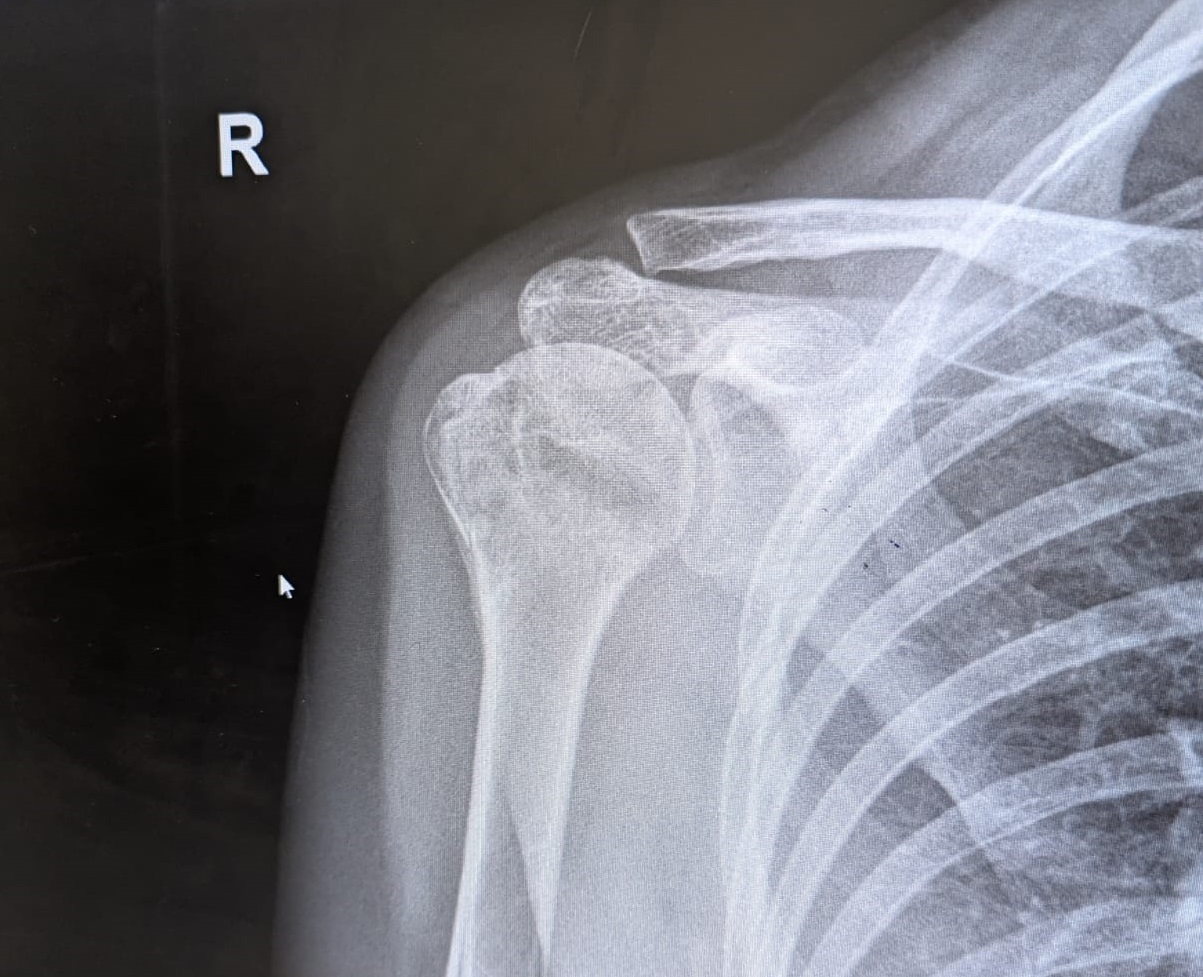
X-Ray of Chloe's Shoulder showing fracture. Substained months before the Mongol Derby 2025

Suddenly, the conversation wasn’t about preparing for Mongolia. It became a question of whether Mongolia was still possible at all.

From a purely physical perspective, I believed I could probably get her there. We had enough time that I could rebuild her shoulder, modify the training and prepare her body well enough for her to complete the Derby.

But completing it was never the standard I wanted us to aim for.

I remember saying to Chloe that whilst I could almost certainly patch her up enough to get her around the course, I wasn’t convinced she would actually enjoy it. When you’re investing close to $19,000 in what is likely to be a once-in-a-lifetime experience, simply surviving ten days isn’t enough. I didn’t want her spending every day managing pain, protecting an injury and counting down the miles until it was over. I wanted her to experience everything the Mongol Derby is supposed to be.

The timing made the decision even more difficult because there was only a short period in which she could defer her place without losing a substantial amount of money. I deliberately raised the conversation early enough that she still had options, then left the decision entirely with her. There was no pressure either way. If she wanted to continue, I would prepare her as best I possibly could. If she chose to postpone, we would rebuild her properly.

After taking some time to think about it, Chloe made what I still believe was one of the best decisions of the entire journey.

She deferred her place until 2026.

That single decision changed everything.

Instead of spending the next few months trying to recover from a serious injury whilst preparing for one of the toughest equestrian events in the world, we suddenly had eighteen months to build the body she actually needed. We were no longer working towards simply getting her to the finish line. We were working towards giving her the best possible chance of enjoying every moment of the experience.

What made the challenge even more interesting was that Chloe wasn’t somebody who enjoyed going to the gym. She’d never really exercised in any structured way before. She loved walking, hiking, travelling and adventure, but strength training was completely outside her comfort zone.

So this wasn’t a story about refining an athlete.

It was the story of building one from the ground up.

Building the Foundations for Mongol Derby Training

Once Chloe had made the decision to defer until 2026, everything changed. We were no longer chasing a deadline. We finally had the time to build her body properly, rather than rushing to make it just good enough to cope.

Before writing a single workout, I spent time understanding where she was starting from.

Chloe wasn’t someone who hated hard work. Quite the opposite. She loved being outdoors, hiking for hours, travelling to remote places and throwing herself into adventures. She had the mindset the Mongol Derby demands. What she didn’t have was a body that had been prepared for it.

She’d never followed a structured strength programme before. The gym wasn’t somewhere she felt comfortable. Squats felt unstable, largely because of her long femurs, and she simply assumed that was how her body worked. She had recurring pain in her right knee, previous elbow injuries and movement patterns that had developed over years without anyone ever really addressing why they existed.

That’s something I see all the time.

People often believe they’re weak because they’re weak.

In reality, they’re usually weak because their body has never learnt to organise movement efficiently.

Relearning How to Move

The first phase of training wasn’t glamorous. There were no heroic workouts, no endless cardio sessions and certainly no attempts to recreate riding in the gym. Instead, we focused on teaching Chloe’s body how to move.

We worked on posture, balance and coordination. We improved hip mobility, began correcting her swayback posture and started teaching her glutes to actually do the job they were designed to do. Every exercise had a purpose. Every progression was earned.

Progress came quickly, but never because we rushed it.

The goal wasn’t to see how much weight she could lift.

The goal was to build a body that would still be functioning after eight or ten hours in the saddle, day after day, on completely unfamiliar horses.

Rehab Without Losing Momentum

As her shoulder gradually healed, we carefully reintroduced upper body training alongside her rehabilitation. Nothing was left to chance. We worked alongside her physiotherapists, although, as a soft tissue therapist with advanced anatomy and physiology, I’d already incorporated rehabilitation exercises appropriate to Chloe’s injury and stage of recovery into her existing programme. By the time she attended physiotherapy, many of the prescribed exercises were considerably more basic than where she had already progressed to, so we simply used them as part of her warm-up before continuing with the programme I’d designed.

As soon as Chloe was signed off by her consultant and we had confirmation that the fracture had healed, the shoulder stopped being the focus.

That might sound surprising, but it’s a principle I feel very strongly about. Once the tissues have healed and medical clearance has been given, continuing to treat an injury as though it’s still injured can actually create bigger problems than the injury itself. People become hyper-aware of the injured area, they subconsciously protect it, and they begin moving differently. Over time, those compensations often become the real problem.

More often than not, it’s actually the opposite side of the body that starts to suffer because it’s been working overtime trying to compensate.

I had no intention of allowing that to happen.

From that point onwards, we stopped treating Chloe as someone recovering from a shoulder injury. Instead, we focused on building a stronger, more capable body as a whole. Every ride became another opportunity to gather information. Where did she grip? What became sore? Which muscles fatigued first? What was her body telling us after spending hours in the saddle? Rather than chasing symptoms, we used that feedback to continually refine the programme.

That philosophy became the foundation of everything we did over the following eighteen months.

We never guessed.

We assessed.

We adapted.

Then we reassessed again.

Every assessment gave us another piece of the puzzle. Every phase built on the one before it. Chloe became stronger, more coordinated, more resilient and increasingly capable of coping with the demands we knew the Mongol Derby would place on her body.

Without really noticing it, she had stopped being someone rebuilding after an accident.

She was becoming an athlete preparing for one of the toughest equestrian endurance events in the world.

Testing Every Aspect of Mongol Derby Preparation

As the months passed, the focus shifted away from simply getting stronger in the gym. Strength alone wasn’t going to prepare Chloe for the Mongol Derby. The real question was whether that strength would transfer when she was spending hour after hour in the saddle, riding completely unfamiliar horses across some of the most unforgiving terrain on earth.

The only way to answer that question was to stop guessing and start testing.

One of the biggest misconceptions people have about preparing for an event like the Mongol Derby is that you simply need to ride more. Of course, saddle time is important, but endlessly riding your own familiar horse doesn’t prepare you for what you’ll experience in Mongolia. There, you’ll be riding a different horse every 40 kilometres. Every horse moves differently. Every horse has a different level of fitness, a different way of carrying itself and a different way of responding to the rider. Your body has to adapt over and over again, often several times a day.

That meant our preparation had to become far more specific.

Throughout the year, we deliberately built a series of test events into Chloe’s programme. None of them were there simply to tick a box. Every single one had a purpose. Each event was an opportunity to stress her body in a controlled environment, gather information and then refine the programme before the next challenge.

The Romania Test

Rider Cantering across Romania Mountain Landscape

Romania became the first major test.

The feedback was incredibly valuable.

Her overall recovery was excellent. She woke up feeling fresh each morning and felt she could probably have continued for another week. That immediately told me her overall conditioning was moving in the right direction.

But the trip also highlighted exactly where the remaining weaknesses were.

A small change in stirrup position created pain through her ankle and both knees before she realised what was happening. Once she corrected her foot position, the pain disappeared almost entirely. That wasn’t simply a riding lesson; it reinforced just how important efficiency of movement would become over ten consecutive days in Mongolia.

Her back also told us a story.

It wasn’t her lower back that failed first. It was her mid-back. After long days in the saddle, she could feel the muscles simply running out of stamina. Mounting and dismounting repeatedly also exposed a lack of explosive strength, while a handful of unexpected moments on sharp horses highlighted opportunities to improve balance recovery and reaction speed.

None of that was disappointing.

In fact, it was exactly what we wanted.

Because now we knew.

Instead of wondering whether her programme was working, we had clear evidence of what needed to improve next.

So we adjusted it:

→ More work for her posterior chain

→ More endurance through the upper back

→ More glute strength

→ More muscle fatigue sessions

Every decision was based on something her body had already shown us rather than something we assumed might happen.

What the Later Test Events Confirmed

The same process continued through every event that followed.

→ Five-hour riding days

→ Back-to-back riding weekends

→ Different horses

→ Different saddles

→ Different environments

Every experience added another piece to the puzzle.

One event highlighted glute fatigue after spending hours encouraging heavier horses forwards. Another showed that her lower back discomfort wasn’t actually a lower back problem at all. It was simply her glutes reaching the point where they could no longer do their job effectively. Once again, the programme evolved to solve the cause rather than chase the symptom.

The reason Chloe continued to make progress was actually very simple.

She did exactly what I asked her to do.

That level of trust is invaluable as a coach because it allows me to do what I do best: assess, programme, reassess and adapt. Every exercise I prescribe, every progression I make and every change to the programme is based on what I see and what your body tells me. When a client follows that plan consistently, I know exactly what’s working, what isn’t and what needs to change next.

That’s how coaching should work.

Over the years, I’ve noticed a very clear pattern.

The clients who trust the process, complete the programme as prescribed and allow me to coach them almost always achieve exceptional results.

The clients who constantly second-guess the programme, skip exercises, add things I’ve never prescribed, or decide they know better because they’ve seen something on social media create confusion.

Chloe never did that.

She trusted my experience completely. If I changed her programme, she knew there was a reason. If I told her we needed another month building strength before progressing, that’s exactly what we did. If feedback from an event meant changing direction, she embraced it without hesitation.

That trust allowed me to coach her exactly as I intended, and it allowed her body to adapt exactly as it needed to.

In my experience, that relationship between coach and client is one of the biggest predictors of success.

It’s certainly one of the reasons Chloe achieved everything she did.

Ready for the Mongol Derby
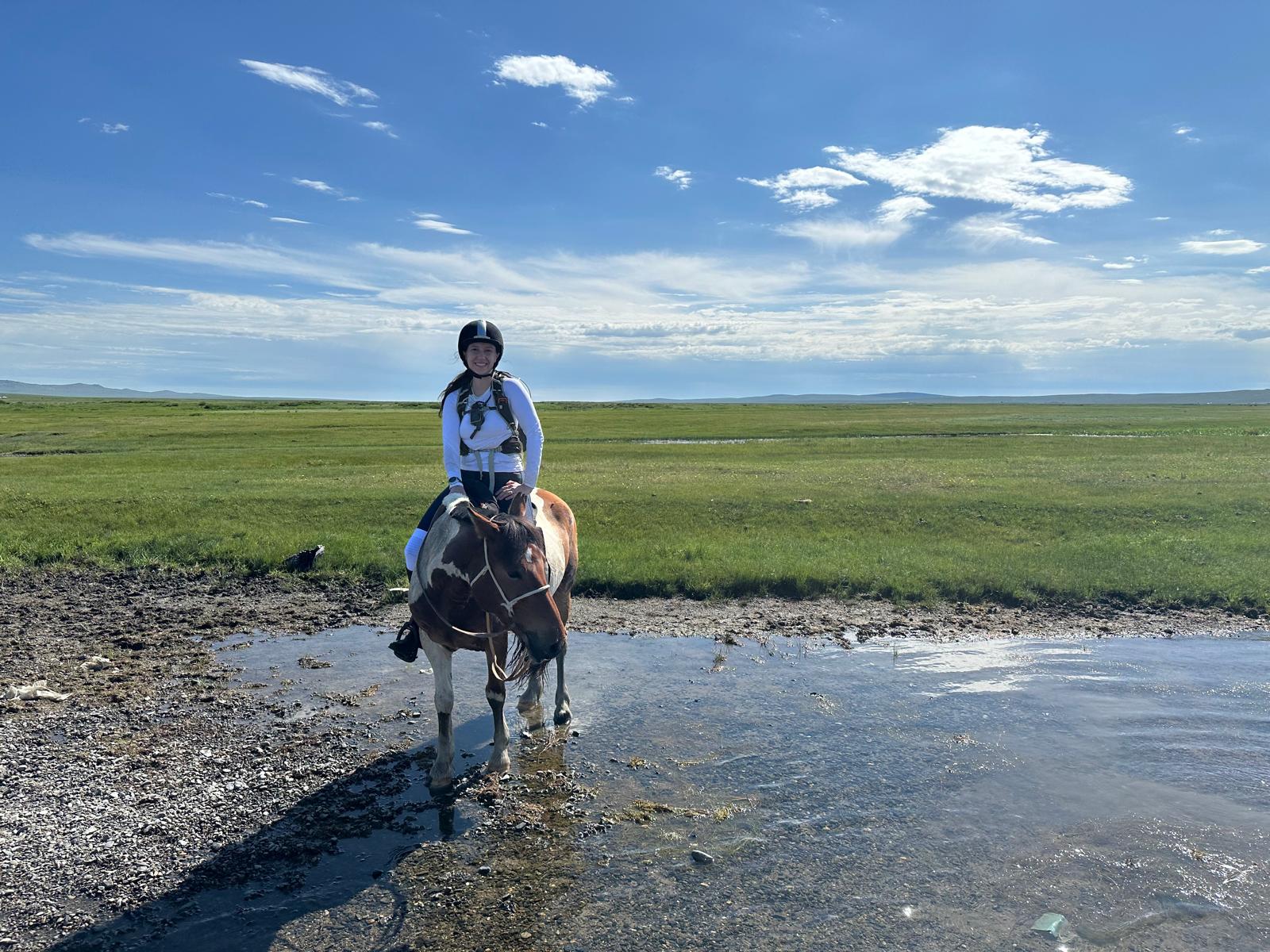
Chloe at the Mongolian Training Camp

As we moved into the final months before the Derby, the work was largely done.

That might sound surprising, but the final phase of preparing an athlete isn’t about trying to squeeze every last bit of fitness out of them. In fact, doing that is one of the biggest mistakes you can make. The closer you get to an event, the more important recovery becomes. The objective is to arrive on the start line feeling fresh, strong and mentally ready, not physically exhausted from trying to fit in one more workout.

By this point, Chloe had become almost unrecognisable from the person I first met eighteen months earlier.

→ She was stronger

→ She moved better

→ Her posture had changed dramatically

→ Her glutes were doing the job they were supposed to do

→ Her balance, coordination and endurance had all improved beyond what either of us could have imagined at the beginning

But perhaps the biggest difference wasn’t what I saw.

It was what she felt.

She no longer questioned whether her body would cope. She trusted it.

One of the final opportunities to test everything came during her riding camp in Montana. This wasn’t just another holiday; it was effectively the final dress rehearsal before Mongolia. She rode unfamiliar horses, spent long hours in the saddle and exposed her body to exactly the kind of demands we had been preparing for over the previous eighteen months.

The feedback couldn’t have been better:

→ There were no major physical issues.

→ Her longer stirrup position had significantly reduced the knee discomfort we’d identified earlier in the journey.

→ She adapted confidently to different horses.

→ She completed every workout despite travelling.

Most importantly, nothing in the feedback suggested we needed to redesign the programme.

That, as a coach, is one of the most reassuring things you can hear.

Instead of finding problems to fix, all that remained was to taper.

The final weeks became about maintaining movement, reducing fatigue and allowing all of that hard work to consolidate. There was no chasing extra fitness. There was no panic. There were no last-minute changes. The preparation had already been done.

People often think success is built in the final few weeks before a big event.

It isn’t.

It’s built in the hundreds of decisions made over the months and years beforehand.

→ It’s built in choosing to postpone when postponing is the smarter decision.

→ It’s built in turning up for workouts when motivation is low.

→ It’s built in trusting the process when progress feels slow.

→ It’s built in listening to what your body is telling you instead of fighting against it.

And it’s built by having the patience to solve the cause of a problem rather than continually chasing its symptoms.

Watching Chloe prepare for the Mongol Derby has been one of the most rewarding coaching journeys I’ve been part of.

Not because she was already an exceptional athlete.

Not because everything went perfectly.

But because she was willing to start where she was, trust the process completely and keep moving forwards, one step at a time.

As I share this with you now, August 4th 2026. Chloe is in Mongolia. The Derby starts tomorrow!

The outcome of the Derby is almost irrelevant.

Of course I want her to complete it, and I believe she has given herself the best possible opportunity to do exactly that.

But the greatest success has already happened.

Eighteen months ago, she was recovering from a fractured shoulder, wondering whether this dream was slipping away.

She isn’t travelling to Mongolia hoping her body survives. She’s travelling knowing her body has been prepared for the challenge ahead.

For me, that’s what coaching is really about.

It isn’t about creating perfect athletes.

It’s about helping ordinary people achieve extraordinary things.

Chloe, thank you for trusting me with your journey. It has been an absolute privilege to coach you, and I couldn’t be prouder of what you’ve achieved already.

Now go and enjoy every single mile.

Follow Chloe's Mongol Derby Journey

The Mongol Derby runs a LIVE Tracking system where you can track all of the riders, go to the main site: https://equestrianists.com/mongol-derby

The LIVE Tracking should be Live from Wednesday 5th August 2026.

Thinking of Doing the Mongol Derby?

If the Mongol Derby is on your bucket list, don’t wait until six months before the start line to think about your preparation.

The body you need for Mongolia isn’t built in a few weeks. It’s built through structured, progressive training designed specifically for you.

That’s why I only work with riders who have a minimum of 12 months before the Derby. It gives us the time to assess properly, build the right foundations, progressively develop the strength, endurance and resilience your body needs, and arrive in Mongolia knowing you’ve prepared as thoroughly as possible.

My bespoke Mongol Derby coaching starts from £4,200 for a 12-month programme.

If you’re planning a future Mongol Derby and you’re serious about giving yourself the best possible chance of enjoying the experience—not just surviving it—I would love to hear from you.

📩 Send me a message to discuss whether my coaching is the right fit for your Mongol Derby journey.
Clare@ridercise.co.uk

Processing...