
Your Body Is Doing Exactly What It's Learned to Do
If you’ve ever felt as though one stirrup is shorter than the other, one hip sits differently, one leg doesn’t hang the same way or one shoulder keeps dropping, you’ve probably tried to correct the place where you feel the problem.
You might lift the shoulder, push more weight into one seat bone, lengthen the leg or change your stirrup length.
Or perhaps you’ve gone looking for horse riding exercises to improve balance, hoping that strengthening, stretching or working one side differently will help you become more even in the saddle.
But before you try to correct anything, there is something much more important to understand.
Where you feel uneven isn’t necessarily where the difference begins.
Your body doesn’t work as a collection of separate parts. What happens through your pelvis can influence your spine, shoulders, hips and legs. Something you notice at your shoulder could be connected to what is happening much further down your body.
And there’s another question we need to answer first:
Is this something that happened today, or is it something that keeps happening?
Before Choosing Horse Riding Exercises to Improve Balance, Look for a Pattern
Your body won’t feel exactly the same every time you ride.
You might have spent hours driving the previous day. You may have slept awkwardly, done something physically demanding, changed your normal routine or simply be more tired than usual.
So if you get on your horse one day and one hip feels tighter or one stirrup suddenly feels shorter, that single experience doesn’t necessarily tell us very much.
Make yourself comfortable, provided any adjustment is appropriate for you and your horse, and see what happens the next time you ride.
What becomes much more interesting is when the same difference keeps returning.
Perhaps your instructor repeatedly tells you that your right shoulder is dropping.
Maybe you continually feel as though one stirrup is shorter even though you’ve checked the leathers.
Perhaps one knee always seems to creep higher, one leg grips more than the other or you consistently feel as though you’re sitting more heavily to one side.
Now we have a pattern worth investigating.
And this is where simply choosing more horse riding exercises to improve balance can become problematic.
Before deciding what exercise you need, you need a clearer idea of what you’re actually trying to change.
Where You Feel Uneven Isn't Always Where the Problem Starts
Imagine your instructor repeatedly tells you that your right shoulder is dropping.
The obvious response is to lift your right shoulder.
You lift it. It looks better.
A few strides later, it’s down again.
So you lift it again.
This can continue for lesson after lesson because you’re correcting the visible result without necessarily changing the reason your shoulder keeps returning there.
Let’s look at one example of what could actually be happening.
Your pelvis may be moving or sitting slightly towards the left. But that doesn’t automatically mean you’ll put more weight through your left seat bone.
Your body wants to keep you upright.
So your right side may work harder to stabilise you against that leftward displacement, increasing the pressure through your right seat bone.
Your upper body then has another problem to solve.
To keep your centre of gravity over your base of support, your torso can respond by rounding or collapsing towards the right.
Now your right shoulder appears lower.
But the shoulder itself wasn’t necessarily where this pattern began.
And it doesn’t have to stop there.
The change around the pelvis can also influence what’s happening at the right hip. The muscles around the front of the hip may work harder, the knee can come higher and the leg may start to grip.
The rider might therefore experience several apparently separate problems:
- =A dropped right shoulder.
- =A heavier right seat bone.
- =A tighter right hip.
- =A higher right knee.
- =A leg that grips more on one side.
- =A stirrup that feels shorter.
But they may all be part of the same overall pattern.
This is why repeatedly correcting each individual symptom doesn’t necessarily resolve the problem underneath it.
Why Horse Riding Exercises to Improve Balance Need to Match What Is Actually Happening
This is where exercise selection becomes important.
If your right shoulder repeatedly drops, should you strengthen the muscles around that shoulder?
Stretch one side of your torso?
Work harder through your right leg?
Strengthen your left side?
Work on your pelvis?
The answer depends on why the shoulder is dropping in the first place.
The same applies when one hip feels tight.
“Tight” doesn’t automatically mean that something simply needs stretching. A muscle can feel tight because it’s working harder to stabilise you. Changing that sensation temporarily doesn’t necessarily change why it was working harder.
And if one leg feels shorter in the saddle, changing your stirrup length may make you feel more comfortable for that ride, but if the same difference returns every time you ride, it’s worth asking why.
This doesn’t mean that horse riding exercises to improve balance aren’t useful.
They absolutely can be.
But the exercise is the intervention.
First, we need some idea of what we’re trying to influence.
You Can Be Uneven and Still Feel Completely Straight
This is one of the most important things to understand about your own body.
You don’t need to consciously think about where every part of you is in order to move.
Your brain receives information from your muscles, joints and other sensory systems to help it understand where your body is in space. This awareness is known as proprioception.
If you’ve repeatedly stood, walked, exercised and ridden in a particular position, your nervous system becomes very familiar with it.
Eventually, that position can feel completely normal.
So you can genuinely believe you’re sitting straight while someone looking at you can clearly see that you’re not.
And when you first move into a more centred position?
That can feel crooked.
This is why I don’t want riders to assume that feeling straight and being straight are necessarily the same thing.
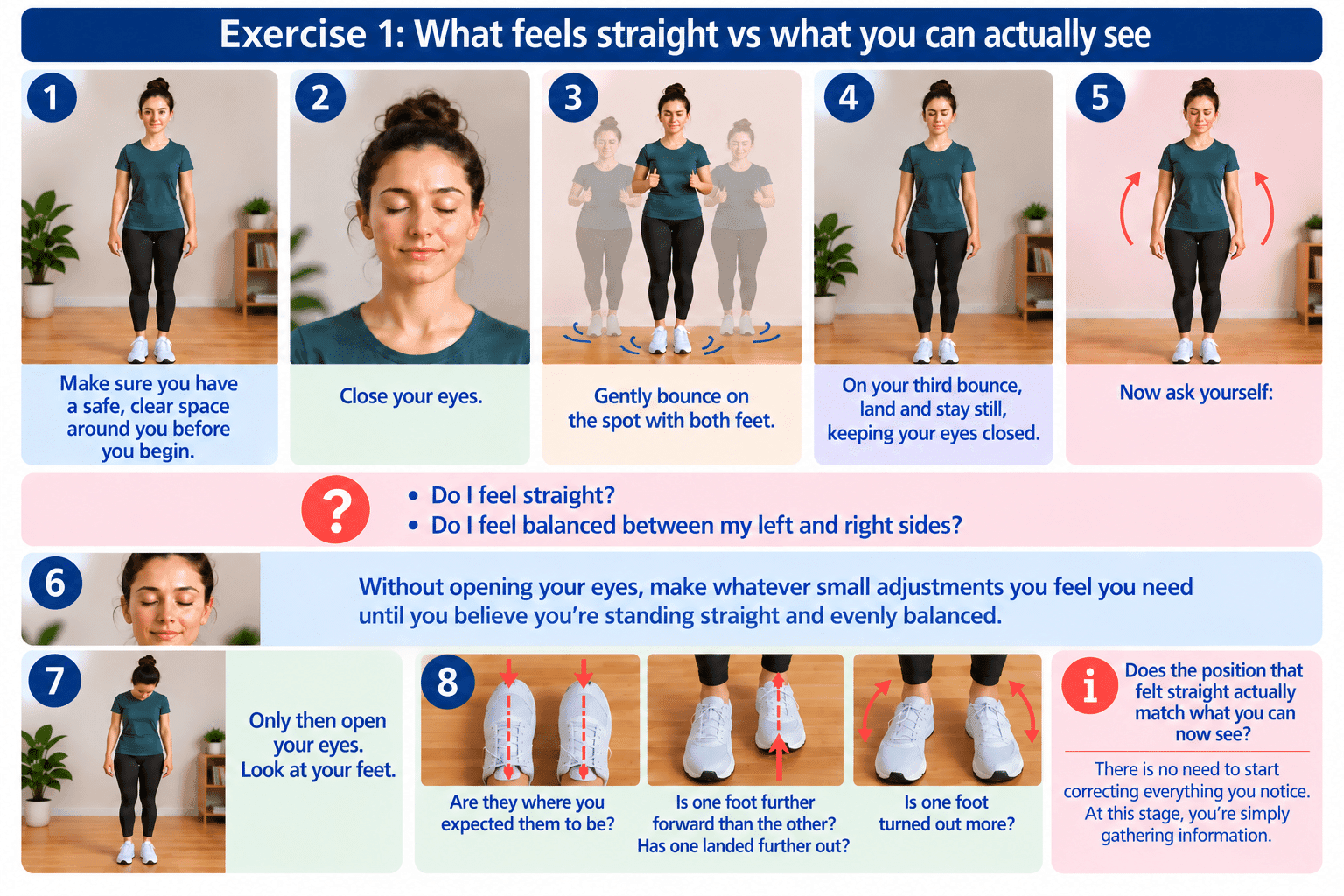
You can test this for yourself.
A Simple Proprioception Exercise for Riders
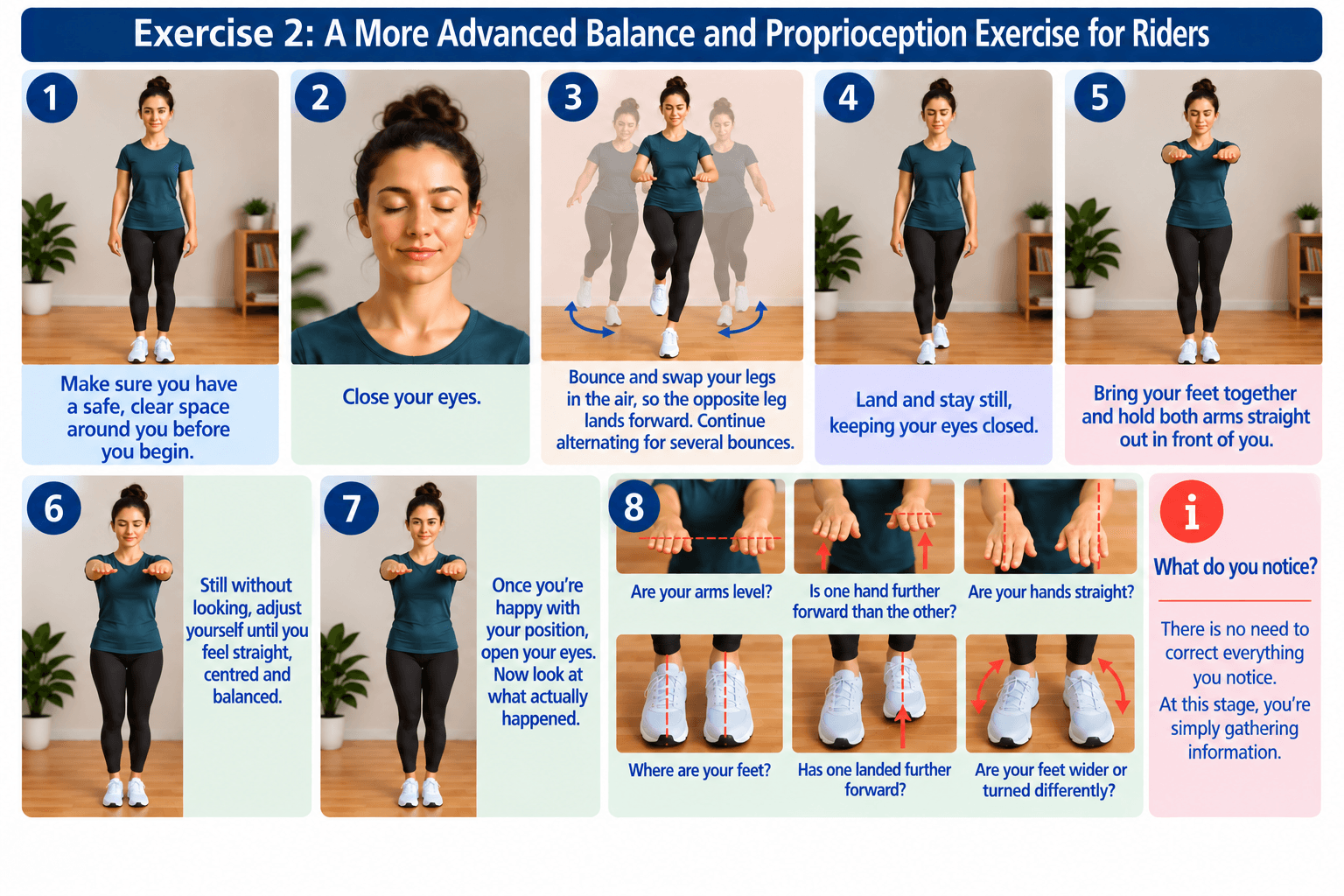
A More Advanced Balance and Proprioception Exercise for Riders
What Does This Mean for Your Balance in the Saddle?
When you’re standing on the ground, you have two feet providing your base of support.
When you’re riding, the situation changes.
You’re sitting on a moving horse, your pelvis becomes a significant part of your base of support and your body is constantly responding to movement underneath you.
A difference that isn’t particularly obvious when you’re standing can therefore become much more noticeable once you’re riding.
It can also explain why your instructor can see something that you can’t necessarily feel.
Neither piece of information should automatically be ignored.
What you feel gives us information. What we can see gives us information.
The useful part comes from putting those pieces together.
Before You Try More Horse Riding Exercises to Improve Balance, Start Here
If you’ve noticed that you feel uneven when you ride, don’t immediately try to fix everything.
Start by asking whether it is actually a recurring pattern.
If it happens once, notice it and see what happens on your next ride.
If it keeps happening, become more specific about what you’re experiencing.
- Which side?
- What exactly feels different?
- When does it happen?
Does your instructor repeatedly notice the same thing?
Do you see anything similar when you’re standing?
And importantly, don’t only look at the place where you notice the difference.
- UIf your shoulder drops, what is happening through your pelvis and legs?
- UIf one knee sits higher, what else changes on that side?
- U If one stirrup feels shorter, what is happening above it?
You’re beginning to look at the relationship between different parts of your body, rather than treating each one as an isolated problem.
That gives you far more useful information when deciding which horse riding exercises to improve balance may actually be appropriate for you.
You Don't Have to Guess Why You Feel Uneven
You also don’t have to work all of this out by yourself.
Your instructor can be an important source of information because they can tell you what they’re seeing while you’re riding. Rather than only asking how to correct something, start asking what they actually see happening.
Static photographs can also provide useful information because they allow you to compare what you feel with what can actually be seen from the front, side and back.
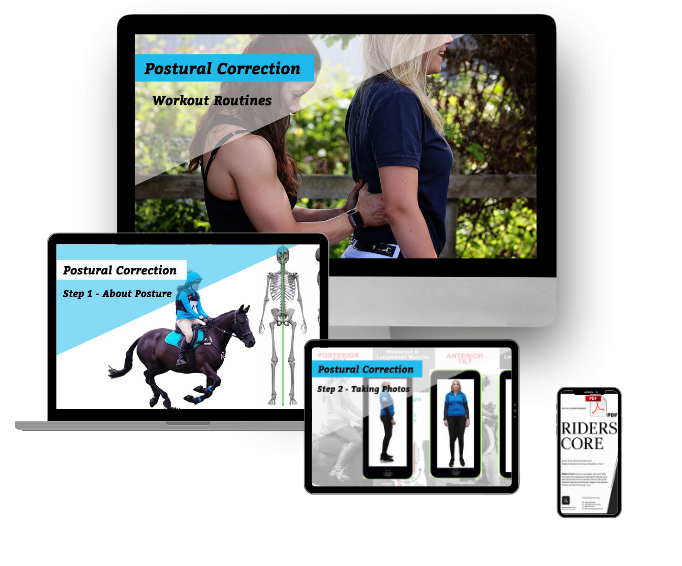
This is one of the reasons I include guidance on taking your own postural photographs within the RiderCise® Postural Bundle.
The Postural Bundle then provides a progressive series of workouts organised around different postural patterns, helping you work on what your body needs away from the horse rather than simply choosing random exercises and hoping they transfer to your riding.
You can also seek an assessment from an appropriately experienced Sports Therapist or movement professional if you want someone to look at you in person.
The important thing is that you don’t have to keep guessing.
Horse Riding Exercises to Improve Balance Should Come After Understanding the Pattern
Feeling uneven doesn’t automatically tell you what needs correcting.
The place where you notice the difference may be part of a much bigger pattern, and something your instructor sees at your shoulder, hip, knee or leg may be the visible result of what’s happening somewhere else.
So before you stretch the tight side, strengthen the weaker side, change your stirrup length or search for another set of horse riding exercises to improve balance, establish whether there is actually a recurring pattern.
Then compare what you feel with what you can see.
Start looking at how the different parts of your body relate to one another.
Because once you understand what your body is actually doing, you can make much better decisions about what needs to change.
Next: Why Riders Feel Uneven
In the accompanying RiderCise® YouTube video, Why Riders Feel Uneven (released on 29th October 2026) , I’m going to take this further.
We’ll look at how you can start investigating an uneven feeling, what different observations can tell you, how to compare what you’re feeling with what can actually be seen, and when it’s worth getting another perspective before you try to correct it.
Because noticing that you’re uneven is only the beginning.
The next step is understanding why.