Running for Rider Fitness

Running for Rider Fitness

Running for Rider Fitness

Running is a great way to improve cardiovascular fitness and increase lean muscle mass. It is also Free!! You get to see areas from a different view, challenge yourself with different terrain, and get high on endorphins!

For many, the feeling of being cardiovascularly challenged is the definition of fitness. If they are not sweaty, aching, and/or unable to continue. They have not worked hard enough.

The sense of achievement and satisfaction, the endorphins, when you have run as much as you can physically endure is highly addictive.

But is running good for Rider Fitness?

What benefits does Running provide Riders?


Running is an excellent way to improve your cardio fitness (cardiorespiratory fitness (CRF)) – Your ability to uptake and supply oxygen to skeletal muscle mitochondria for energy production. When oxygen is used for energy production it is known as aerobic exercise.

Anaerobic exercise means that the body uses different systems to produce energy. In the absence of oxygen.

Cardio fitness is expressed as your VO2 Max – The maximum volume of oxygen you can take in through your lungs, pump around your body using your heart and blood vessels and then make use of the oxygen in your muscle’s energy expenditure.

In addition, running can help develop lean body mass but this is highly dependent on whether you are fuelling your body correctly for muscle growth.

Running for Rider Fitness

Running improves your cardiovascular fitness. Improving your body’s ability to uptake and utilise oxygen for energy production. 

Event Fit

Why is Cardio Fitness Important for Riders?


A normal heart rate at rest can vary between 60-100 beats per minute. The ‘ideal’ range is 50-70 beats per minute. The lower the resting rate, the fitter you are, and the less stress on your heart to pump blood around your body.

When riding your heart rate will be higher than its resting rate. Mainly because you are actively using your body to ride but also because of stress, anxiety, and excitement.

If you have a low level of cardio fitness, this puts excess stress on your heart and can leave you feeling weak, dizzy, or sick.

In worst-case scenarios, it can also lead to stroke and heart attacks.

Because your heart rate will fluctuate when riding, depending on what you are doing, how your horse is feeling beneath you, how you are feeling, and of course how fit you are.

Cardio fitness is an essential component of Rider Fitness but not classed as Rider Fitness.


Running Considerations


Whilst running itself is not harmful to the body. The way in which you run can be.

Your running technique will be influenced by your level of fitness and your posture.

  • If your posture is compromised it affects your body’s ability to run efficiently and absorb impact which can lead to injuries.
  • If your fitness level is low then you will be training anaerobically which can lead to lactic acid build-up (heavy legs / burning sensation) which in turn affects your body’s ability to run with good technique.
Is Running good for Rider Fitness

If you have a compromised posture you would be best advised to correct your posture first through corrective exercises (where possible) so that your body is able to deal with the impact effectively, reducing the risk of injuries and the damage to joints that can occur.

Postural imbalances such as a Kyphotoic posture where your upper body is rounded and you will probably have a posterior pelvic tilt (bottom tucked under) can be made worse by performing exercise activities such as running, rowing or cycling. This is because the muscles that you should be using to perform these activities will be shortened/tight:

  • Hamstrings
  • Abdominals
  • Glutes
Pelvic Tilts - Posterior

This will inhibit their ability to function correctly because these activities typically force you into a crouched/rounded position (running because it’s hard and how the majority of runners run). It further shortens those muscles and contributes to the weakness of your hip flexors and lower back

If you have a low level of fitness, start gradually by walking with small intervals of jogging. There are many running programs available on the internet for beginners. Take your time and build up your fitness slowly.


Running Technique

  • Posture: Ensure that your posture is in the best alignment possible before starting running.
  • Function: It is important that you run by pushing yourself forward by using your glute (bum), not dragging yourself forward. Using the incorrect muscles will cause fatigue quicker and also alter your body’s running posture which will reduce its ability to absorb shock.

Watch this short video to see the differences between incorrect and correct running technique.

Note: Sally has good posture and runs regularly and is coached in her technique. It is very difficult to run incorrectly when you have learned to run correctly. This means this video will not show the true extent of running incorrectly. It will be much worse.

Summary

Once you have gotten past the hardship of learning to run correctly and have built up a good level of cardiovascular fitness. Running is enjoyable and delivers high amounts of endorphins.

It is satisfying and rewarding and improves heart and lung function. Best of all, it’s free and you can explore your area and participate in local running groups and take part in a variety of running competitions.

But it’s not for everyone. Riders with a compromised posture are best seeking other activities to boost their cardiovascular ability. Once which doesn’t put them at risk of injury. Activities such as walking, swimming, and using a cross trainer. Cycling and rowing are also options if you don’t have a kyphotic or posterior pelvic tilt.

Running can improve muscular endurance if you run long distances and can improve lean muscle development if you are eating for performance.

  • Muscular endurance and lean muscle development are not typically achievable or considered a benefit of running to the average runner. This is due to many running short distances and normally in a calorie deficit.
  • If you run as a sports activity. You will be combining your running with sprints, hill work and resistance training in order to enhance your muscular endurance and lean muscle. 

Running is a beneficial form of cardio exercise for riders but running doesn’t make you rider fit. There are 7 more components that make up rider fitness: Balance, Coordination, Stability, Agility, Mobility,  Muscular Strength and Muscular Endurance.

Rider Biomechanics

Rider Biomechanics

What is Rider Biomechanics

Rider biomechanics refers to the study of how a rider’s body movements, positioning, and muscle activity affect their riding performance, comfort, and safety. It encompasses the analysis of various factors such as balance, posture, and the interaction between the rider and the horse.

Rider biomechanics is important in equestrian sports, where small changes in the rider’s position or muscle activity can have a significant impact on the horse’s movement and performance. By understanding the principles of rider biomechanics, riders can improve their riding technique, reduce the risk of injury, and enhance their overall riding experience.

In addition, rider biomechanics can also be used to evaluate and select appropriate equipment, such as saddles, stirrups, and reins, to optimize the rider’s position and comfort while riding.

What does Rider Biomechanics Assess?

When assessing rider biomechanics, several factors are typically considered, including:

  1. Alignment and posture: This refers to the rider’s ability to maintain a neutral spine and aligned body position, which helps distribute their weight evenly across the horse’s back and allows for clear communication between the rider and the horse.

  2. Balance: Good balance is essential for effective riding. It involves the rider’s ability to maintain their center of gravity over the horse’s center of gravity, which is important for staying in control of the horse’s movements.

  3. Joint angles: Proper joint angles, such as hip, knee, and ankle flexion, can improve the rider’s stability and balance, while also allowing them to move with the horse’s motion.

  4. Muscle activation: The rider’s muscle activation patterns can affect their balance and stability, as well as their ability to influence the horse’s movement.

  5. Rein contact: The way the rider holds the reins and applies pressure can impact the horse’s response to their cues.

  6. Movement: The way the rider moves with the horse, such as their ability to absorb and follow the horse’s motion, can affect the horse’s comfort and overall performance


Rider Biomechanics

By assessing these factors, riders can identify areas where they may need to improve their technique and develop a more effective, efficient, and comfortable riding style.

Event Rider

Considerations of Assessments

It is important that any rider biomechanics assessment takes into account learned behavior, habits, and body responses that come from riding experience, as well as any injuries or traumas that a rider may have experienced.

These factors can play an important role in shaping a rider’s biomechanics.

For example, a rider who has experienced a fall or riding trauma may have developed habits or muscle activation patterns that are designed to protect them from future injury. These patterns may not be optimal for riding performance, but they can be difficult to overcome without the help of an experienced coach who understands the rider’s history and needs. Similarly, a rider who has developed a habit of leaning too far forward or gripping too tightly with their legs may need to retrain their muscles in order to achieve a more balanced and effective riding position.

Pros & Cons

Pros:

  • Improved riding performance: By optimizing rider biomechanics, riders can improve their balance, stability, and overall riding technique, leading to better performance in the arena or out and about.
  • Reduced risk of injury: Proper biomechanics can help riders avoid injuries such as falls, muscle strains, and joint pain, by distributing forces and stress evenly throughout the body.
  • Enhanced horse welfare: Optimal rider biomechanics can also benefit the horse by reducing interference with the horse’s movement and allowing the horse to move more freely and comfortably under saddle.
  • Improved communication between horse and rider: Good biomechanics can help the rider communicate more effectively with the horse, by using clear and subtle cues that are easy for the horse to understand.
  • Increased rider confidence: By improving their technique and reducing the risk of injury, riders may feel more confident and comfortable in the saddle.

Cons:

  • Focus on form over function: Some riders may become overly focused on achieving a “perfect” position or technique, to the point where they force their bodies into positions they are not designed or conditioned to perform. A riders ‘perfect’ position is individual. Where their skeletal structure may mean it is not possible for them to obtain the ear, shoulder, elbow, hip, heel alignement. 
  • Potential for injury from over-correction: In some cases, riders may overcorrect their biomechanics in response to coaching or training, leading to new injuries or imbalances. As above, the ‘perfect’ alignment is not possible for some riders. This should be recognised and advised by coaches.
  • Overemphasis on individual technique: While rider biomechanics can be an important factor in riding performance, it should not be seen as the only or most important aspect of riding. Factors such as horse training, rider conditioning, and nutrition can also play a significant role in achieving success in the saddle.
  • Time and resource-intensive: Coaching or training for rider biomechanics can be time-consuming and require riders to understand that correction is a process.

Taking Action


Following a Rider Biomechanics assessment you will need to work on yourself off the horse to improve upon the areas identified by your Biomechanics Coach. 

Whilst you can improve upon the identified areas in the saddle it is important to understand that your body is used to a particular way of functioning in the saddle. It has created muscular memory, recruitment and activation pathways that cannot simply be undone by adjusting your posture and function in a session. It takes time.  

Rider Fitness Made Easy

Research shows that improving functional movement on the ground can lead to improvements in functional movement on the horse. Developing proper functional movement patterns, such as good posture, core stability, and balanced weight distribution, can help riders maintain a stable and effective position in the saddle, which can in turn enhance their ability to communicate with the horse and improve overall riding performance.

Summary

Overall, rider biomechanics is a complex and dynamic field that takes into account the individuals skeletal structure, needs and experiences of each rider, as well as the unique characteristics of the horse they are riding. The key to improving the your riding biomechanics is working with a knowledgeable instructor or coach. And understanding that is is a process. Results are not achieve overnight but the benefits are improved technique, reduction in the risk of injury, and enhance yours and your horses overall riding experience.

Improving functional movement on the ground can have a positive impact on riding performance, by enhancing core stability, balance, and overall fitness. It allows you to focus solely on yourself without having to worry about a negative impact on the horse as you learn, develop and adapt. 

Other key points to remember is that riding is a unique and complex activity that involves many different factors beyond just functional movement, including horse training, communication, and tactical decision-making, that also play a significant role in achieving success in the saddle.

References:

  • A study published in the Journal of Equine Veterinary Science in 2016 found that riders who participated in a six-week core stabilization program experienced significant improvements in riding performance, including increased stability in the saddle, improved leg position, and better overall balance.

  • Another study published in the Journal of Equine Science in 2017 found that riders who engaged in Pilates training had significant improvements in their riding posture, including better alignment of the pelvis and spine.

  • A review of the literature published in the Journal of Equine Veterinary Science in 2020 found that strength training and core stabilization exercises can have a positive impact on riding performance by improving riders’ ability to maintain a stable and effective position in the saddle.

Rider Fitness Workout Roadmap

Rider Fitness Workout Roadmap

Designed to give you clear direction of where to start, when to move forwards and how to maintain your rider fitness.  

Rider Fitness Workout Visual Overview


Having a visual overview of your Rider Fitness Journey helps you to map out in your mind, where you currently are and where you want to be. Broken into 3 Phases, it gives you a clear path of which Rider Fitness Workouts you should be starting with and how to progress forwards. 

Rider Fitness Workout Roadmap

Postural Workouts


These workouts have been added to ensure that you are building upon a strong base. Like training a horse. If you are trying to build upon a weak base it will only lead to more problems in the future.

The Foundation Program is fantastic for re-setting your body awareness and control but over the years I have found that riders need more help to build that strong base.

Life stresses and the way we move and function can often compromise our static posture. When our static posture is altered it inhibits the ability of the core to function optimally.

We all have a core that functions as we use it to sit, stand, move and ride. But if it is not able to function correctly it means the body needs to rely more on certain muscles or use muscles not designed for that job, which leads to aches and pain, and a lack of ability to control our movement.

The Core consists of around 34+ muscles that need to work together in order for your Core to function optimally. Our static posture can cause short, tight, weak and/or lengthened muscles which inhibit those muscles to work together.

Rider Fitness Workout - Postural Correction

When you are struggling to use your core to move and ride, it isn’t because you don’t have strength in the Psoas or Transverse or whatever the latest ‘Buzz’ word is. Because no muscle works alone. You cannot improve function in one muscle without altering the function in another.

Riders Core

The Riders Core – Postural Imbalance

To help subscribers understand more about the Core and how their posture may be holding them back, there is an educational video which explains all you need to know! 

The Postural Workouts

Rider fitness Workout
Slide 1
previous arrow
next arrow

Sign Up To On Demand

You can access ALL of the RiderCise Rider Fitness Workouts for just 35p per day!

Equestrian Riders – Our Brand New Website Is Now Officially Live

Equestrian Riders across the world can now subscribe to our On Demand video library of Horse Riding Fitness Exercises. Finally, riders can improve their riding ability from any device with an internet connection with RiderCise On Demand! Our aim is to make horse rider...

Improve Your Riding: If Riding Still Feels Harder Than It Should, Here’s Why

Struggling with your riding? Discover key insights to improve your riding and build confidence on the road with RiderCise.
Are you a Fit Equestrian or Equestrian Fit?

Are you a Fit Equestrian or Equestrian Fit?

Do you consider yourself to be a Fit Equestrian or Equestrian Fit? Do you exercise off the horse to improve your riding or for general health and well-being? Is there a difference?

There is a huge array of options available to improve our general health and wellbeing. Any form of movement/exercise is beneficial (if done correctly, obviously). But when it comes to exercising to improve your riding are you aimlessly wasting time, money, and effort, or are you seeing measurable progress and specific transferable benefits?

What’s the Difference?

When you exercise in addition to your generally active lifestyle (caring for and riding horses) you will see changes and experience benefits. The reason is that you are overloading your body with different stimuli than what you are used to.

The changes and benefits you see, and experience will differ depending on what form of exercise you have chosen.

Cycling for rider fitness

If you have started running or cycling, then you may be seeing that you are not as out of breath as much in the saddle.

Woman on Yoga Mat

Or you have started Yoga/Pilates classes and feel that you have better mobility (strength, balance, and coordination to control body movements) and can sit more balanced in the saddle.

Horse Rider Strength

Or perhaps you have started lifting weights and feel stronger, straighter, and can control your riding posture and give clearer effective aids.

All of the above forms of exercise focus on improving a specific component of fitness or a combination of.

There are around 11 Components to Fitness but I have listed the 7 that are relevant to riding

Component

Meaning

Example

Agility

The ability to change the position of the body quickly and control the movement

– Sitting a spook.

– Give clear effective leg aids

– Jumping position

Balance

The ability to maintain the body’s center of mass above the base of support

– Sit evenly and centrally in the saddle.

– Move with the horse through all gaits whilst maintaining correct posture

Cardiovascular

The ability of the heart, lungs and blood to transport oxygen

– Not getting out of breath during riding

– Able to breathe correctly for core engagement

Coordination

The ability to use two or more body parts together

– Riding!

– Giving seat, leg, and hands aids simultaneously

Flexibility

The range of motion (ROM) at a joint

– Altering hips to move with the horse in left/right lead canter

– Opening/closing of the knee to put the leg in front, on, and behind the girth.

Muscular Endurance

The ability to use voluntary muscles repeatedly without tiring

– Ride for longer than 10 minutes without fatigue.

– Perform repetitive tasks such as giving aids

– To jump / Event

ANY FORM OF RIDING

Reaction Response

The time taken to respond to a stimulus

Reacting to a spook or change in direction.

By being generally active and performing a form of exercise that focuses on one of, or a combination of the above fitness components then you would be considered a fit equestrian.

How Do I Become Equestrian Fit?

To become Equestrian Fit you will need to incorporate all of the 7 components listed above, into your exercise regimen. It may sound like it’s an impossible task but all you need is variety and structure.

Instead of doing the same class, exercise routine or getting the bike out, or going for a run. Mix it up. It really is that simple. To ensure that you are continuously progressing you also need to make sure that you are overloading your body appropriately.

All that means is that you increase the intensity, sets, duration, and weight once you feel that you that what are currently doing is fairly easy. This will ensure that your body is constantly adapting. You don’t need to increase all of those, just one or the other.

The easy option is to sign up to RiderCise – where Rider Fitness Expert and Founder, Clare. Has designed all the workouts using based on the 7 Key Components for Rider Fitness

Become Equestrian Fit

Learn more about how RiderCise can help you.

How Pelvic Tilts affect your Riding

How Pelvic Tilts affect your Riding

Bad posture is the most common reason for an Anterior or Posterior Pelvic Tilt.

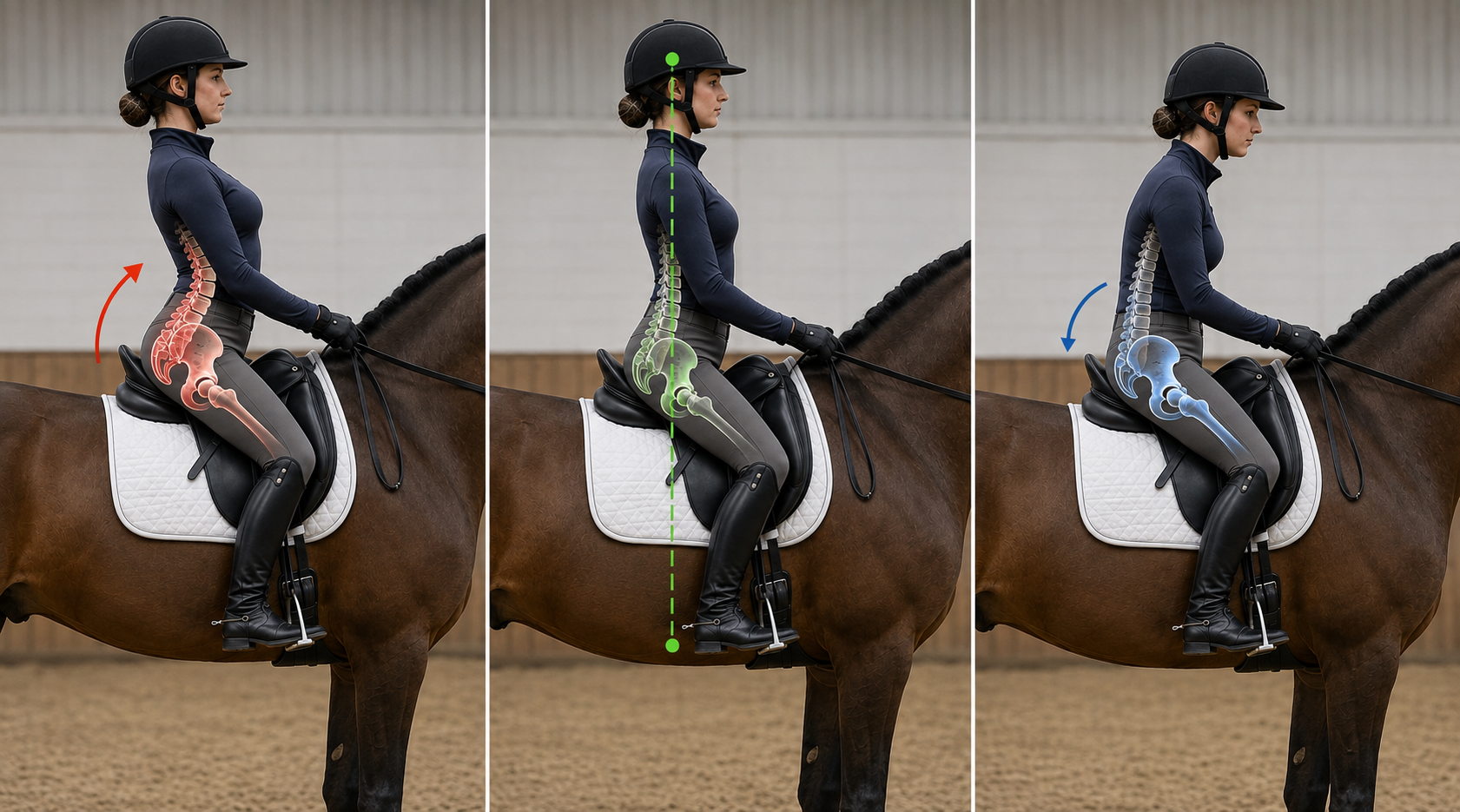
For good posture, balance, and stability in the saddle, it is essential that we have a neutral pelvis. Having a neutral pelvis allows us to maintain upper body posture stability. Lower limb control WHILST allowing movement in the hips to follow the movement of the horse.

The tilt of the pelvis is determined by measuring the angle of the Anterior Superior Iliac Spine (ASIS) and the Posterior Superior Iliac Spine (PSIS). These are bony structures on the front and back of your pelvis. You should be able to feel these with your fingers.

There are many considerations when measuring the range of ASIS and PSIS. Generally, a neutral pelvis is when there is a straight line from the PSIS to the ASIS or a slight anterior (forward) angle of 7-10 degrees.

Anterior Pelvic Tilt (APT)

An Anterior Pelvic Tilt is when your pelvis is rotated forwards causing an increased curve in the lumbar (Lower Back) and an appearance of a ‘bulging’ stomach.

What muscles does APT affect?

How Pelvic Tilts affect your riding

When you have an APT the Rectus Abdominis and External Obliques (abdominal muscles) and Glutes & Hamstrings (bum & back of legs) are typically weak / lengthened muscles.

Simultaneously. The Psoas, Iliacus (internal postural muscles), Rectus Femoris (quadriceps), Tensor Fascia Latae (Hip) and Erector Spinae (spine) muscles are strong and stiff.

How does an APT affect your riding?

You will have a tendency to sit on your pubic bone instead of your seat bones. And because you are sitting more forward you will further increase the already dominant arch in your lower back. This reduces the suppleness of your shoulder girdle and hips. Which may result in being able to obtain an elastic contact (give and take with ease).   

Due to the tight muscles in your quadriceps and TFL. You will also ride fairly short to counterbalance your seat and torso position. This makes you feel perched and unstable at times. It is most noticeable through downward transitions.

Anterior Pelvic Tilt is visible during horse riding. Photo thanks to the courtesy of EquinePhotoDesign.com 

A Posterior Pelvic Tilt (PPT)

A Posterior Pelvic Tilt is when your pelvis is rotated backward which causes the back to be pulled downwards giving the appearance of a [Flat Back and Flat Bum].

What muscles does PPT affect?

When you have a PPT you would have short & tight Hamstrings (back of legs), tight abdominal muscles (no, this is not a benefit as it will also be pulling on the pelvis, upwards which will make the PPT worse), and tight Glutes (bum), Weak Hip Flexors and lower back.

How does a PPT affect your riding?

You may find that you round your shoulders and carry your hands forwards and collapse through the chest and look downwards (think slumping in a chair).

You will often feel left behind in the saddle and you can rely on your reins for balance as you are not able to engage your core and left your chest high.

Because of the slumping type of posture, the back is compromised and there is no ‘natural’ curve in the lower back which inhibits the spines’ ability to absorb shock. This can lead to pain over time and even compromise the structure of the spinal discs.

Posterior Pelvic Tilt visible during horse riding. Photo thanks to the courtesy of EquinePhotoDesign.com
Posterior Pelvic Tilt

Does having a non-neutral Pelvic Tilt really matter?

It really depends on the extent of the tilt and whether you have any issues with riding and/or are suffering from some pain of some sort after riding.

More often than not, pelvic tilts occur over time from lack of exercise, mobility, and poor posture. Because it is often gradual, we don’t realize the effect it has on us.

The pelvis should have the mobility to move through the anterior, neutral, and posterior positions. When it is rigid it can cause a number of issues. From increased tension in the shoulders/neck to lower back ache/pain. You may even experience ‘Sciatic Symptoms’, due to the tight glutes applying pressure on the sciatic nerve. This can lead to pain and tingling sensations down one side. As well as a possible weakness in the knee and foot. This will, of course, affect your ability to control your legs.

Sciatica can only be determined by MRI, otherwise, it is a symptom. Which can typically be treated when the cause is addressed.

How do I know if I do have a Pelvic Tilt?

It is often best to seek advice from a Soft Tissue Therapist or Sports Therapist as finding the anatomical structures on your body yourself can be difficult!

Watch these videos which explain a little more about how to test yourself or ask someone to help you.

Posterior Pelvic Tilt Video

Anterior Pelvic Tilt Video

So how do I correct my pelvic tilt?

To correct a pelvic tilt you should stretch the short and tight muscles and do a range of exercises to increase mobility and strength.

Below I have listed some exercises for you to try. The links take you to videos on the RiderCise® Facebook page. This allows you to see how to perform the movement.

Stretches for Anterior Pelvic Tilt

Stretches to correct a Posterior Pelvic Tilt

Strengthening exercises for both APT and PPT

Get in Touch

Keep up to date with the latest content by following our Social profiles on Facebook, and Instagram.

Processing...