Do you suffer from Rider Knee Pain during and/or after time in the saddle? Or perhaps you suffer from knee pain every day and riding makes it worse? In this article, I am going to explain some reasons why you may be suffering and how you can determine the cause and manage the pain.
Causes of Knee Pain
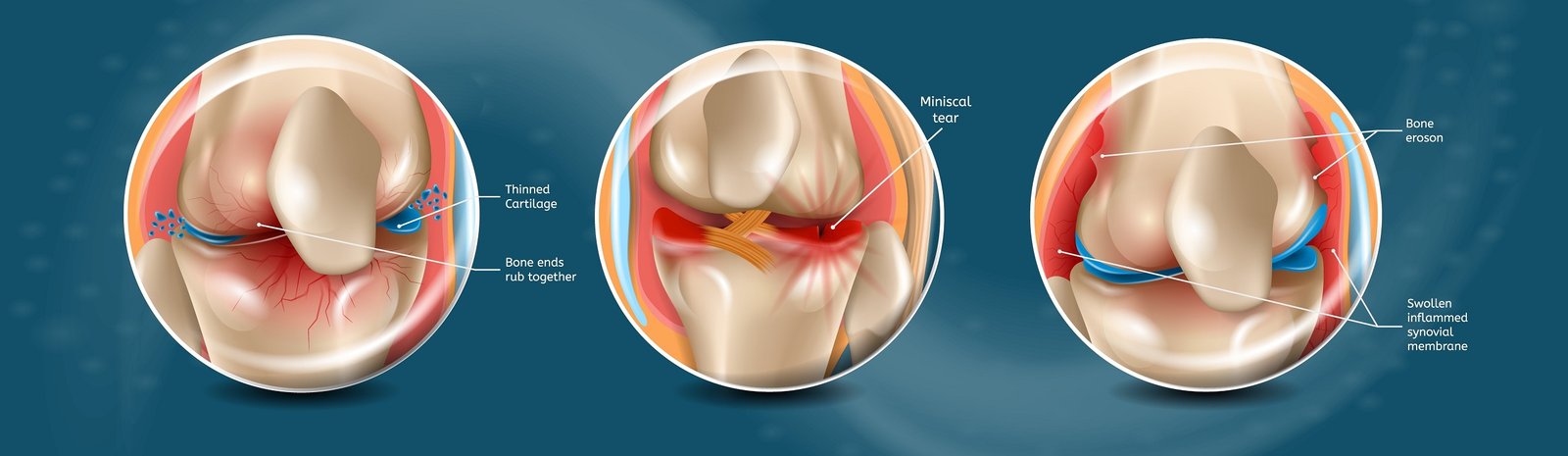
Causes of knee pain include arthritis, strained ligaments, tendonitis, and muscular tightness. You could have any of these that are more noticeable through riding but riding itself doesn’t cause knee pain.
Arthritis
There are 3 types of Arthritis:
Osteoarthritis
This is the most common of the types. Osteoarthritis wears down the cartilage which is the cushioning between the bones in your knee joint. Without the cartilage, the bones rub together which causes pain, stiffness and restricts movement.
Post-Traumatic Arthritis
Following a trauma like a break or an impact. The cartilage starts to thin and the bones rub together and cause the same symptoms as Osteoarthritis. It may be years after the trauma before you notice.
Rheumatoid Arthritis
This is an autoimmune disease where your unhealthy immune system triggers inflammation in your joints even though there is no need for the body to do so. It believes there is an infection, an injury or a foreign invader when there is not.
When you believe you have arthritis you will visit the doctor who will check if the joint is swollen/inflamed, the range of movement and ask a number of questions. The one key point to remember is.
To diagnose arthritis of the knee officially, you will need an X-Ray and/or MRI.
You cannot diagnose without. It is an assumption.
Meniscus Tear
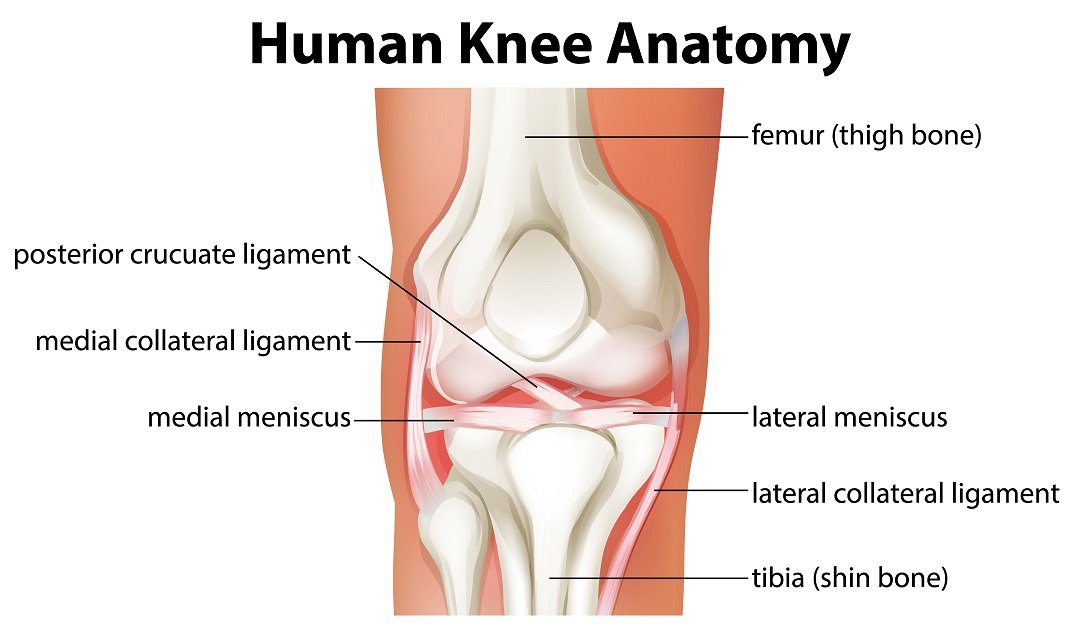
The meniscus is a piece of connective tissue that sits below the thigh bone (femur) in the knee joint. It acts as a shock absorber and enhances the stability of the joint. They are often caused by sharp sudden changes in direction such as in football or running. The cartlidge also thins as we age.
In a meniscus tear, you will often experience intermittent knee pain which can be sharp. This is because when you bend and straighten the leg the flap of the tear can get caught on the knee bone. Sometimes it will stay caught for a period of time which causes constant pain until the flap returns. Other times the flap just ‘flicks’ as the knee bends and straightens which causes the sharp shooting pain. Not always, but you may also experience swelling.
There are a number of movement tests that can be performed to assess if you have a meniscus tear although these are not reliable as the tests may not move the flap at that given time. Similar to arthritis. The only way to know for sure is to have an X-ray or MRI
Ligament Sprain
Similar to a meniscus tear, you can strain your knee ligaments by sudden changes in directions, twisting of the knee, or over-reaching. A sprain may also be caused by impact.
There are 4 ligaments within the knee joint.
Posterior cruciate Ligament (PCL) - Controls backward movement of the shin bone
Anterior Cruciate Ligament (ACL) - Controls rotation and forward movement of the shin bone
Medial Collateral Ligament (MCL) - Provides stability to the inner knee
Lateral Collateral Ligament (LCL) - Provides stability to the outer knee
Tendonitis
When a tendon becomes inflamed it causes swelling, pain, and discomfort. There are many causes of tendonitis such as strain, overuse, injury, or too much exercise. To determine if you have tendonitis a doctor will take a small amount of fluid from the joint to test. Tendonitis can occur anywhere in the body but for the knee to be affected it is normally associated with those that run or cycle long distances and those that play jumping sports such as basketball where the force of hitting the grounds strains the tendon.
Muscular Tightness
The quadriceps tendon (front of thigh) sits over your kneecap and your hamstring (back of thigh) attaches to the back of the knee
When these muscles, either individually or separately, become tight. The muscle shortens pulling the tendon taut across the joint which applies pressure to the knee area. This pressure can make it feel like the issue is within the knee itself. Inflammation doesn’t usually occur from muscular tightness but it is possible. Especially if you have tight muscles and riding is aggravating those tight muscles.
Tightness in the quadriceps and hamstrings can occur in many ways. Such as being inactive, sitting for long periods of time. Repetitive exercises which target these areas but are never stretched/massaged.
Muscular tightness can be assessed formally by Soft Tissue Therapist.
How Do you Find out Why You Have Knee Pain?
As you can see from the possible causes above the knee pain symptoms you may be experiencing are all similar. If you are concerned that it is possibly anything other than muscular tightness then go to your doctor and ask for an X-ray or MRI. There are other methods but these are the most common. Such tests are the only way you will know for sure.
Assuming that the doctor has cleared you, muscular tightness may be the cause of your knee pain. A Sports or Soft Tissue therapist can identify which muscles may be causing you the issues.
Alleviating Knee Pain
In case you have tendonitis then you will need to reduce activities and reduce the inflammation by applying an ice compression. If it doesn’t improve your doctor may discuss steroid injections or surgery. Because of its nature, you will need to be guided by your doctor and work with them until the issue is resolved. Be strong and if you are not getting answers. Ask them to refer you to a specialist.
If the cause of your knee pain is arthritis or muscular tightness the best way to manage pain is to actually lengthen the muscles surrounding the knee joint through stretching and massage and improve the strength in your legs. The more you move, the better it will become. Having regular Sports massage or Soft Tissue therapy (not holistic massage) will also improve the tightness in the muscles as well as aid recovery in the muscle fibers.
You can of course take pain relievers and anti-inflammatories but on the understanding that this will simply mask the problems. It will not solve them.
Will Riding Make my Knee Pain Worse?
As mentioned above. Riding doesn’t cause knee pain but it will highlight that there is an underlying issue. Without knowing what that underlying issue is and then dealing with it then yes. Riding will make the knee pain worse.
The truth is many riders don’t know the real reason for their knee pain. It has not formally been diagnosed, rather just ‘labeled’. When you have tight leg muscles and/or arthritis of the knee then not exercising and having regular sports massage only makes it worse over time. Riding will become more and more uncomfortable.
Read our next article to learn how to Prevent Knee Pain when Riding
An equestrian workout is exercise aimed to specifically improve your riding. Using a range of variety to help ‘condition’ the rider’s body for the sport.
An equestrian workout is different from general fitness. Being fit generally means having the ability to perform everyday tasks with ease.
Whilst any form of fitness is beneficial, there is a difference between being fit and fit to ride. For you to become a conditioned rider you must train the muscles riders use, in the variety of ways the muscles operate when in the saddle.
What is an Equestrian Workout - And Why It Matters
Sports like horse riding, at any level and in any discipline, require the rider to have the appropriate strength, mobility, and awareness to meet the demands of the sport.
An equestrian workout is designed specifically to prepare your body for those demands — not just to improve general fitness, but to improve how your body actually functions in the saddle.
Because there is more to riding than simply not being out of breath.
Riding requires coordination, balance, control, and the ability to move your limbs independently while maintaining stability. This is what allows you to communicate clearly and effectively with your horse.
Unfortunately, activities like running, cycling, or yoga — while beneficial for general fitness — do not provide the full stimulus needed to support riding. They don’t train the specific movement patterns, control, or muscle coordination that an equestrian workout develops.
What Does an Equestrian Workout Actually Do?
An equestrian workout focuses on conditioning the muscles and systems your body relies on when you ride.
This includes developing:
Muscular strength
Cardiovascular fitness
Mobility
Coordination and reaction
Muscle recruitment (how muscles work together)
This is what rider conditioning really is — using targeted exercise to improve how your body performs in the saddle, not just how it looks or feels off it.
Why Riders Need Equestrian Workouts Specifically
Whether you are a leisure rider or a competitor, following a structured equestrian workout approach is important — not just for you, but for your horse.
Horse riding requires multiple muscle groups to work together to keep you balanced, stable, and aligned without collapsing or relying on the horse for support.
Without this, riders often compensate by:
Pulling on the reins
Gripping with the knees or thighs
Collapsing during transitions
Losing balance in the saddle
These are not conscious choices — they are physical responses to a body that isn’t fully prepared for the demands of riding.
If your body hasn’t been conditioned correctly, it can also lead to:
Slower progress in your riding
Increased fatigue
Aches and pains after riding
An effective equestrian workout helps prevent this by preparing your body to meet those demands properly.
How Your Body Affects Your Horse
When you are not in control of your body, it directly impacts your horse.
It can lead to:
One-sidedness
Uneven muscle development
Tension or soreness
If you collapse during a transition, your body will instinctively try to stabilise itself. Most riders do this by gripping or using the reins.
This is a natural reaction — but it is not an effective one.
To stabilise correctly, your body needs coordinated activation from multiple muscles, including:
Glute medius
Transversus abdominis
Multifidus
Obliques
Diaphragm
Erector spinae
This level of control doesn’t happen automatically. It requires targeted training — which is exactly what an equestrian workout develops.
Why General Fitness Isn’t Enough
One of the biggest misconceptions is that general fitness translates directly to riding.
It doesn’t.
Running improves cardio but not rider-specific strength
Yoga improves mobility but not control or stability under load
Cycling builds strength but limits mobility and coordination
Each form of exercise has benefits — but none of them fully prepare your body for riding on their own.
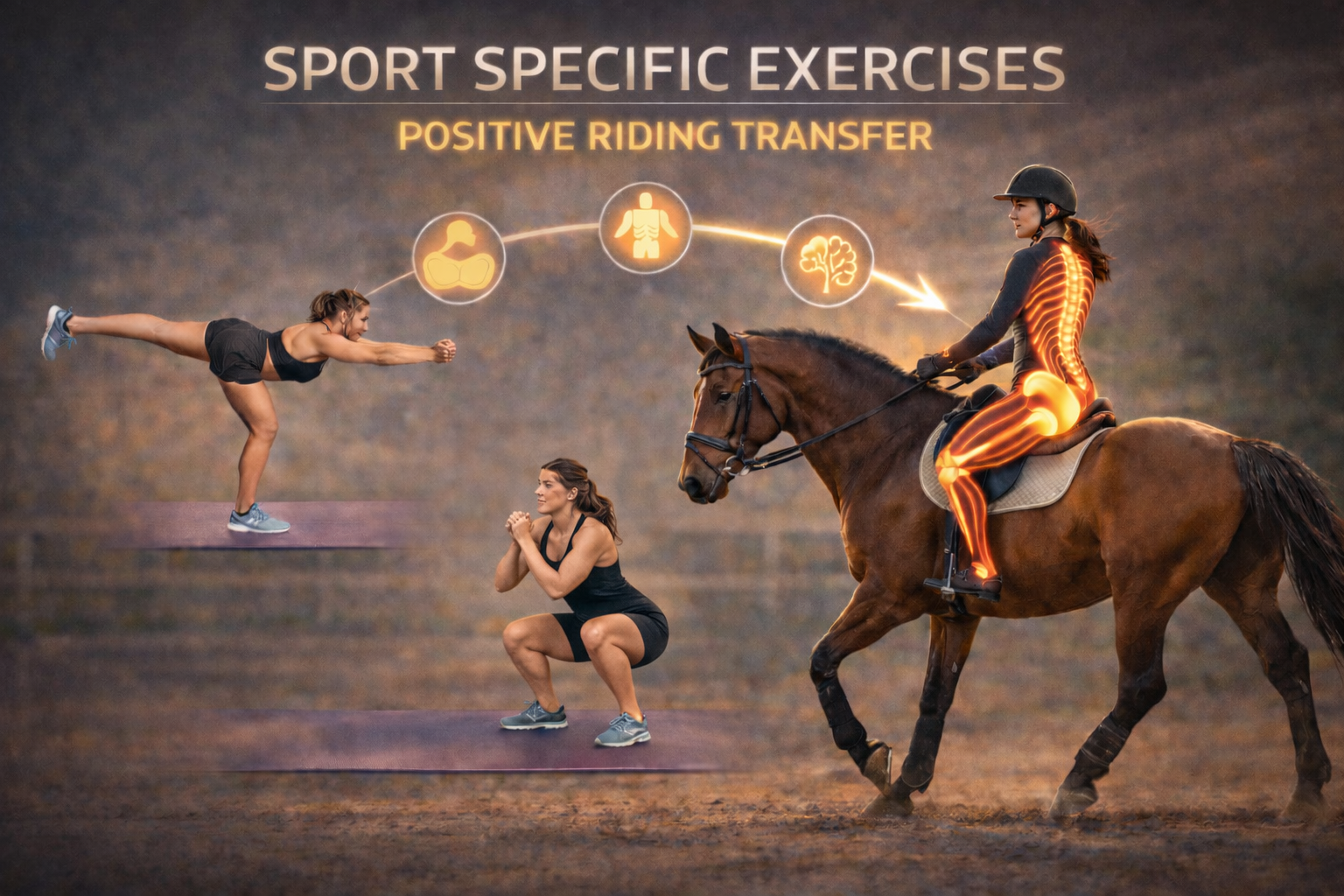
An equestrian workout bridges that gap by combining all the elements you need in a way that directly transfers to the saddle.
How to Build an Effective Equestrian Workout Routine
To become properly conditioned for riding, your training needs to develop:
Strength to maintain posture
Coordination so muscles work together
Cardio fitness to sustain performance
Mobility for independent movement
You can achieve this by combining different types of exercise — for example:
Strength training + mobility work
Cardio + coordination-based training
But the key is not just doing more — it’s doing the right type of work.
That’s what makes an equestrian workout different.
It is structured, specific, and designed to improve how your body performs when you ride.
The Bottom Line
Riding well places a significant demand on your body.
If your body isn’t prepared for that demand, it will compensate — and those compensations are what show up in your riding.
An equestrian workout doesn’t just make you fitter.
It improves your control, your balance, your communication, and ultimately, your partnership with your horse.
Because better riding isn’t just about what you do in the saddle.
It’s about what your body is capable of producing when you’re in it.
Start Understanding Your Body First
If you want to improve your riding, the first step isn’t doing more — it’s understanding what your body is currently doing and why.
✔ What I look for when assessing riders ✔ How your movement patterns affect your riding ✔ Why your body responds the way it does in the saddle
Ready for a Structured Equestrian Workout?
If you’re ready to go beyond awareness and start improving how your body actually performs in the saddle, my rider-specific programs are designed to give you that structure.
These are not generic workouts. They are targeted equestrian workouts built to improve:
✔ Strength ✔ Stability ✔ Coordination ✔ Balance ✔ Control
Clare Gangadeen is the founder of horse rider fitness business RiderCise®. In this blog, she takes us all the way back to 2012 when a nasty fall changed her life forever.
I have loved horses and riding since I was a little girl, so it was a dream come true when I finally bought the horse of my dreams in 2012. Annick is a beautiful Friesian mare with huge expressive paces and the most incredible nature. I was so excited about our future partnership. As a fit and experienced rider, I didn’t foresee what was going to happen next.
A scary fall that lead to some reflection…
Annick became scared of a flapping label on a back protector I was trying. I had left the label on to return it, should the protector catch on the cantle of my saddle. Being only a green 5-year-old, she took off around the school with such power and speed. I lost my balance due to her sheer power, scaring her even more and causing her to go faster. My saddle slipped which caused her to start bucking, and I hit the ground with enormous force. As she travelled past me, she kicked me with her hind on the peak of my hat. She only missed my face by centimetres.
Winded from the impact of hitting the floor, I got to my hands and knees and tried to breathe. I looked at Annick who was standing by the gate looking back at me which fear, concern and confusion.
Annick wasn’t at fault, I knew that I was responsible for not being in better control of my body. Had I been better balanced and stable, I could have reacted better to her spooking at the label. That means I wouldn’t have contributed to her fear, which provoked her more.
As a fitness specialist, I’ve spent years working on myself to ensure I was strong, lean and had an aesthetic look to my body. However, I wasn’t conditioning myself with riding in mind. I wasn’t holding up to my side of the partnership.
The fall not only shattered my confidence but lead me to question my abilities as a rider. I clearly was not as rider fit as I thought I was.
Could being ‘rider fit’ have helped?
The muscles we use for riding are different from those used in other popular fitness activities and sports. Of course. It’s far better to be a rider who goes for the occasional jog or spin class than do nothing at all. But being rider fit requires strength, balance and mobility to independently move your body in the way the riding requires. No single form of exercise offers that.
Riding, at any level and in any discipline is demanding. It requires the individual to be sensitive, yet reactive to an independent dynamic animal. No other sport requires that. When we ride we need to be in control of our bodies. To communicate effectively yet gently. To react to response, immediately. And to act as a partner, not a hindrance.
Not only does rider fitness improve your riding ability and performance. It also helps protect the rider against the severity of injuries that can occur, if the horse suddenly spooks, stops, spins or bolts!
“I know that the one thing my unfocused training had provided was. It prepared my muscles, ligaments and joints to deal with external stress. Other than suffering concussion for 10+days I didn’t have any sprains, bruising or bone breaks.“
A rare combination of riding and fitness expertise
As a personal trainer and soft tissue therapist with over 15 years of experience in the fitness industry. It was only natural that my thoughts turned to rider fitness. I know the benefits of being fit. But I also know first-hand the difference of being ‘Rider Fit’.
I founded RiderCise®to help riders become the rider they want to be. Like I wanted to be that moment I saw Annick staring back at me from the gate. I’ve tapped into everything I know from my background in the fitness industry with expertise from my riding journey. And that of the coaches and instructors I’ve worked with and learned from.
“I truly believe that you need the rare combination of true fitness expertise and an understanding of the role of the rider to create targeted rider fitness workouts. And that’s where I come in!“
How RiderCise has Changed My Life
I am not an elite rider. I am not a professional rider. But I do consider myself to be on a journey to becoming the rider I want to be. Through rider fitness, I have learned to control my body to allow me to feel. I feel when my horse needs more or less from me. I know when I need to allow them to find their way. And when I need to guide them. I am able to ride independently with softness and balance. So that they may find theirs.
This is not something that has happened overnight but something I have worked on every since founding RiderCise. By working the muscles that I use in the saddle, on the ground. I have developed the strength I need to control my body. The awareness of how I am riding to correct myself. I have become a better rider.
I have developed rider skills. Skills that I want to pass on to every rider, across the world. No matter where you are on your journey. You can improve with the RiderCise workouts.
Rider Fitness Workouts – On Demand
Every Rider Fitness Workout I design has the objective of helping a rider improve their riding. For them and their horses to be able to enjoy riding with ease. Reduce riding aches and pains. And boost performance.
As a rider and owner I know how much time horses take up. But I also know how important rider fitness is, to all riders. Horse owners are some of the busiest people around. They’re often juggling jobs, families and an all-consuming passion with the occasional snippet of downtime! I get that.
RiderCise On Demand allows riders to follow along with me. In the comfort of their home. On any device with an internet connection. Anywhere in the world. This makes rider fitness truly accessible for everyone.
My aim is for riders to take as good care of themselves as they do their horse. RiderCise® changed my life forever. Will you rise to the challenge and allow RiderCise® to change your life?
I would love to hear your views so do not hesitate to contact us. Subscribe to our newsletter to keep up to date with the latest. And don’t forget to content follow our Social profiles on Facebook, and Instagram.
Working out how many calories you need is fairly straightforward. There are many calculators available online that will help you do this quickly and easily.
It’s important to point out first that in order to succeed at changing your calories to meet a goal you have to understand exactly where you are currently. The reason being is if you are consuming way more calories than you should be then cutting them drastically suddenly means you could be setting yourself up for failure.
I only recommend cutting calories drastically and suddenly when you have the professional guidance and support of a coach who knows what they are doing. Not only to make sure that the new calorie/macro amounts are sufficient for you. But many underestimate the emotional and mental effect cutting calories can have.
Calorie Baseline
To set yourself up for success it is important to acknowledge and accept:
You are making a lifestyle change, not dieting
In order to make a lifestyle change, you need to learn the values of food
You have to understand what you are currently consuming
Changes should be made gradually so it’s achievable
If you can accept the above then you are well on your way to losing fat, forever! If you don’t yet know what you are consuming each day then I highly recommend you start here:
Once you have a good understanding of what you are consuming, it should paint a clearer picture of where you may be going wrong. Now let’s look at how you go about adjusting your input (food) to smash your fat loss goals.
What is BMR
BMR = Basal metabolic rate: is the total number of calories that your body needs to perform basic, life-sustaining functions. These functions include breathing, circulation, cell production, nutrient processing, protein synthesis, and ion transport. All that before you have even gotten out of bed, let alone fed the horses!
To find out your BMR you calculate your height, weight, age, and gender. It does not take into account lean body mass and the amount of fat vs muscle you have so using this method will be very accurate if you don’t have lots of fat or muscle. If you do, it is a good starting point if you just want a rough idea.
Men: 10 x weight (kg) + 6.25 x height (cm) – 5 x age (y) + 5
Women: 10 x weight (kg) + 6.25 x height (cm) – 5 x age (y) – 161
So, let’s take me as an example:
I weigh 68kg, 161cm tall and 37years
680 (10 x 68kg) + 1006.25 (6.25 x 161cm) – 185 (5 x 37) – 161 = 1340.25 BMR
You can use this calculator to figure your BMR if you would prefer – it is much easier.
Once you have your BMR number, let’s move on to the next number you need.
What is TDEE
TDEE = Total Daily Energy Expenditure: is an estimation of the total number of calories you burn per day on top of your BMR through activities and exercise. It also includes energy spent on digesting foods known as TEF and general movements known as NEAT.
I would say at this point, understand it but don’t get too caught up in it. Keep it simple for now.
There are a few ways to calculate your TDEE but I am going to keep it simple:
Status
Description
TDEE Number
Sedentary
Not riding and a desk job
1.2 x BMR
Lightly active
Riding 1 – 3 days per week
1.375 x BMR
Moderately active
Riding 1-2 horses, 3 – 4 days per week
1.55 x BMR
Very active
Riding Several Horses per day, 5 – 6 days/ week – Actively Competing Regularly / Exercising
1.725 x BMR
Extremely active
Riding Several Horses per day, 5+ days per week – Actively Competing Regularly / Exercising /Active Job
1.9 x BMR
KEY INFORMATION – We all tend to think we do more than we do! Be conservative with your TDEE for true success.
The Magic Calorie Number
Now that you have your BMR and your TDEE you can calculate how many calories a day you need to lose body fat. To lose body fat, you must consume less than you expend.
Calories needed per day for maintenance: BMR x TDEE
Using me as an example again:
I go to the gym 6 days a week for a minimum of 2 hours and I ride two horses 4-6 times a week for about 45mins each in addition to working as a Personal Trainer and Soft Tissue Therapist, I can spend lots of time on my feet so I would be extremely active.
My TDEE Calculation is: 1340.25 BMR x 1.9 = 2546 calories per day
Start with taking 200 calories from your TDEE per day.
If you want to be more aggressive then take 500 calories
Remember: If you cut calories drastically and suddenly it is less sustainable. Your mental willpower will give before your body does. I STRONGLY urge you to go for a lower number, making it more achievable.
I always prefer to underestimate that be generous when calculating this. Going forwards and increasing calories is much easier than going backward and decreasing them!
Calories needed per day for fat loss: BMX x TDEE – 200 calories = The Magic Calorie Number
Using me as an example again:
TDEE Calculation is: 1340.25 BMR x 1.9 = 2546 calories per day
How do I split the calories between the macros
If you remember my post about Body Types, it provides you with a macro ideal based on your body type.
But as I have said in my blog – The Truth about Dieting the majority of people will respond to a balanced diet of all macros
Ectomorphs: A ratio of roughly 50% of calories should be from good carbs (not sugars) and 25% from both protein and fats.
Endomorphs: A rough ratio of 30% of calories should be from carbs and 35% for both protein and fat.
Mesomorph: An equal ratio of 1/3 Protein, Carbs, and Fat but this needs to be adjusted depending on you feel and look over a period of time – 1-2months
Get in Touch
I would love to hear your views so do not hesitate to contact us, subscribe to our newsletter for free, or click here to get in contact for any questions or queries you may have. Keep up to date with the latest content by following our Social profiles on Facebook, and Instagram.
Following on from my Blog – ‘The reality of owning horses and keeping them sound’, I wanted to share Annick’s story with you. As mentioned in the blog before, sometimes we play a part in their unsoundness, and sometimes things just happen. I think as owners we forget this, a lot. That they are living beings and like us sometimes they just overdo it, sleep or move the wrong way. Then all of a sudden, they’re just not right! And Annick did just that, she was having fun being a horse!
In June 2020, whilst enjoying the sun in the garden. Adam and I heard the horses galloping around in the fields. We checked the cameras to see what they were up to behind the stables. When we had looked at the footage we saw that Annick completely stacked it.
As you can see from the video below, she bucked but missed the floor with her legs on landing. Resulting in her landing on her side, hard! She got up and carried on and I didn’t think much of it, at the time.
I Could Sense Something Wasn’t Right
We had just finished the major works at home which took up most of my time project managing. Therefore, Annick was only just coming back into work which meant not much was being asked of her. The majority of her work was in a walk. It wasn’t until I started trotting that I felt something wasn’t right.
She doesn’t appear hopping lame and although I had many people out to see her. In a similar way like Rana, they couldn’t see it but I certainly felt it. Many had the opinion that I needed to push her forward. Make her work more through her body and get her to engage. However I was not prepared to ask or push her, I know my horse and I felt something was wrong.
She naturally has a lot of movement through her lumber which results in her plaiting (think of the hind walking on a tight rope) which is what contributes to the majority of the power in her hind and her large over track. She is extremely powerful and challenging to ride because of her movement. So when I felt the lack of swing, the occasional drop in the hind and non-existent power. That is when I knew there was something going on. But without any of the professionals I have engaged with knowing, I was at a loss.
The Animal Communicator, Joanna
Annick was in light work as I wasn’t sure what to do and It got to the point where I lost faith in professionals so I contacted an Animal Communicator – Joanna at the Wild Thread. To be honest, it’s not something I believed in but I was desperate and willing to try anything. I was taken back completely by what Joanna told me about Annick. Especially given that I only provided a few old photos, her name, age and what I wanted to know. It made me quite emotional to hear what Joanna had to say. Aso no one but I would have known all the things she said.
One of the questions I asked Joanna was ‘Was she in pain somewhere as when I ask her to go forward the hollows, throws her head a bit and sometimes keeps looking at my leftleg’.
Joanna told me that Annick was saying that it is uncomfortable in her left lumber area and she cannot lift her back and use her diaphragm to bring her leg underneath her, but she’s trying.
After my call with Joanna I made some calls and contacted an Osteopath I used many years ago for Annick when I lived back South. I needed someone I trusted and I hadn’t had much luck finding anyone yet. Plus I wasn’t prepared to trial and error anymore. I spoke with Stuart McGreggor who kindly put me in contact with Nick White who covered Shropshire. Nick first came in November 2020. He listened, assessed, provided treatment and we agreed I would continue to work Annick. The main focus on allowing her to find her own balance and giving her the support through my legs when needed. In order to see how she got on during the period till her next treatment.
Refitting Annick’s Saddle
As Annick was in light work but still not right her Comfort Elite Flocked saddle slipped slightly and her saddle cloth slipped completely and I know the saddle fitted but because of her imbalances she was causing the saddle to slip. It is important to note here that horses and riders imbalances can cause a well-fitting saddle to move. Its easy to blame the saddle/saddler but you have to look at the bigger picture. A saddle is a static object on a living being which moves and fit has to take that into account. A horse and rider can affect the fit just as much as the fit can affect the horse.
So in December, Dean and Gini from the Saddle Exchange came to check the girls saddles and re-fit my Reactor Panel Saddle to Annick. Anyone that has read my story about the Reactor Panel will know how much I not only highly recommend these guys but my opinions on the Reactor which change our lives way back in 2013 and the reason that I needed the Reactor fitted to Annick is because the Reactor is much more stable on a horse due to the flexi panels covering a greater range of area and it provides much less pressure under the load bearing surface of the saddle area across the horses back meaning that Annick would be able to move without the hinderance of a slipping saddle caused by her.
Having told Gini of my challenges with Annick, she called Felicity Wilson whilst at my yard and together they performed Flow on Annick and Felicity pinpointed the left Psoas muscle causing restriction and discomfort! Felicity asked if Annick was ‘Banana-ing’ to the left and she was! It explained exactly how she felt when she moved and what Felicity found tied in with Joanna had said Annick had told her. I was finally getting some answers to complete the puzzle!
And Then There Was Lockdown
Lockdown was announced and the planned visit from Felicity, plus the follow-up from Nick had to be put on hold. I left Annick really, just ticked her over every now and then as I wasn’t comfortable moving forward without having her treated in-between.
Over Christmas I started to think about it more in depth about the missing pieces of the puzzle. I noticed that Annick had a slight dip behind her last rib on her left side. Initially what I thought to be a sub laxed rib. When Nick came back in March 2021, I pointed this out the dip and he agreed, it could indeed be a sub laxed rib but without doing an Xray, there was no way to tell but he did some work on the diaphragm with the aim of helping Annick to release the rib herself and we agreed to follow up in 1 month.
On The Path to Improved Recovery
Since March Annick has continued to make improvements and in my opinion is 75% better than she was. Now it is about rebuilding the strength through her back and hind, helping her to use her body correctly and I will continue working with ‘Team Annick’ until we get her where she should be. This will take time. Whilst in a year she has come far, I don’t envisage her returning to full strength. At least for a minimum of another 6 months. Though the bigger picture is Annick being sound, strong and happy in her work
As a rider I play a very important part in her rehab. And again, I think this is something that many don’t realise. When bringing a horse back into work or developing a young or green horse we as riders MUST help our horses. They have enough to deal with without us adding to them by not being in control of our bodies. Collapsing or shifting our weight excessively in the saddle with changes of speed and/or direction. We need to be able to offer support and take it away without changing our posture or using our hands.
During her road to recovery it is essential that when I ride that I am helping her, not contributing to her challenges. No matter what she does. Whether it be lose her balance, change speed, throw her head up, drop her shoulder or lack energy. I MUST remain balanced, stable and offer her the support of my leg when needed and take it away when she doesn’t.
Help Your Horse by Being in Control
I come across so many riders who don’t believe that they need to improve their rider fitness because they are active around the yard and/or because they just hack a few times a wee. But you see, Rider Fitness is more than not feeling out of breath its about being in control of yourself to help your horse. If you are not in control of your body, you are a passenger, not a rider no matter what level or discipline you ride.
So this is Annick’s road to recovery so far. We have a way to go but believe we are on the right path. I wanted to share this with you all to just show that sometimes horses will be horses and like any living being, things can just happen. Her road to recovery isn’t a straight forward one but it is achievable, as long as we work together as a team, myself, Annick, Nick and Dean & Gini.
I hope reading this has helped you in some way to understand:
Lameness, unsoundness, challenges happen. Sometimes we contribute (see my blog about Rana) sometimes its just when horses are just being horses
Find a team you trust and respect and work together (think outside the box if you need to)
Understand that Rider Fitness is ultimately about helping your horse
See the bigger picture, there isn’t always a simple answer
You know your horse, trust your instinct and keep searching for answers
Get in Touch
I would love to hear your views so do not hesitate to contact us! Subscribe to our newsletter for free or click here to get in contact for any questions or queries you may have. Keep up to date with the latest content by following our Social profiles on Facebook, and Instagram.