We love delving into the daily routines of the people who are building amazing brands in the equestrian community. Juggling horses, riding and running a business is no small achievement. But what about 4 horses AND staying in enviable shape whilst helping other riders improve their fitness?! Clare Gangadeen, founder of RiderCise, takes us through how she squeezes it all into a day and gives us some insight into her current rider fitness challenges. Let’s go behind the brand at RiderCise!
Waiting hand and foot on four Friesian mares
Like all horse owners, my life revolves around horses – oh, and 3 cats and my partner Adam! I am fortunate that I now have the horses at home, which saves me so much time previously spend travelling to and from the yard. However there is one tiny downside – the girls have worked out exactly WHERE I LIVE! If you have seen my Facebook videos you would have seen naughty Imke escaping and coming to the house! The result is that they are now waited on hand and hoof – there are downfalls to everything! But I really do love having them at home. It means I get to see the babies growing up and spend time with them without always wanting something but I now visit them at least 5 times per day!
I have 4 beautiful Friesian girls:
Annick – a 2nd Premie Star Mare who is 12 years old and my Queen, my inspiration, the face of my Brand.
Rana – a 3rd Premie Mare who is also 12 years old and my first Friesian who started this addiction I now seem to have.
Zeva – a 2-year-old filly who is just massive but the gentlest girl. She loves attention, treats and galloping.
Imke – a 2nd Premie Filly, 2 years old who is probably the sweetest and cleverest horse I have met. She is an escape artist extraordinaire! Just head over to the RiderCise® Facebook page to see ALL her videos.
Clare and her beloved Annick
An early start to a busy day
I typically get up at about 6:30am, feed the cats and then go feed the girls, turn out, muck out and fix whatever Imke has destroyed. It takes me about 1.5hrs to do four boxes and prep them for the evening. I then head back in to do my cardio. I normally do between 30-60mins on the cross trainer whilst making calls, responding to emails and going through my diary.
At the moment I am busy recording for the new RiderCise® On Demand Platform. That means that after my cardio, I’ll have a shower and then record 1 or 2 routines before a late breakfast at about 11am. I then head out to ride the two older horses. I try to alternate between Annick and Rana but of course, they are horses so that doesn’t always go to plan and they sometimes get left longer between rides depending on how they felt when previously ridden.
Both Annick and Rana are slowly improving their fitness as I don’t typically ride much through the summer. They just don’t cope well with the heat and, as always, there are ongoing challenges with horses. They are individuals, nothing is plain sailing and there are often more downs than ups!
Behind the scenes of RiderCise®
At about 2pm I normally have some lunch and then sit down. I start looking through my client’s updates on the RiderCise® current platform, responding to questions and queries. I then typically start editing videos (which takes forever!) until about 5pm. Despite the girls having access to grass there isn’t anything in it at this time of year. That means they are often bored and want to come in, so off I trot to the yard to bring them in and feed.
After feeding I head back to my office and continue editing videos. Then I do the majority of my client calls who are on Custom Designed Programmes. I often finish at about 8:30pm, sometimes later if I have a webinar or am speaking to clients in another time zone. Then, I start making my dinner and usually have a glass of wine. I do love wine and it helps me shut my mind down, especially when working so late. Just before I eat, I go check the girls. I top up their hay and give them their sweets for the night.
Fitness to ride supporting her horses
Rana has slipping stifles, something she has always suffered from and she needs to work a lot more through her body. She has a tendency to drag herself rather than push herself and she doesn’t have much focus. She would much rather be watching what everyone else is doing instead of her feet, which doesn’t help her stifles. With her, I work on forwardness mainly, long and loose, she must find her balance and learn to use her body properly. We do lots of transitions, serpentines, zig-zags to keep her focused. I also pay particular attention to my body posture, balance and control so she doesn’t have to worry about dealing with me as well as herself.
Annick hasn’t been right for a while. She was caught on our CCTV playing in the field, bucking and landing upside down on the floor! She needs to lengthen and strengthen her muscles (as with most of us riders) so, whilst I need to work her, she often needs bigger recovery gaps. It will often feel like she is going 4 steps backwards and then has a really great session. Annick also has to work more proactively from her hind and find her own balance. She also needs more support from me, to help pace her (she will rush if allowed) through my tempo and encouragement to go forward with impulsion with my energy and seat.
A total body approach to fitness
I keep a total body approach with my own fitness, but at the moment I am personally focusing on the control of my body for both horses. It’s important that I’m in control of what my body is doing. It enables me to stay as light as possible in my seat, not leaning or collapsing through transitions whilst still having the strength to create impulsion to drive them forwards. For Annick, I need the strength in my legs to wrap around her and support her when needed and release when she has rebalanced. I also need the strength in my posterior chain to control the pace of her trot through the tempo of my posting.
I’m constantly looking at ways I can improve myself for the benefit of my girls. Small changes in the way I ride can have huge positive impacts on their ability to move beneath me. Focusing on rider fitness truly has changed my life!
Learn more about RiderCise®
Clare’s message that rider fitness is just as important as horse fitness has truly resonated with riders around the world. Rider fitness is not just for elites, it’s for anyone who cares about their horse! Riding is a partnership and we have to hold up to our side of the bargain.
Keep an eye out for the launch of the RiderCise® on Demand programme when it launches later this month take a closer look here.
Get in Touch
I would love to hear your views so do not hesitate to contact us, subscribe to our newsletter for free, or click here to get in contact for any questions or queries you may have. Keep up to date with the latest content by following our Social profiles on Facebook, and Instagram.
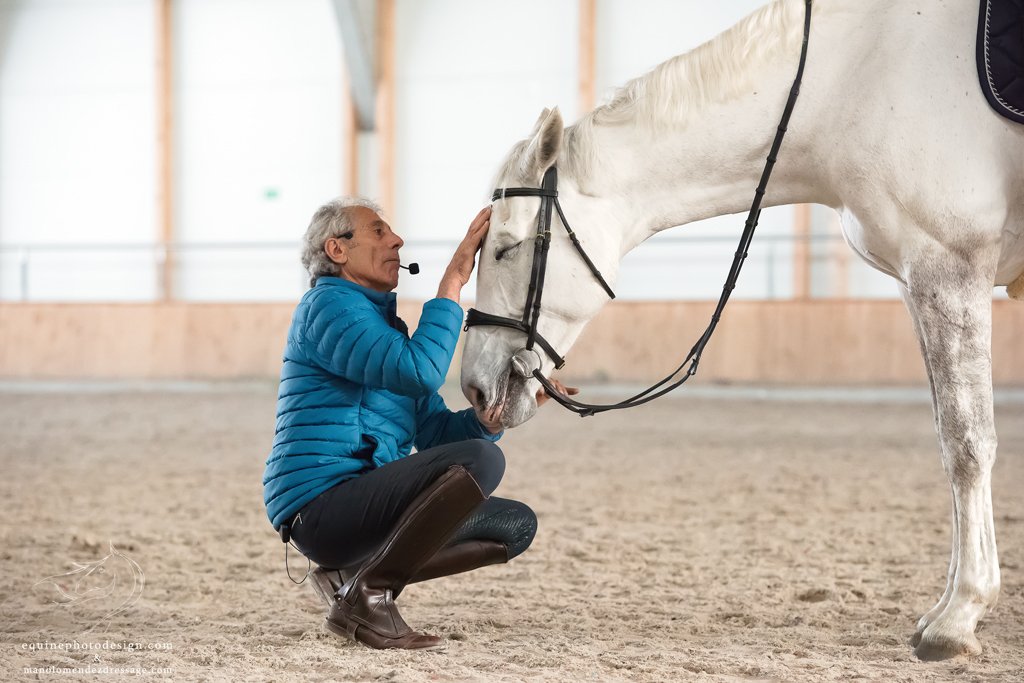
I attended a clinic with Manolo Mendez in Poland on 26th – 28th April 2019. It was truly enlightening and awakening to see a person have such a connection, with not just a one-horse, but all of the horses he met.
I believe that learning never stops and will always seek the opportunity to further increase my knowledge and experience. Whether it be riding, fitness, horse training, anatomy, physiology, or therapy.
The more I know, the more I can help riders help themselves, to help their horses.
Background
Manolo is a seasoned horseman; he likes to say he has over sixty years of experience living, breathing, working with and training horses. He started his professional career at the young age of 14, training the Alvaro Domecq’s personal horses, to later become one of the six founding members of the Royal Andalusian School of Equestrian Art. Manolo is well known for Classical Dressage training. With specialist skills in training the Piaffe, Passage, and Pirouette, known as the 3 P’s without coercion or force.
Manolo uses a holistic approach to training, looking at the horse as a whole to sympathetically train, develop and rehabilitate. An approach that is sought after by many professionals and individuals across the world. It helps with straightening, releasing tight, stiff, and crooked horses. And to assist in the development of correct posture, movement, and gait enhancement.
For the 3 days, I sat in an indoor arena for about 10 hours a day. In so many layers of clothes to keep warm in the cold and damp weather that Poland greeted me with. Despite being so so cold I was fascinated, mesmerized, and moved by Manolo’s ability. How he saw, felt and understood so much from a horse in such a brief encounter. I was not able to leave, despite how cold I was. It was truly enlightening and awakening to see a person have such a connection, with all of the horses he met.
There were a total of 8 riders who each had a session a day with Manolo. This allowed you to see the progress over the 3 days of the clinic. Whilst many of the sessions started mounted, but if Manolo saw that the horse was stiff, tight, anxious, nervous or just unsettled. He would then ask the rider to dismount, and un-tack horse to then work with him from the ground.
There were times when Manolo would just walk to the horse and touch a specific area. The horse would immediately react as if Manolo heard the horse tell him exactly where there was an issue. It was truly emotional to see as you saw Manolo change, as he felt the pain himself, sharing it with the horse.
The sessions lasted as long as they needed to in order for the horse to feel comfortable and confident in their environment. With whatever task was being asked of them. For some this simply meant walking around, a little lunge work, some in-hand, and bodywork from Manolo. There was never any rush. Pushing, forcing, or frustration from Manolo. If the horse ‘expressed’ themselves Manolo was listening and would say ‘ok’ and go with whatever the horse needed.
When allowed a voice, many of the horses had much to say. Expressed through their body language, head tossing, and resistance to settle due to nerves, anxiety, or tension. Or perhaps they were already saying it but there wasn’t anyone listening or they didn’t understand what was being said?
I think it is easier to think that horses are resistant, lazy, and naughty rather than that they are trying to communicate with you.
Manolo loves to give you analogies and detailed descriptions to help you understand to educate and increase your understanding. To show you that it’s not complicated; it’s simple when you look and listen. I love this. I will never be Manolo but if I am prepared to look, listen and feel then I can learn how to be better for my horses.
Whilst the sessions were perhaps not what the rider originally hoped for it was clear that Manolo’s approach of watching, listening, and going back to simple basics paid dividends. Come to the next session you could see the horse had changed. They were freer, more content, and soft in the eye. More willing to listen and work alongside Manolo and their owner/rider.
I am unsure of where it really comes from, the need to rush a horse through its experiences and education. It seems that society expects horses to be at a certain level by a certain age. Irrelevant of the fact that they are still young. To be able to perform a variety of moves such as Travers, Shoulder In, flying changes, Piaffe.Yet the horse has not been granted the time to become balanced, have straightness and rhythm to work with regularity and ease.
I have felt that pressure myself with my girls. Being made to feel that they should be competing at a specific level or have achieved such moves but I have never pushed them and at the age of 11 now, they are just starting to really expand themselves and for my resistance to the pressure I will have happy, healthy horses with longevity.
Manolo uses a cavesson and bamboo for groundwork and nothing more as it is important to allow the horse to work without restriction and stress and to develop a fitter, healthier, sounder horse. Whilst watching him working on the ground with the horses it was easy and quick to see how the horses started to correct slight imbalances such as leaning into a circle, flexing outwards and shortness on a side. When allowed to move correctly and freely.
Manolo’s Teachnings
Manolo expressed that when working a horse on the ground it is important to make the work as easy as possible. And then they will give back 10 times more because you have allowed them to be comfortable.
Manolo has many stories to tell but the main message is you must treat horses with respect and kindness. We would not like to be strapped up and made to rush around unbalanced, horses are just like people. When given the opportunity to be comfortable and free through the body and mind the horse will be happy and want to work.
This is something that I think we may be starting to forget. Some appear to be more interested in their pride, stature or the money the horse can generate for them; the latest gadget, fashion or luxury item or promise of peer respect, success and vanity.
“ Be kind to your horse”
– Manolo Mendez –
Manolo always focuses on the horses and works on what they need to work on to find balance and regularity in their movement. Whilst the rider may want more advanced work, Manolo does what the horse needs. This is a quality I greatly admire and respect.
A quality that I think many instructors have lost or never found. In order to create harmony between horse and rider, you need to work within the capabilities of the horse, not the desire of the rider.
“A trainer should act like a horse’s bodyguard and not let anything bad happen to them in lessons. The horse knows when the trainer’s instruction is causing him pain”
I have found it hard to write about such an experience as I came home tired, emotional, and feeling a little broken. Feeling that perhaps I have let my horses down at some point.
I’ve listened to an instructor push my horse when I should have protected them. Or been too focused on what I wanted to achieve. That I did not see what they needed.
Whilst I know that this would never have been intentional. I can’t help but think ‘have I let myself and my horses down?’
It has taken me a few days to get my head around how I have brought my horses up through their years. But have come to the conclusion that yes, I have made mistakes but. My continued desire to learn and strive for better harmony and partnership gives me some reassurance that I have and will continue to. Be the best that I can to make their lives better.
What I have learned or more so remembered is that. I have horses because I love them and it is not about what they can do for me. It is about what we can do together.
Treat your horse with kindness and respect and allow your horse to grow healthily both physically and mentally naturally. Protect them from those that may harm them, intentionally or not.
You are their partner, their friend, their protector.
I Urge You
I am quite shocked that most of the people I mention Manolo to have never heard of him. Especially in the dressage circles but I urge you. No matter who you are, go to one of his clinics, open your eyes, your mind, and listen. Remember why you have horses and see that it is possible to help your horses through correct training, kindness, and patience more than spending money on material items they just don’t need.
I would love to hear your views so do not hesitate to contact us. Subscribe to our newsletter for free, or click here to get in contact. Keep up to date with the latest content by following our Social profiles on Facebook, and Instagram.
There are 3 main categories but you can also be a mixture.
Ectomorph: Lean and long, with difficulty building muscle
Endomorph: Big, high body fat, often pear-shaped, with a high tendency to store body fat
Mesomorph: Muscular and well-built, with a high metabolism and responsive muscle cells
How does this translate to exercise?
Depending on your body type you may be better suited to a particular type of activity, and by that I mean you will find it easier. Ectomorphs will find it easier to run distances. Endomorphs will find it easier to do slow sustained cardio and weights. Mesomorphs will find it easier to weight train with small amounts of high-intensity cardio.
To find out what Body Type you are, take this simple, easy quiz: TAKE QUIZ
How does a riders body type affect their riding?
Ectomorph riders
Will often feel fatigued more easily as they have less muscle mass and they burn energy at a higher resting rate when doing nothing. When they are active, the body will choose to use muscle as an energy source when glycogen (carbohydrates) are depleted. This is because the body has little fat stores, so it’s the only option available.
Nutrition is key. If you are riding regularly each week, or multiple horses you are more likely to ‘burn out’. Whilst we equestrians push through, you will more often than not be surviving on caffeine, high sugar foods, fruit, and snacks.
By eating more of the right foods (nutritionally rich protein, carbs, and fat), you are highly unlikely to put on fat. However, if you continue to not feed your body what it needs you put yourself at risk from injury. A ratio of roughly 50% of calories should be from good carbs (not sugars). 25% from both protein and fats.
In addition to affecting your performance and putting you at risk of injury. Not eating correctly can also go as far as changing the appearance of your skin and speeding up the aging process.
High levels of cardio are not ideal for Ectomorphs either. You are best suited to a strength training program to increase lean muscle mass (long sleek muscle) to help reduce the risk of injury, protect joints and give you the ability to ride with less fatigue and more energy.
Endomorph riders
Can often feel sluggish with low energy levels. You will find it challenging to lose body fat and unfortunately will need to work harder than the other body types to lose it. When the body is active its primary source of energy will be glycogen. This is typically in abundance so the body rarely has to seek an alternative energy source.
Changing the types of foods that you eat and breaking meals into smaller ones will help the body to increase its metabolism. Avoid carb-heavy foods and seek a higher protein intake with an average of good fats.
When you are carb reliant, reducing them is hard. Initially. You will adjust and feel so much better for it. Eat an abundance of vegetables to replace that ‘full’ feeling you would normally get from rich carb sources (bread, pasta, rice, potatoes). A rough ratio of 30% of calories should be from carbs and 35% for both protein and fat.
Having excess fat not only increases your risk of a number of health-related issues. But it can also put undue stress on your body. You will probably find that your posture isn’t great and you feel tension, tightness and have a fair few aches and pains.
Due to the body carrying more, it has to work even harder when you ride. The body will look for a way to perform movement using muscles that are not designed to do such jobs. Mainly because the postural muscles used when riding are tired and fatigued from life itself.
Performing long bouts of cardio are also not the answer for you. I always promote strength training and more so with Endomorphs than others. Muscle increases the metabolism meaning you burn more calories at rest! So, not only does it make you stronger, increases your mobility and stability. But you benefit when you are doing nothing!
Due to the stress already placed on the body. I would recommend low-impact cardio exercises such as walking, cross trainer, or boxing and for periods. For no longer than 15minutes in total.
Mesomorph riders
are often at a happy medium but this can cause them to become complacent. Having a natural ability to build lean muscle and lose fat fairly rapidly. When the body is active it will use glycogen as energy, then fat, and lastly muscle. Because the body provides the best of both worlds, it is easy to become complacent in the way that you eat and exercise which can sometimes lead to putting on fat and then dropping, on and off during the course of your lifetime.
A Mesomorphs diet is generally higher in calories as muscle uses more and needs more to maintain. This is a good thing when used wisely. Yes, you can get away with eating more ‘cupboard’ food but these lack in nutritional value which will affect your mood, energy, and performance as a rider. Also, it doesn’t mean you can’t put on fat weight at all, especially if you are consuming more calories than you are burning. Typically mesomorphs respond best to an equal division of 1/3 of Protein, Carbs, and Fats.
To be completely honest, most riders don’t know if they are this body type. Purely because they are not exercising correctly by building muscle to sustain their natural type or see muscle as ‘bulky’ so restrict calories to reduce the ‘bulk’ and end up going hugely affecting performance and feeling like it is a constant battle.
Typically mesomorphs respond best to an equal division of 1/3 of Protein, Carbs, and Fats but work with your body and adjust depending on how it makes you feel and look judged over a period of time, not within a week. Not only will you feel better and stronger but you will also increase your energy levels and performance as a rider.
Does my body type matter when it comes to riding?
No, we are all different shapes and sizes but if you are lacking in rider fitness, strength, straightness, and balance but are happy generally then look for a program or trainer that will work on your riding weaknesses.
How many calories should I eat?
This is another blog as there are a fair few things to consider. Finish reading this blog and then click >>HERE<< to read calculate your needed calorie intake.
How can I change my body shape?
It may alter as you age and you can work with your body to adapt it to an appearance that you would prefer but you will have to work hard and it won’t happen overnight. For example, if you are an Ectomorph, you can build lean muscle and have more curves and shape but it can take a couple of years.
The best advice I can give you is to find a Fitness Expert with real-life experience working with a variety of clients. One size does not fit all and it will take you and your expert time, working together to find out what works for you and what doesn’t. This goes beyond just diet and training, you also need to take into consideration your lifestyle, barriers, and budget.
You can try on your own but there is so much confusing information available on the internet it may cause you to yo-yo between methods when you don’t see results after a few weeks.
Changing your body type is possible as I mentioned before but it will take time. This is something you must accept. If you are looking for a quick fix, it is not going to happen.
Get in Touch
I would love to hear your views so do not hesitate to contact us, subscribe to our newsletter for free, or click here to get in contact for any questions or queries you may have. Keep up to date with the latest content by following our Social profiles on Facebook, and Instagram.
The Truth About Dieting is, it doesn’t matter which one you choose they all have one thing in common which is that they all have a calorie deficit. I wish there was more to it. I wish I could say that dieting was difficult and there are so many considerations to take into account and that is why people fail. But there isn’t anything more to say.
To lose fat you have to be in a calorie deficit. That’s it. It’s simple. So why do so many people struggle? it comes down to consistency and discipline. Some won’t like this answer, but it’s the truth.
What is a calorie deficit?
A calorie deficit is when you consume fewer calories than you burn or use in a day.
Why do we need a calorie deficit?
The simple fact is. To lose fat the body needs to be using more calories than you are consuming. That means when the body needs more energy it uses the fat stored in your body.
So why are there so many diets?
Simply because of marketing. If I told you that this ‘new diet’ would make you lose fat, you’d try it, right? Of course because you haven’t done this ‘new diet’ before so it may just be the one!
This ‘new diet’ is no different from all the others. There is still a deficit of calories but to sell this diet I have said its high fat, low protein based. No carbs.
When you start to look at all the diets around you will see that there is always one macro that is low or missing. Protein, carbs or fat. This is was creates a deficit.
Are you suited to a particular diet?
Yes and No. We have different body types, yes and some of us are more resistant or reactive to a particular macro.
A macro is a macronutrient – Protein, Carbs, Fat.
But really, these people are in a minority. The majority of people respond to a balanced diet of all macros.
I prefer a particular macro mix
If you prefer higher fats, proteins, or carbs that’s fine. You can diet and have one of those macros at a higher number but either protein or carbs must be reduced.
Let’s talk about the roles of each in a very SIMPLE way.
Protein: Builds and maintains muscle
Carbs: Provide Energy
Fats: Maintain hormones
So by taking a very simple view that each has a needed place in your diet.
What would work best for me?
The first question you must ask is ‘What Do You Want to Achieve’?
The diets of physique and performance are very different for someone who wants to lose fat but has no desire to run a marathon or do a bodybuilding class.
The typical rider wants to lose some body fat, feel leaner, look better (in their view), and build confidence. Most importantly they want to do it without giving up going to restaurants, have a glass of wine, or 2. Or well, living life.
Secondly, they don’t want to be on a ‘diet’ for the rest of their lives!
This is why having a balanced diet is the best way forward.
How Do I Have A Balanced Diet?
The very first thing you need is to understand WHAT EXACTLY you are consuming each day.
I often ask clients to tell me what they eat and what they think they are consuming in calories, fat, protein, and carbs.
Having been a fitness coach for many years I can quickly give an estimate based on what I’m told.
The numbers are very different….
Many have very little understanding of what is in the foods they eat and how calories quickly add up.
1 A gram of Fat = 9 Calories
1 A gram of Protein or Carbohydrate = 4 Calories
A typical shop sandwich will be between 256 calories and 590. Doesn’t seem like much but if your total calories per day are 1500 then it could be 1/3 of your needs.
I don’t want to track calories
I get this but, try to look at it as educating yourself and once you have you won’t need to anymore.
Whichever ‘diet’ you have used requires you to either use points, tracking, or grouping of foods in some way. So if you have ever dieted then you have already tracked your food.
The difference between tracking calories vs tracking foods in numbers and groups is that you learn the nutritional value of foods.
I can walk into a shop and know roughly the calories and macros of EVERY food item in there. Sad? Maybe for some but it means that no matter where I am I can subconsciously make the right choices so that I NEVER put on body fat.
It also means that if I want to have that burger and the bottle of wine for dinner then I can adjust what I eat during the day to accommodate it and NOT PUT ON FAT.
This is the benefit of becoming educated by tracking calories.
Now. I am not saying that eat like that all the time because I don’t. Usually, my diet is balanced, and when I want to go out, eat with friends, treat myself, or just because it’s Tuesday. I have the knowledge to do it without affecting my body. And So Can You!
Do not worry about your goals or what the calories are right now. Just track EVERYTHING for one week so you have an understanding of where you are.
Step 2. After 1 WEEK of tracking read this blog to learn how to calculate your macros
Do not be tempted to go to Step 2 before completing Step 1. This could hinder your success and I will share why in the next blog.
Get in Touch
I would love to hear your views so do not hesitate to contact us, subscribe to our newsletter for free, or click here to get in contact for any questions or queries you may have. Keep up to date with the latest content by following our Social profiles on Facebook, and Instagram.
Sport Specific Training simply means fitness and performance training (exercise/workouts / Sessions) designed specifically to help develop and improve athletic performance in their chosen sport.
For a rider, this would mean exercising / training off the horse to improve the skills required when on the horse. Such skills would be
Stability
Balance
Coordination
Endurance
Reaction speed (agility)
Mobility (different to flexibility)
Strength
Why is a specific training program important for sport?
Undertaking a training programme which has been designed with your sport in mind helps your ability to perform that sport. It is also known as Sports Conditioning or Functional Training.
Typically a training program will consist of corrective and restorative exercises. Strength training, conditioning, and cardiovascular training. Sports specific techniques which have been chosen specifically to mimic the movements and demands that your sport needs.
Imagine you are a rugby player. An equally dangerous sport, but you don’t work off the pitch on your strength, power, cardiovascular or agility skills. But you walk the dog every day, work on a construction site -lifting heavy and difficult objects and do Pilates once a week.
Do you think:
A Rugby player would be effective on the pitch?
That they would be at a higher risk of injury from impact?
They would be a player the team could depend on?
If a Rugby player does not ensure that they can deal with the cardiovascular demands of running on a pitch (c.5miles per match) without fatigue and still have the ability to skillfully play. Or have prepared their muscles, ligaments, and tendons to be hit head-on by another player of 14+ stone at full speed. And probably moved in ways they are not designed to go. Then they are not able to be part of the team. They become a hindrance, slowing the possibility of success for the team and putting themselves at serious risk of injury.
Horse riding is no different. Horse riding is actually one of the most dangerous sports in the world. We are required to sit balanced, stable and provide clear effective aids on an independent thinking animal that weighs more than 5 times our body weight.
What are the 5 Sport Specific Training principles?
Overload
Going above and beyond. Training your body in agility, strength, power, endurance etc beyond what is required in the sport allows the body to deal with the demand of the sport easier. Imagine you only had to ride a test or jump a course which took 2 mins but you trained to ride it for 6mins, riding the 2 mins would be easier for your body to deal with meaning that you would perform optimally.
Progression
The human body is amazing. If you practise a given program, movement or regime without changing the demand in some way then your body will adapt. You will no longer make progress. To continue to progress you must gradually increase the stimulus or overload so that the body doesn’t adapt and become stagnant. Or your performance will too.
Specificity
As a rider, this is really important. Running is not going to help your stability, mobility or balance but it will help improve your cardiovascular ability. The training should be relevant to the demand of the sport.
Variation
Don’t become stuck in a routine. Your body thrives on being exposed to different stimuli. It enables the body to utilise different muscles and body systems to perform. In turn, this allows greater performance, lower the risk of over-use injuries and helps to maintain the needed intensity (overload).
Reversibility
If you give up then be prepared to lose what you gained. If you have a prolonged period of time off training then yes. You will lose all of the good gains you have made. Your fitness level, strength, mobility, stability and balance will all start to decrease back to zero.
It is easy to keep going than to start again….it should become a way of life, not a ‘quick fix’.
Summary
If you want to ride without the aches and pains after, stop feeling exhausted during a lesson, boost confidence, struggling to step up to the next level, collapsing in transitions, not able to give clear effective aids, struggle to sit a spook or take forever to recover from a general injury then you would benefit from a Sport Specific Training Programme.
There are just too many benefits not to. Learn more about RiderCise programmes by watching a short video:
Get in Touch
I would love to hear your views. Subscribe to our newsletter for free. Keep up to date with the latest content by following us on on Facebook, and Instagram.
by Tracy Thompson, Endurance Rider since 1990. Tracy suffered a spinal injury in 1998, but with the continued support of her fellow riders and husband, Tracy has been able to compete alongside her son, Jamie and complete yet another 160km.
Many years ago I worked in a trekking centre and was stunned by how much difficulty people could have trying to get on the horses, with the more mature amongst them saying things like” I have lost my spring”. At the time I couldn’t comprehend what on earth they meant and suspect I was far from sympathetic but their words have now come back to haunt me and I realise I owe them an apology!
I have mobility problems as a result of a spinal injury in my thirties but have been fortunate enough to be able to continue to ride. The horses have been my sanity and provide me with the freedom to go places that I could never reach on foot.
Through my love of Endurance Riding, I have been able to explore lots of the British countryside and I am very fortunate that my fellow Endurance Riders are a great group of people and are all too willing to open any gates that I can’t manage from the horse.
Over the last few years, I have noticed a marked decrease in my range of movements and mobility. One of the biggest issues is getting on the horse. (When I say horse I actually mean 14hh pony but let’s not split hairs). I use a mounting block and provided the pony stands still I can just about launch myself into the saddle. This is a far from an elegant procedure and often involves a little swearing and cursing. If for any reason I have to get off I am completely stuck and have to hover about hoping some well-meaning hiker will take pity and hoik me into the saddle.
At the start of 2019, I was feeling pretty despondent about the whole situation and was beginning to wonder what I could do to remedy things. A friend mentioned RiderCise® and suggested it might help.
RiderCise® is the brainchild of Clare Gangadeen who is a rider, Soft Tissue Therapist and a Personal Trainer with much experience in the Fitness Industry. Using all her skills, knowledge and real-life experience with riding and training people Clare developed a series of programmes that are specifically designed to improve fitness, strength, mobility, stability and balance in the saddle. RiderCise® provides Online Programmes to riders at any level, in any discipline across the world, making Rider Fitness Easy and Affordable.
It sounded too good to be true but I contacted Clare to learn more and she explained how you can access her training programmes via an App on your phone and given my individual needs she was able to adapt the programme and was always available to help.
January 7th found me starting on the RiderCise® 9 Week Rider Challenge, which is something that Clare offers riders to allow them to see how easy it can be to improve their Rider Fitness, totally Risk Free! Not only do you get direct access to Clare for help and guidance when needed but you can cancel anytime.
Despite being useless with technology I found it very straightforward. The ‘Challenge’ starts at Foundation level and begins with ten minute sessions that are easy to fit into your day. There are a set of exercises with written instructions and a step-by-step video of how to do them properly; there are also a range of stretches. As the programme needed to be adapted due to my mobility issues, Clare took a very detailed medical history so she could customise the programme. She plays a very active role in the ‘Challenge’ and regularly messages to see how you are getting on. I have been amazed that despite messaging her at some random hours she still responds very quickly.
At first I found some of the exercises nigh on impossible but was surprised to find that each week they became a little easier. They focus on quality rather than quantity and gradually you increase the repetitions. They are something you can do almost anywhere, which makes it easy to fit into a busy schedule.
I did encounter a slightly embarrassing moment when I was doing the” Bear Walk”. This involves walking along on all fours and I was doing my best Grizzly impression around the kitchen floor. I had not put in my hearing aid and so did not hear the arrival of the delivery man. I had my back to him as I wandered around the kitchen on all fours and it was only when I turned round I spotted him standing at the door looking somewhat bemused. I inelegantly hauled myself to my feet and thought I owed the poor guy an explanation.
I told him I was doing an exercise programme and that it involved Bear Walking. There was a look of horror on his face as he practically chucked the parcel at me and shot off muttering” bloody hell, naked exercising whatever next?”
I was bent double laughing at the thought of him going back to the depot with tales of crazy women.
On a more serious note I can’t believe what a difference a few minutes a day can make. I feel suppler and my posture has improved, as my core muscles have got stronger. I love the way that the workouts can be moved around to fit in with your life and that the exercises are very varied so you don’t get bored. Clare manages to find something to challenge you and is so supportive. It’s like having a personal trainer at your beck and call.
Horse riders spend a great deal of time and money getting horses fit but we are inclined to be a bit lax when it comes to our own fitness. Recent studies have shown what a dramatic impact the rider can have on the horse’s way of going. Injuries and weakness in riders often cause them to sit unlevel and this can have a very negative impact on the horse. Perhaps we owe it to our horses to try and sort out our own niggles as well as looking at their problems.
Get in Touch
I would love to hear your views so do not hesitate to contact us, subscribe to our newsletter for free, or click here to get in contact for any questions or queries you may have. Keep up to date with the latest content by following our Social profiles on Facebook, and Instagram.