Improve Your Riding: If Riding Still Feels Harder Than It Should, Here’s Why

Improve Your Riding: If Riding Still Feels Harder Than It Should, Here’s Why

Improve Your Riding: If Riding Still Feels Harder Than It Should, Here’s Why

If you’re actively trying to improve your riding, but it still feels harder than it should, you’re not alone — and more importantly, you’re not doing anything wrong.

Many riders reach a point where progress quietly slows down or feels inconsistent. Lessons are still happening. You’re still showing up. You might even be stronger, fitter, or more experienced than you were before. And yet riding feels effortful in a way that’s hard to explain. Not dramatic. Just heavier. Noisier. Less fluid than it used to be.

Some days things feel fine. Other days you feel unbalanced, tense, or strangely disconnected from your body. You understand what your instructor is asking for, but your body doesn’t seem able to maintain it for long. Or you leave the yard physically tired rather than mentally satisfied, even after an otherwise “good” ride.

This is often when self-doubt creeps in.
Why does this still feel so hard?
Why does my body not do what I know it should?
Why does it feel like I’m fighting myself?

The issue here isn’t effort, discipline, or commitment. It’s that improving your riding requires more than riding more or trying harder. It requires understanding what your body has learned to do over time — and why it defaults to those patterns when you ride.

Improve Your Riding by Understanding What Your Body Is Doing

To genuinely improve your riding, you have to move beyond surface-level correction and cues, and start understanding how your body is organising itself in the saddle.

Your body doesn’t arrive on the horse as a blank slate. It brings with it years of experiences — not just from riding, but from life. How you sit at a desk. How you carry stress. How you’ve protected yourself through injury, fatigue, or uncertainty. All of that shapes how your body stabilises, balances, and reacts when you ride.

This is why two riders can be told the same thing in a lesson and have completely different experiences. One can apply it easily. The other understands it but cannot sustain it. That difference isn’t talent or effort — it’s organisation.

When riding feels harder than it should, it’s rarely because you’re incapable. More often, your body is quietly compensating — redistributing effort, tension, or balance to get the job done in the safest way it knows how. Until those compensations are understood, effort alone won’t resolve them.

Improve Your Riding Starts With Recognising Adaptation

Your body is designed to adapt. That’s how it keeps you upright, functioning, and safe.

If you’ve ever protected one side after an injury, braced to feel secure, tightened to stay in control, or collapsed to reduce effort, those responses weren’t mistakes. They were intelligent solutions at the time. Your body found a way to cope with the demands placed on it.

The problem is that the body doesn’t automatically discard those solutions once circumstances change.

Over time, short-term strategies become long-term habits. Habits become default movement patterns. And those patterns show up every time you ride, regardless of what you intend to do.

This is why being told to “relax” or “sit taller” can feel impossible. Your body isn’t ignoring instruction — it’s prioritising what feels familiar and safe. Recognising this removes blame and creates the foundation for real change.

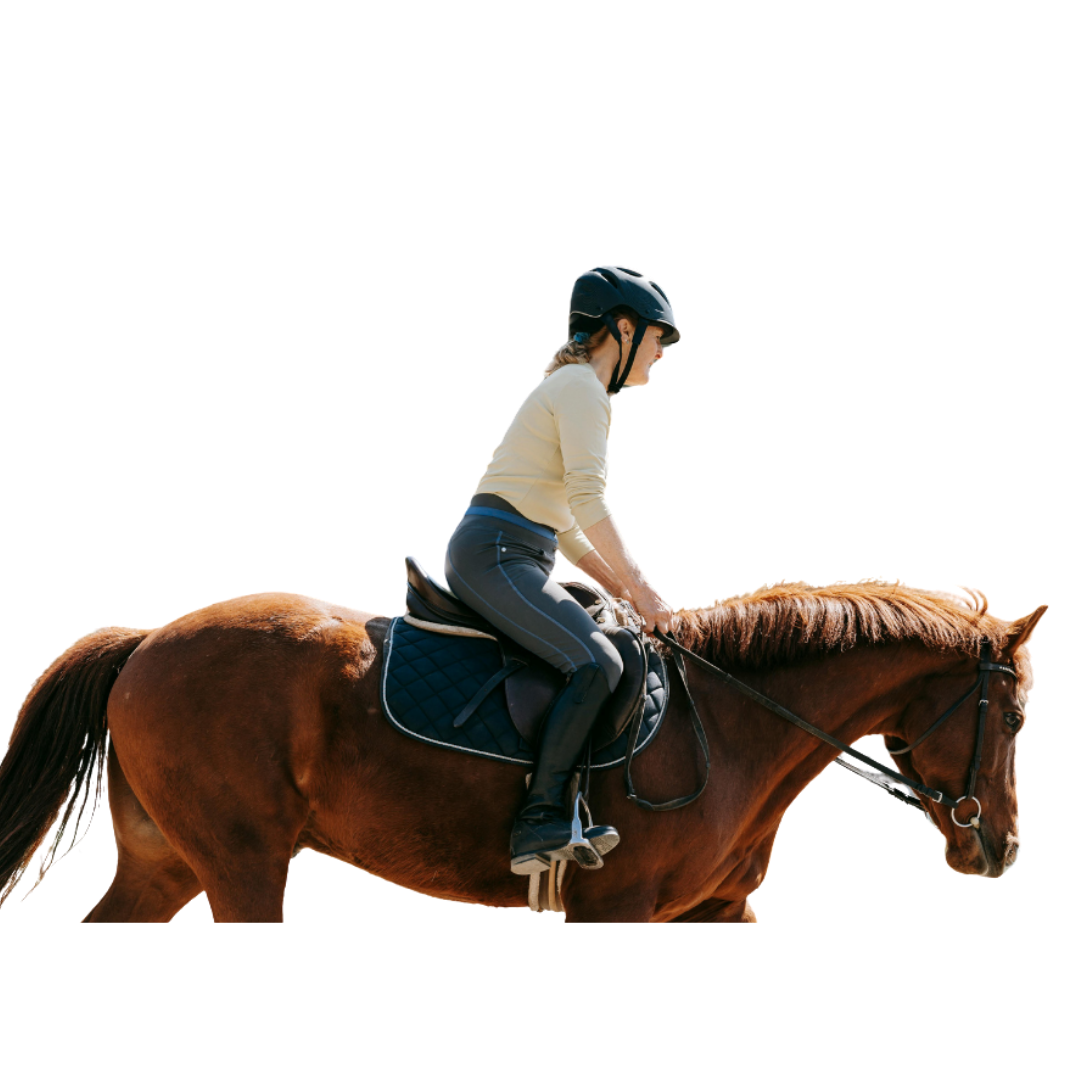
Diagram showing asymmetry in a horse rider’s posture while sitting in the saddle

Why Trying Harder Doesn’t Always Improve Your Riding

One of the most frustrating experiences as a rider is doing more and feeling like you’re getting nowhere.

You concentrate harder. You apply more effort. You ride more deliberately. And yet the same issues keep resurfacing. Sometimes they even feel more pronounced the more you try to fix them.

This happens because effort doesn’t override adaptation.

If your body doesn’t have the stability, coordination, or awareness to maintain a position, trying harder simply reinforces compensation. You might hold something briefly, but it will feel forced and unstable. As soon as attention drops, the body reverts to what it knows.

This is why riders often feel they can “find it” for a moment, then lose it again. The issue isn’t understanding or motivation. It’s that the body doesn’t yet have the capacity to support what’s being asked.

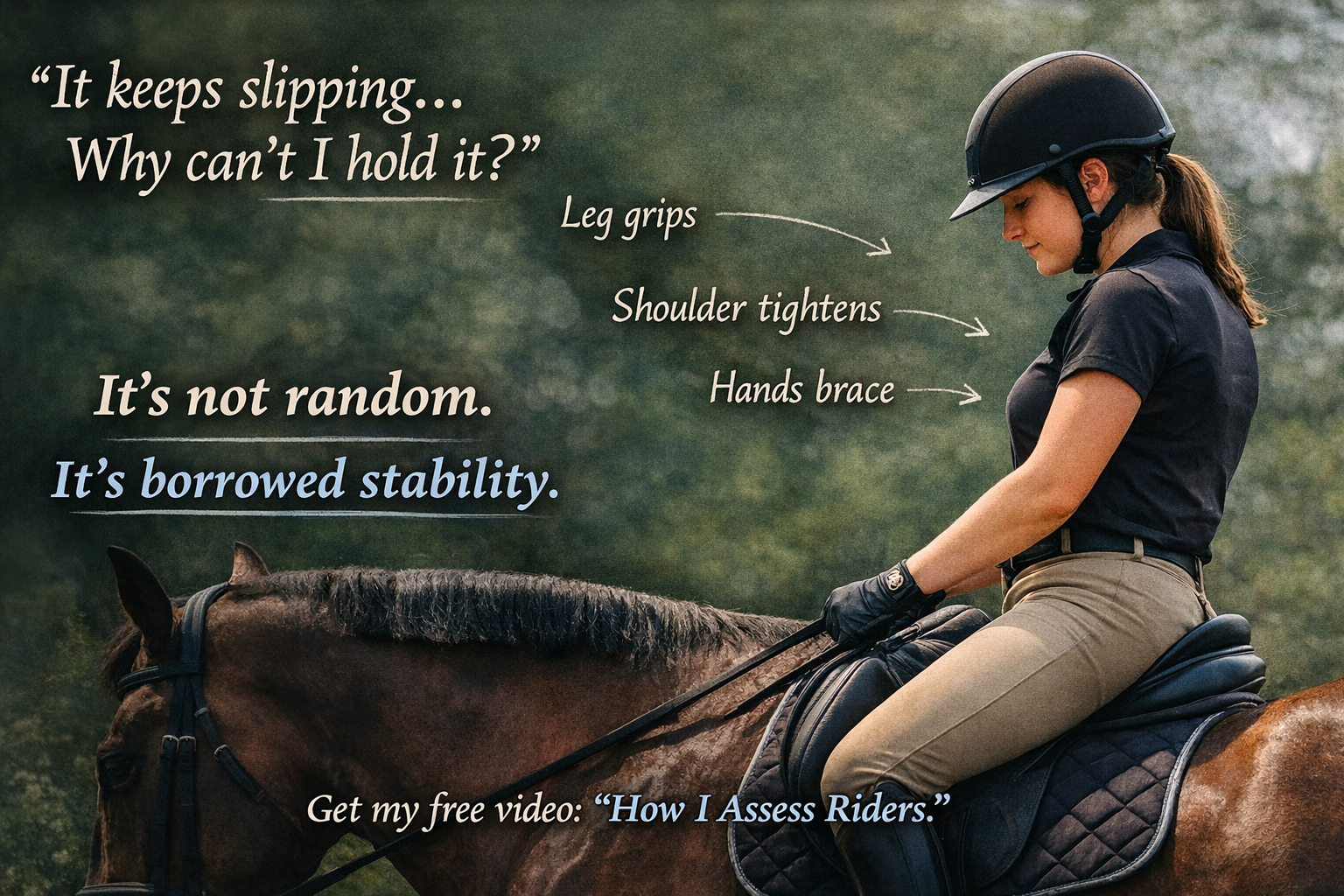
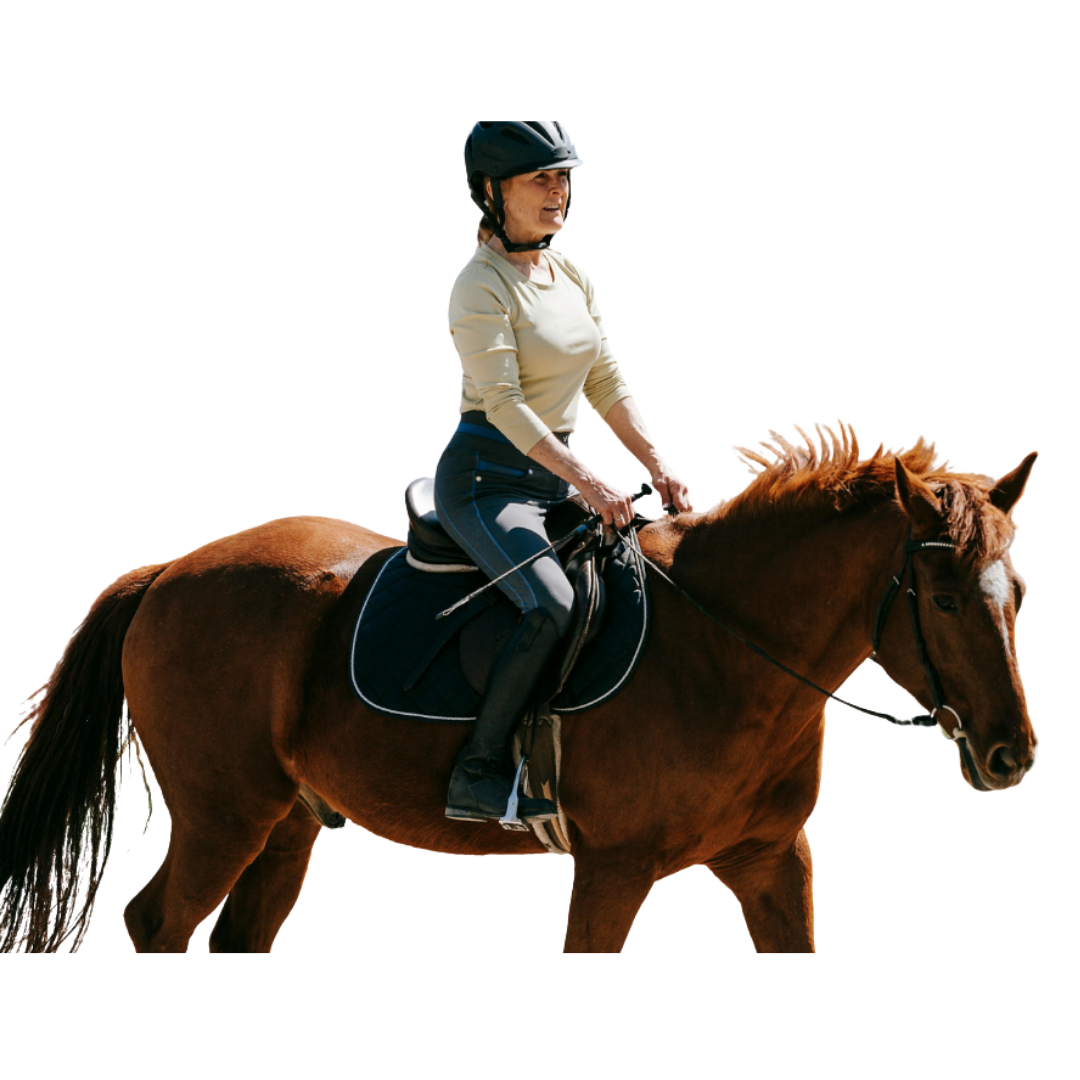
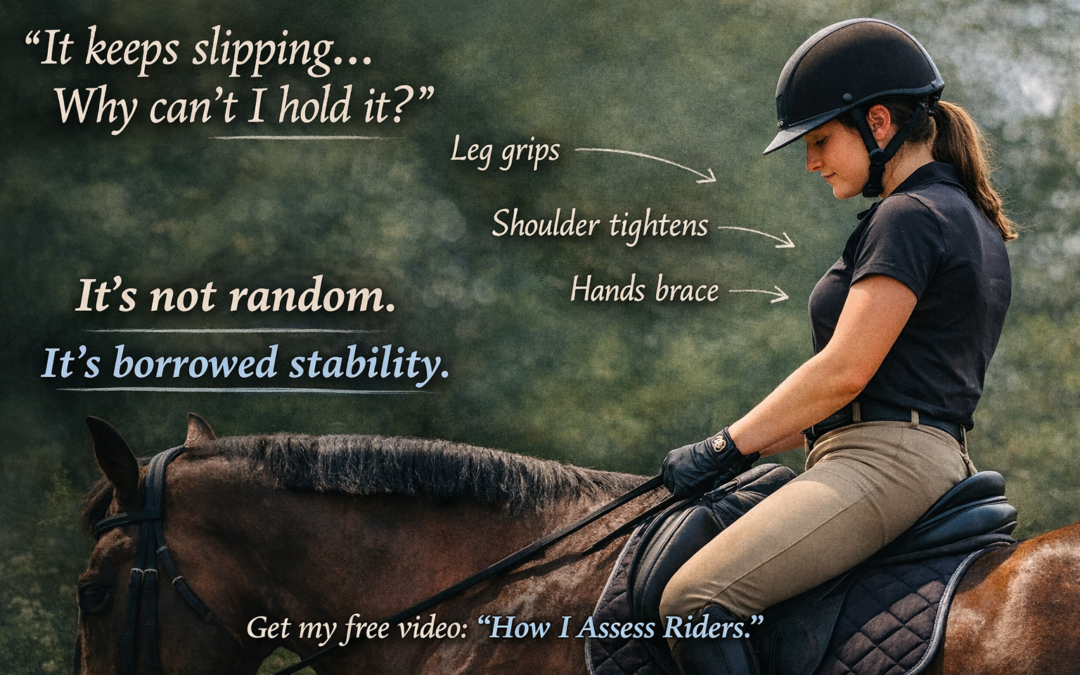
Horse rider gripping and bracing in the saddle while trying to maintain balance

Improve Your Riding by Addressing the Root Cause, Not the Symptom

Most riders end up focusing on symptoms.

Uneven reins.
Collapsing through one side.
Gripping with the legs.
Losing balance in transitions.

But symptoms are signals. They’re the result of something else happening underneath.

When you chase symptoms, progress stays temporary. You fix one thing, another pops up. You feel like you’re constantly managing issues rather than moving forward.

Symptom

⬇️

Pattern

⬇️

Root Cause

When you address the root cause — how your body is organising itself and why — change becomes more stable. Positions feel easier to maintain. Balance becomes less effortful. Riding starts to feel quieter again.

How to Improve Your Riding Without Forcing Change

Lasting improvement doesn’t come from forcing your body into a shape it can’t maintain.

It comes from a clear order:
awareness first,
support second,
strength built on top.

When awareness comes first, you begin to notice patterns without judging them. When the body feels supported, it’s willing to change. Strength layered on top of that support actually transfers into the saddle, rather than being overridden by old habits.

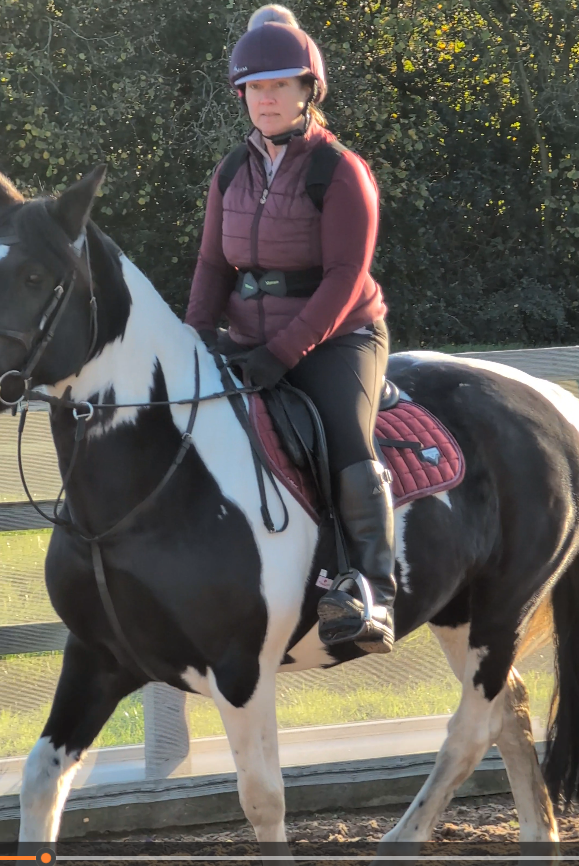
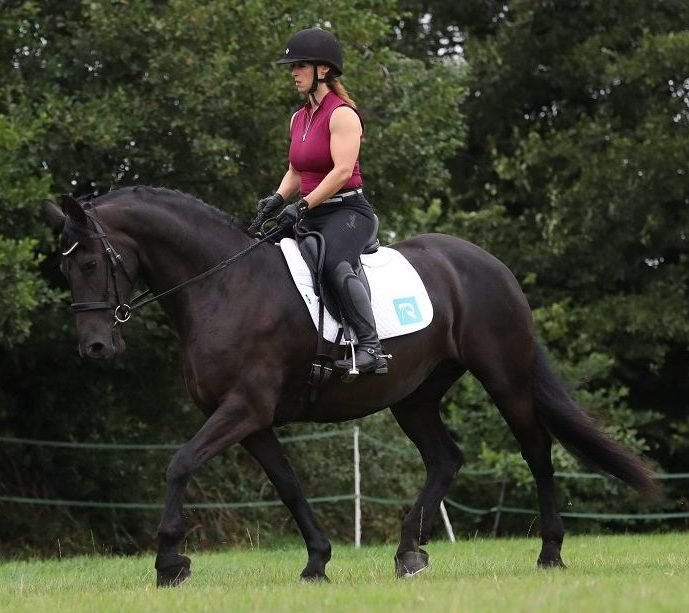
Clare riding Annick - Ridden Sessions

Riders often describe this as riding feeling lighter. Not because they’re doing less, but because their body isn’t fighting itself anymore.

Improve Your Riding Starts With Understanding

If riding still feels harder than it should, it doesn’t mean you’re failing.

It means your body has adapted — and now needs a different kind of input.

Understanding removes blame. It replaces frustration with clarity. And it creates a path forward that doesn’t rely on pushing, forcing, or starting over.

You don’t improve your riding by fighting your body.
You improve your riding by understanding it — and working with it.

If this resonates with you, the next step isn’t more effort — it’s insight.

I’ve created a free insight called “How I Assess Rider Movement — and What It Shows Me.” It walks you through the key movements I use to assess a rider off the horse, and explains what those patterns reveal about how your body is organising itself in the saddle.

To receive it, sign up to the RiderCise newsletter using the box below, and I’ll send it directly to your inbox.

If you’re already on my mailing list and would like it resent, email me at *protected email* and I’ll make sure you have it.

Understand first. Then build properly.

How to be Confident

How to be Confident

How To Be Confident

Losing your confidence is something that many can’t grasp if they’ve never lost it. But it can and will affect nearly every one of us in one way or another. When we lose confidence in one area of our life, it affects our confidence in other areas.

How We Lose Confidence

Losing your confidence doesn’t necessarily come from having an incident in the saddle. It can occur when we have had a period out of the saddle, feedback from an instructor or individual, overhearing someone negatively talk about us, going through personal challenges and even suffering a fall at home or recovering from an illness or surgery.

As we get older, we are more likely to lose our confidence as we start to notice the signs of aging such as your hair going grey, getting wrinkles, hormone levels starting to diminish and play havoc with your moods, your outlook on life and maintain or losing weight becomes a battle. We also start to notice the things we could once do with great ease are no longer so easy.

All and any of these things affect our confidence.

When you lose your confidence, you become self critical and conscious of yourself. The way you move, feel, ride and look.

Whilst you may appear to be happy and content on the outside. The truth is. You’re not happy. You can be angry, frustrated, overwhelmed, sad and unsure of how to move forward.

Helen loves her Fell pony Wally, he is her retirement plan! They are going to spend all their time exploring the Yorkshire Dales together. Doing exciting things with friends and going to clinics and shows.

And they did, till Helen fell down the stairs at home and lost all belief in herself as she struggled to function day-to-day as she was recovering. Simple tasks like doing the washing, lifting items and cleaning the house was difficult. Not being able to do these simple tasks had a huge effect on Helen.

Helen couldn’t contemplate getting in the saddle, she couldn’t even bring herself to just go and enjoy being with him.

Losing your confidence makes you unhappy. And not being happy limits your enjoyment of your horse, your riding and your life.

Regaining Your Confidence

Seems simple but it’s incredibly challenging when you are not sure where to start or what to do. Having a plan, support and guidance and being realistic in the time it will take is key.

  • 1. You Need To Have A Plan
  • Whatever you decide to do, whether it be to have coaching sessions, join a program or set yourself small manageable tasks. You must understand that it will take a minimum of 6 months to make real progress or you risk being back at square one.
  • You should decide what you are going to do, how frequently you are going to do it and how long you will do it for. During that time, don’t change the approach. Stick with it. Give it time to work.

Examples: Hypnotherapy, NLP Sessions, Menopause Coaching, Going to the Gym/Class, Rehab Sessions with a Trainer, Having riding lessons on a school master, Join a Transformation program or simply setting yourself little tasks each week.

  • 2. You Need and Deserve To Have Support
  • Many of us feel that we don’t need help or are embarrassed to ask for help but there will be times when it feels like the world is against you and you feel low. Not having someone to listen and guide you is setting yourself up for failure.
  • You will naturally think negatively of the progress you are making, instead of remembering and celebrating all the wins.
  • Having support not only keeps you on plan and moving forward. It helps guide you, pick you up when you need it, drive you forward when you want to quit, and remind you just how far you’ve come.
  • 3. Transformations Take Time
  • It takes time to gain confidence back, acknowledge that. It’s not going to be a week or a month. But if you are consistent and keep moving forward you will become the confident rider you want to be. You will find joy in being with and riding your horse.
  • You will have a more positive outlook on life.
  • You will be happy in your skin and learn to make the most of every opportunity that comes your way.

Whilst Helen didn’t lose her confidence riding, it affected her confidence to ride and handle Wally.

Having been in a similar position before, Helen knew that to move forward she had to improve her daily function. She needed to build up her strength and improve her mobility so that every day tasks weren’t so difficult. This would make her believe in herself again. That she could overcome her injury, she was strong, physically and mentally and She could cope if Wally was a little overwhelming on a particular day.

Helen signed up for the Strong Confident Rider Program in 2022 with the goals of:

I want to be a calm, capable and focused rider. I want to be courageous and responsive rather than timid and reactive.

  • Change the pictures and narrative in my head!
  • I want my body to feel strong and confident
  • I want to develop a heartfelt connection with Wally, to ride with an awareness of how I’m using my body and how this affects Wally.
  • I’d like to be able to think something and Wally would respond with minimal aids.


Helen smashed her goals within months of joining and has continued on to the SCR membership program where she is living her best life with Wally.

    “I can’t quite believe just how much has changed over the last 12 months.

    I’ve gone from dithering on the mounting block to planning my next adventures with my beloved Fell Pony, Wally.

    I think he’s as happy as I am.”

    Helen

    Fell Lover and Countryside Explorer

    Take Action

    The most important step you can do right now is to take action. Life is too short to ‘do it tomorrow’. If you had done it yesterday, you’d be one step closer to becoming more confident. Taking action doesn’t need to be overwhelming.

    Simply take the time today to decide the first step in your plan. How do you want to work on your confidence?

    • If it’s the riding aspect, are you going to book some lessons with a schoolmaster?
    • If it’s more about changing the way you view yourself, are you going to work with a confidence coach or have Hypnotherapy/NLP sessions?
    • If is improving your mindset, health, well-being and riding, are you joining the Strong Confident Rider Program?

    Whatever route is right for you. Don’t waste any more time worrying. Take action today and be one step closer. Just imagine where you could be in 6 months time.

    Are you a Fit Equestrian or Equestrian Fit?

    Are you a Fit Equestrian or Equestrian Fit?

    Do you consider yourself to be a Fit Equestrian or Equestrian Fit? Do you exercise off the horse to improve your riding or for general health and well-being? Is there a difference?

    There is a huge array of options available to improve our general health and wellbeing. Any form of movement/exercise is beneficial (if done correctly, obviously). But when it comes to exercising to improve your riding are you aimlessly wasting time, money, and effort, or are you seeing measurable progress and specific transferable benefits?

    What’s the Difference?

    When you exercise in addition to your generally active lifestyle (caring for and riding horses) you will see changes and experience benefits. The reason is that you are overloading your body with different stimuli than what you are used to.

    The changes and benefits you see, and experience will differ depending on what form of exercise you have chosen.

    Cycling for rider fitness

    If you have started running or cycling, then you may be seeing that you are not as out of breath as much in the saddle.

    Woman on Yoga Mat

    Or you have started Yoga/Pilates classes and feel that you have better mobility (strength, balance, and coordination to control body movements) and can sit more balanced in the saddle.

    Horse Rider Strength

    Or perhaps you have started lifting weights and feel stronger, straighter, and can control your riding posture and give clearer effective aids.

    All of the above forms of exercise focus on improving a specific component of fitness or a combination of.

    There are around 11 Components to Fitness but I have listed the 7 that are relevant to riding

    Component
    Meaning
    Example

    Agility

    The ability to change the position of the body quickly and control the movement

    – Sitting a spook.

    – Give clear effective leg aids

    – Jumping position

    Balance

    The ability to maintain the body’s center of mass above the base of support

    – Sit evenly and centrally in the saddle.

    – Move with the horse through all gaits whilst maintaining correct posture

    Cardiovascular

    The ability of the heart, lungs and blood to transport oxygen

    – Not getting out of breath during riding

    – Able to breathe correctly for core engagement

    Coordination

    The ability to use two or more body parts together

    – Riding!

    – Giving seat, leg, and hands aids simultaneously

    Flexibility

    The range of motion (ROM) at a joint

    – Altering hips to move with the horse in left/right lead canter

    – Opening/closing of the knee to put the leg in front, on, and behind the girth.

    Muscular Endurance

    The ability to use voluntary muscles repeatedly without tiring

    – Ride for longer than 10 minutes without fatigue.

    – Perform repetitive tasks such as giving aids

    – To jump / Event

    ANY FORM OF RIDING

    Reaction Response

    The time taken to respond to a stimulus

    Reacting to a spook or change in direction.

    By being generally active and performing a form of exercise that focuses on one of, or a combination of the above fitness components then you would be considered a fit equestrian.

    How Do I Become Equestrian Fit?

    To become Equestrian Fit you will need to incorporate all of the 7 components listed above, into your exercise regimen. It may sound like it’s an impossible task but all you need is variety and structure.

    Instead of doing the same class, exercise routine or getting the bike out, or going for a run. Mix it up. It really is that simple. To ensure that you are continuously progressing you also need to make sure that you are overloading your body appropriately.

    All that means is that you increase the intensity, sets, duration, and weight once you feel that you that what are currently doing is fairly easy. This will ensure that your body is constantly adapting. You don’t need to increase all of those, just one or the other.

    The easy option is to sign up to RiderCise – where Rider Fitness Expert and Founder, Clare. Has designed all the workouts using based on the 7 Key Components for Rider Fitness

    Become Equestrian Fit

    Learn more about how RiderCise can help you.

    How Pelvic Tilts affect your Riding

    How Pelvic Tilts affect your Riding

    Bad posture is the most common reason for an Anterior or Posterior Pelvic Tilt.

    For good posture, balance, and stability in the saddle, it is essential that we have a neutral pelvis. Having a neutral pelvis allows us to maintain upper body posture stability. Lower limb control WHILST allowing movement in the hips to follow the movement of the horse.

    The tilt of the pelvis is determined by measuring the angle of the Anterior Superior Iliac Spine (ASIS) and the Posterior Superior Iliac Spine (PSIS). These are bony structures on the front and back of your pelvis. You should be able to feel these with your fingers.

    There are many considerations when measuring the range of ASIS and PSIS. Generally, a neutral pelvis is when there is a straight line from the PSIS to the ASIS or a slight anterior (forward) angle of 7-10 degrees.

    Anterior Pelvic Tilt (APT)

    An Anterior Pelvic Tilt is when your pelvis is rotated forwards causing an increased curve in the lumbar (Lower Back) and an appearance of a ‘bulging’ stomach.

    What muscles does APT affect?

    How Pelvic Tilts affect your riding

    When you have an APT the Rectus Abdominis and External Obliques (abdominal muscles) and Glutes & Hamstrings (bum & back of legs) are typically weak / lengthened muscles.

    Simultaneously. The Psoas, Iliacus (internal postural muscles), Rectus Femoris (quadriceps), Tensor Fascia Latae (Hip) and Erector Spinae (spine) muscles are strong and stiff.

    How does an APT affect your riding?

    You will have a tendency to sit on your pubic bone instead of your seat bones. And because you are sitting more forward you will further increase the already dominant arch in your lower back. This reduces the suppleness of your shoulder girdle and hips. Which may result in being able to obtain an elastic contact (give and take with ease).   

    Due to the tight muscles in your quadriceps and TFL. You will also ride fairly short to counterbalance your seat and torso position. This makes you feel perched and unstable at times. It is most noticeable through downward transitions.

    Anterior Pelvic Tilt is visible during horse riding. Photo thanks to the courtesy of EquinePhotoDesign.com 

    A Posterior Pelvic Tilt (PPT)

    A Posterior Pelvic Tilt is when your pelvis is rotated backward which causes the back to be pulled downwards giving the appearance of a [Flat Back and Flat Bum].

    What muscles does PPT affect?

    When you have a PPT you would have short & tight Hamstrings (back of legs), tight abdominal muscles (no, this is not a benefit as it will also be pulling on the pelvis, upwards which will make the PPT worse), and tight Glutes (bum), Weak Hip Flexors and lower back.

    How does a PPT affect your riding?

    You may find that you round your shoulders and carry your hands forwards and collapse through the chest and look downwards (think slumping in a chair).

    You will often feel left behind in the saddle and you can rely on your reins for balance as you are not able to engage your core and left your chest high.

    Because of the slumping type of posture, the back is compromised and there is no ‘natural’ curve in the lower back which inhibits the spines’ ability to absorb shock. This can lead to pain over time and even compromise the structure of the spinal discs.

    Posterior Pelvic Tilt visible during horse riding. Photo thanks to the courtesy of EquinePhotoDesign.com
    Posterior Pelvic Tilt

    Does having a non-neutral Pelvic Tilt really matter?

    It really depends on the extent of the tilt and whether you have any issues with riding and/or are suffering from some pain of some sort after riding.

    More often than not, pelvic tilts occur over time from lack of exercise, mobility, and poor posture. Because it is often gradual, we don’t realize the effect it has on us.

    The pelvis should have the mobility to move through the anterior, neutral, and posterior positions. When it is rigid it can cause a number of issues. From increased tension in the shoulders/neck to lower back ache/pain. You may even experience ‘Sciatic Symptoms’, due to the tight glutes applying pressure on the sciatic nerve. This can lead to pain and tingling sensations down one side. As well as a possible weakness in the knee and foot. This will, of course, affect your ability to control your legs.

    Sciatica can only be determined by MRI, otherwise, it is a symptom. Which can typically be treated when the cause is addressed.

    How do I know if I do have a Pelvic Tilt?

    It is often best to seek advice from a Soft Tissue Therapist or Sports Therapist as finding the anatomical structures on your body yourself can be difficult!

    Watch these videos which explain a little more about how to test yourself or ask someone to help you.

    Posterior Pelvic Tilt Video

    Anterior Pelvic Tilt Video

    So how do I correct my pelvic tilt?

    To correct a pelvic tilt you should stretch the short and tight muscles and do a range of exercises to increase mobility and strength.

    Below I have listed some exercises for you to try. The links take you to videos on the RiderCise® Facebook page. This allows you to see how to perform the movement.

    Stretches for Anterior Pelvic Tilt

    Stretches to correct a Posterior Pelvic Tilt

    Strengthening exercises for both APT and PPT

    Get in Touch

    Keep up to date with the latest content by following our Social profiles on Facebook, and Instagram.

    How to Prevent Knee Pain When Riding

    How to Prevent Knee Pain When Riding

    In this article, I will show you the common stretches that can be performed before and after you ride to help prevent knee pain when riding.

    It’s important to note that Riding itself doesn’t cause knee pain, it simply highlights an underlying issue. If you haven’t already, check out my article on the causes of knee pain in horse riders.

    Prevent Knee pain when riding by stretching the quadriceps and hamstrings

    Overview of Causes of Knee Pain in RidersThe most common reason for knee pain in horse riders is due to muscular tension around the quadriceps. The quadriceps tendon runs over the knee cap and attaches just below.

    Tightness in the hamstrings can also cause knee pain because the hamstring tendons run over the back of the knee and attach to the lower leg bones (tibia & fibular).

    Because the tendons run over the knee joint they can cause pressure which makes it feel like there is a problem with the knee itself. Actual knee issues such as arthritis can be officially diagnosed by an MRI or X-Ray.

    When a rider experiences knee pain when riding and/or generally the most common reaction is to limit movement and exercises. This can actually contribute to the pain you are experiencing and over time, make it worse.

    Even if you have a confirmed diagnosis of arthritis in the knees. Not stretching and exercising will contribute to the pain you are experiencing.

    2 Stretches to Prevent Knee Pain when Riding

    Is it really just 2 stretches? yes! stretching out the quadriceps and hamstrings before and after riding will really help you reduce knee pain when in the saddle. If you can do these stretches daily to, whether you ride or not, then you will experience less and less pain in the knees overall.

    Quadricep Stretch

    There are two versions of the quadriceps stretch. There is a basic stretch for those that really struggle with their range of movement and a more advanced stretch for those that have good mobility.

    Both stretches are highly effective.

    Option 1 – Easier

    Hold for 30 seconds on each leg

    Option 2 – Harder

    Hold for 30 seconds on each leg

    Quad Stretch for horse riders - - Prevent Knee Pain when Riding
    • Place a hand on the wall/fence or use a broom to balance yourself.
    • Keep your standing leg soft at the knee (not locked out)
    • Bend the knee behind and grasp the front of your foot (or use a lead rope/band to help you)
    • Gently pull the foot towards your bottom
    • Make sure that your upper body remains as straight as possible
    • Avoid tilting the pelvis
    Quad Stretch Advanced - Prevent Knee Pain when Riding
    • Place the front of your foot on a mounting block, low wall, or bench (about 1meter high)
    • Rest on a broom or stick in front of your body, to help balance yourself.
    • Slowly bend your standing knee so you dip downwards keeping the bent knee pointing downwards
    • Go as low as you can comfortably until you feel the stretch in the front of your bent leg
    • Make sure that your upper body remains as straight as possible
    • Avoid tilting the pelvis

    Hamstring Stretch

    Again there are two versions. An easier one for those that have a limited range of movement in their hip and a stretch for those with greater mobility. If you don’t feel the stretch in the back of your leg, the hamstrings, move back and forth slightly, gently, till you do. Everyone is different so you may just need to ‘adjust’ yourself slightly.

    Option 1 – Easier

    Hold for 30 seconds on each leg

    Option 2 – Harder

    Hold for 30 seconds on each leg

    • Place one foot around 1meter in front of your body
    • Keep the back leg soft at the knee (not locked out)
    • Rest on a broom or stick to the side of your body, to help balance yourself.
    • Bend forward from the hip, keeping your back straight throughout
    • Keep foot flat on the floor or lift the toes to intensify the stretch

    Advanced Hamstring Stretch - Prevent Knee Pain when Riding
    • Place the heel of your foot on a mounting block, low wall or bench
    • high)
    • Keep the back leg soft at the knee (not locked out)
    • Rest on a broom or stick to the side of your body, to help balance yourself.
    • Bend forward from the hip, keeping your back straight throughout
    • Keep the leg straight to feel the stretch closer to the knee
    • Bend the knee and bend forward from the hip to feel the stretch closer to your bottom

    The Golden Rule for Horses and their Riders

    The golden rule of horse rider welfare and fitness, as well as horses, is ‘Lengthen, Strengthen, REPEAT. When a horse gets a muscular/tendon injury. They must of course rest first then lengthen the muscle/tendon and strengthen over time. Lengthening can be therapy and/or walking in hand to start and is built up over time. Gradually increasing the time, intensity, and complexity (such as different terrain, up and down hills, pole work, in hand core work). This rehab work is done to ensure that the muscle/tendon can deal with the demand of being a horse and riding/competing, if applicable.

    For riders, we typically spend the majority of our life sitting, standing, or moving with short strides. This causes the muscles in the legs to become shortened and tight. When muscles become shortened and tight they pull on the tendons that attach to the tibia bone.

    You can learn more about how muscles can cause knee pain by clicking the button to take you to the article.

    How to Prevent Knee Pain when Riding

    Being active by walking the dog, doing yard duties etc do not use your muscles or joints through their full range. It is important to perform exercises that condition your muscles within their full abilities to prevent issues from arising.

    Whilst stretching these muscles will help to elevate pain/discomfort caused by tight muscle tendons pressing on the knee joint it will take time. To alleviate it quicker you should consider strengthening exercises. This will also help to prevent knee pain when riding, and in general, long term.

    Rider Leg Muscle

    I was experiencing a lot of pain in my knee and it was beginning to stop me from doing the things I wanted.  The GP asked me about my symptoms and diagnosed arthritis without getting any scans.  This was worrying for me – my mum is disabled by arthritis in her knees.  I was recommended to speak to Clare at RiderCise. 

    Clare designed a program of exercises to build my strength and put me in touch with a sports therapist for soft tissue massage.  The pain in the knee is a thing of the past.  I’m fitter now than I have been for years, and I’m no longer stopped from doing anything I want. 

    Thank you, Clare.

    Processing...