You’ve done the crunches. You’ve held the plank until your arms shook. And yet the moment your horse spooks sideways or drops his shoulder into a canter transition, you’re grabbing mane and hoping for the best. Sound familiar?
That gap between “fit” and “secure in the saddle” is exactly why generic ab workouts let riders down. This article walks through core exercises for horse riders that actually translate to the saddle, why they work, and how to build them into a week that already feels too full.
Why Generic Ab Workouts Don’t Fix Your Riding Stability
Most fitness advice for riders is just fitness advice with a horse photo slapped on top. Sit-ups, standard planks, a few crunches. None of it accounts for the fact that your core needs to react to movement it can’t predict.
A horse doesn’t move like a gym floor. It shifts weight, changes rhythm, and occasionally does something neither of you planned. Your core’s job isn’t to look good on a beach. It’s to keep your pelvis and spine stable while the ground underneath you keeps changing.
Most rider problems aren’t down to lack of effort or fitness. They come from how your body has learned to stabilise and protect itself over time. That’s why isolated ab exercises rarely translate to a more secure seat.
What Rider Core Strength Actually Means in the Saddle
Rider core strength isn’t about visible abs. It’s your deep stabilising muscles firing automatically, without you thinking about it, to keep you centred over the horse’s centre of gravity.
This is also where the difference between core strength and balance matters. Balance is your ability to sense and correct a shift in position. Core strength is what gives your body something solid to correct with. You can have great balance instincts and still get pulled off centre if the muscles supporting your spine and pelvis aren’t strong enough to hold the correction.
Build both, and you stop bracing with your hands, gripping with your knees, or collapsing through one hip every time the ride gets unpredictable.
The 6 Best Core Exercises for Horse Riders
These aren’t generic gym moves borrowed from a fitness magazine. Each one targets a specific stability pattern you need in the saddle. Every cue below is written with a real riding moment in mind.
Stability Exercises for Riding an Unpredictable Horse
1. Dead bug
Lie on your back, knees bent at 90 degrees, arms reaching towards the ceiling. Slowly lower one arm and the opposite leg towards the floor without letting your lower back arch off the mat. This trains the anti-extension control you need when your horse drops his head or lurches forward unexpectedly.
2. Glute bridge
Lie on your back, feet flat, and lift your hips until your body forms a straight line from knees to shoulders. Squeeze your glutes at the top rather than pushing through your lower back. Strong glutes work with your core to stabilise your pelvis in sitting trot. A weak connection here shows up as bouncing rather than absorbing.
3. Bird dog
From all fours, extend one arm and the opposite leg until they’re in line with your spine, keeping your hips level throughout. This is one of the best stability exercises for riding because it trains your body to stay square when a horse spooks or bulges sideways under you. That’s exactly the moment riders lose their seat.
Anti-Rotation and Deep Core Moves for Balance
4. Side plank
Prop yourself on one forearm with your body in a straight diagonal line, hips lifted and stacked. Hold, then switch sides. This builds the lateral stability that stops you collapsing through one hip during sitting trot or a leg-yield. It’s a pattern that shows up again and again in rider assessments.
5. Anti-rotation press
Using a resistance band anchored to your side, press it straight out in front of you while resisting the pull that wants to twist your torso. This mirrors what your core does every time your horse twists, bucks, or changes direction faster than you expect.
6. Plank with shoulder taps
Hold a forearm or high plank, then lift one hand to tap the opposite shoulder without letting your hips rock. This builds the same anti-rotation control as the band press, without needing equipment. Useful for canter transitions, where your upper body wants to twist ahead of your seat.
Together, these six moves build the deep core stability that generic sit-ups never reach.
How to Build a Core Workout for Riders Around Your Riding Week
A core workout for riders only works if it fits around the rest of your life: yard time, lessons, actual work, family. So keep it simple.
Pick three sessions a week. Each one takes fifteen to twenty minutes. Rotate through the six exercises above, two or three per session, building up reps and hold times as you get stronger. That’s it. No two-hour gym commitment, no separate ab day bolted onto an already packed schedule.
How Often Should Equestrians Train Their Core?
Riders typically only need three focused fifteen-to-twenty-minute core sessions a week to see a noticeable improvement in saddle stability. That makes it realistic for time-poor amateur and competitive riders alike.
Progression matters more than volume. Add a few seconds to your side plank hold. Slow down your dead bug tempo. Increase the band resistance on your anti-rotation press. Small, steady increases beat cramming in extra sessions you’ll resent and eventually skip.
Consistency over a few weeks does more for your seat than one exhausting session ever will.
Common Mistakes When Training Abs for Equestrians
The biggest mistake riders make when training abs for equestrians is holding their breath. If you’re clenching through every rep, you’re bracing rather than stabilising. Bracing is exactly the habit that makes you rigid and reactive in the saddle instead of soft and adjustable. Breathe through the movement, every rep.
The second mistake is training the core in isolation from the hips and glutes. Your seat doesn’t work as a set of separate muscle groups. It works as a chain, from your feet through your hips to your spine. A strong core sitting on top of weak or disengaged glutes will still let your pelvis tip and your lower back take the strain.
The third, and often the most overlooked, is ignoring the protective habits your body has already learned. A rider who collapses through one hip in sitting trot is often compensating with their lower back rather than using deep core stabilisers. Doing more crunches won’t undo that pattern. It needs retraining, not just strengthening around.
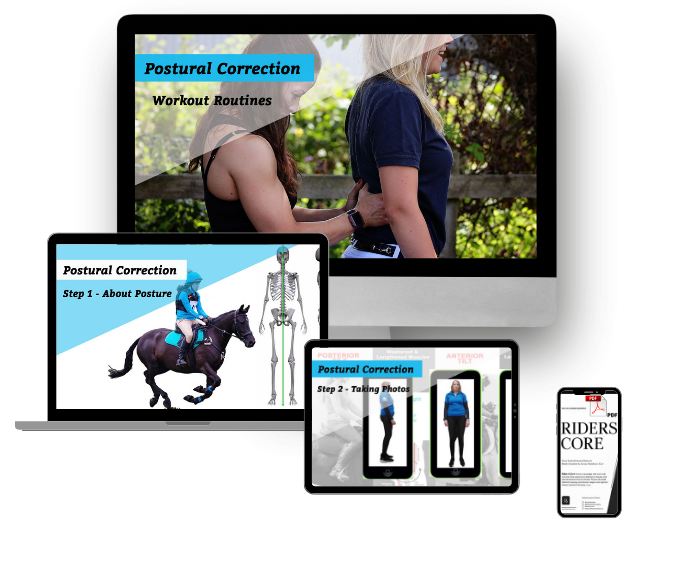
This is where a biomechanics-first approach matters more than a bigger rep count. If postural collapse is part of your pattern, the Postural Workout Bundle is built to address it directly, rather than layering more ab work on top of a habit that’s still working against you.
When Off-Horse Core Work Isn’t Enough: The Rider Core Mini Course
A list of exercises can get you started. But real, lasting saddle stability comes from a structured plan that progresses in the right order, at the right pace, for your body specifically.
That’s the gap between doing exercises and doing a programme.
What’s Inside the Rider Core Mini Course
The Rider Core Mini Course was built around the pelvis and spine stability patterns riders need for sitting trot, canter transitions, and unexpected spooks. It’s not a generic ab routine with a horsey theme.
It gives you a clear progression instead of a random list, so every session builds on the last one, with cues designed for what actually happens in the saddle, not just what looks good in a gym mirror.
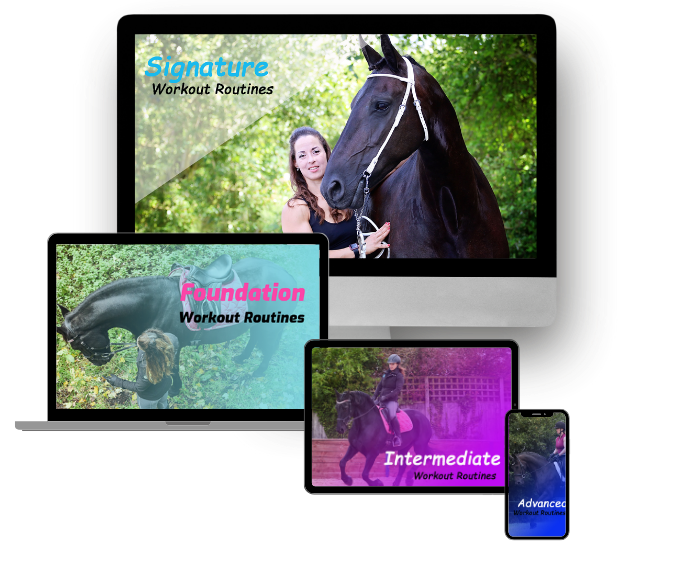
If you’re ready to stop guessing which exercises matter and start training with a plan, this is your next step. If you finish it and want to build further, the Signature Workout Bundle takes your strength and stability further still.
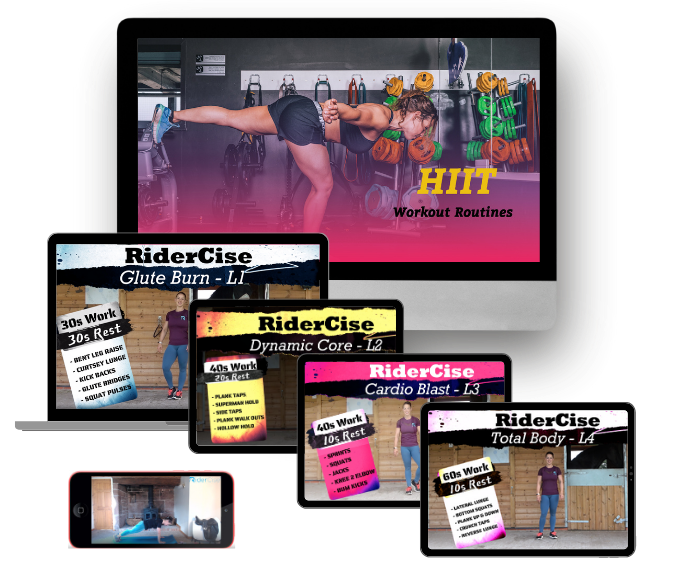
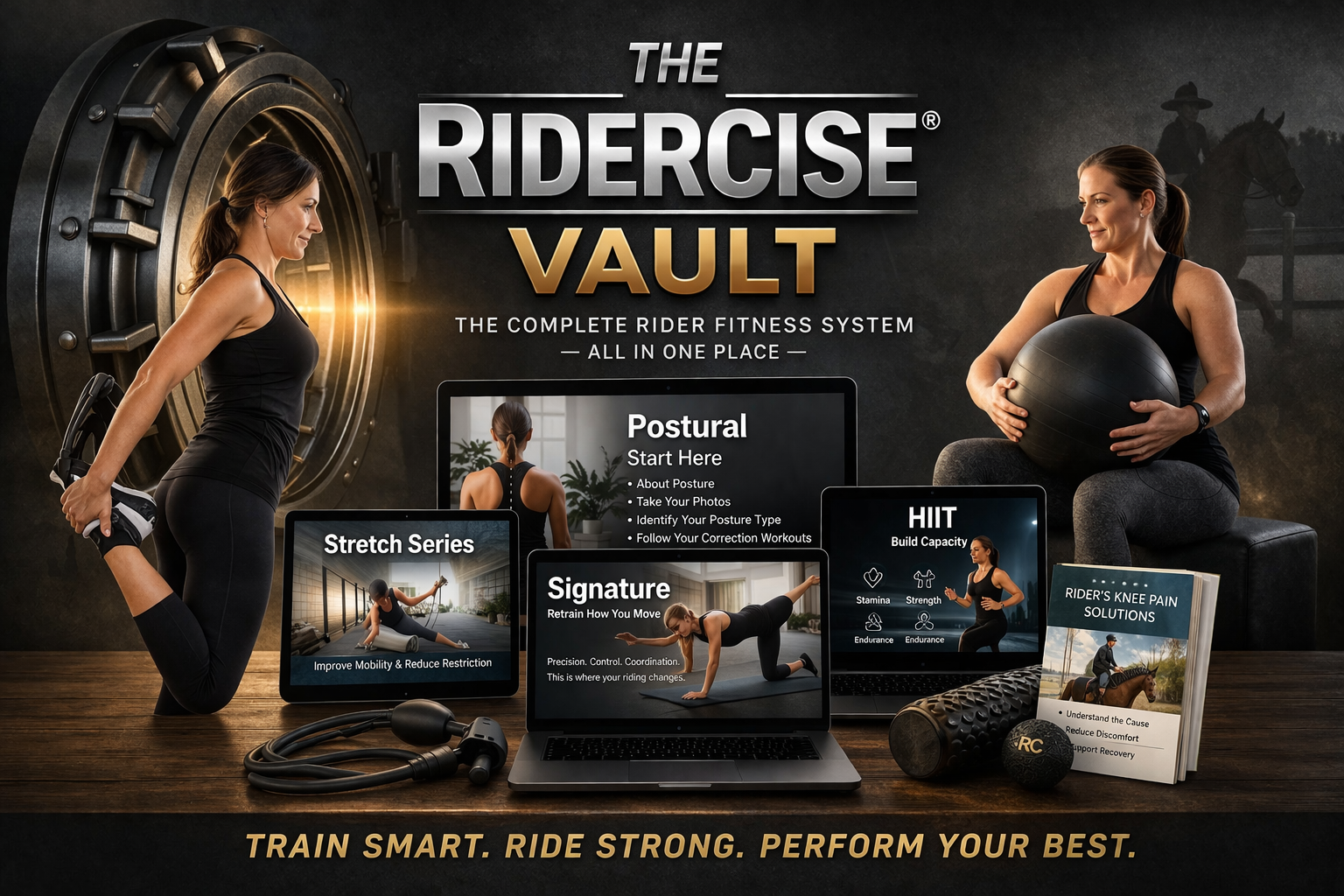
And if you want to see how core work fits alongside posture, mobility, and strength training as a rider, the full range of RiderCise workout bundles shows you the whole picture.
You already know your core matters. Now stop guessing and start training it the right way, for the rider your horse actually needs.