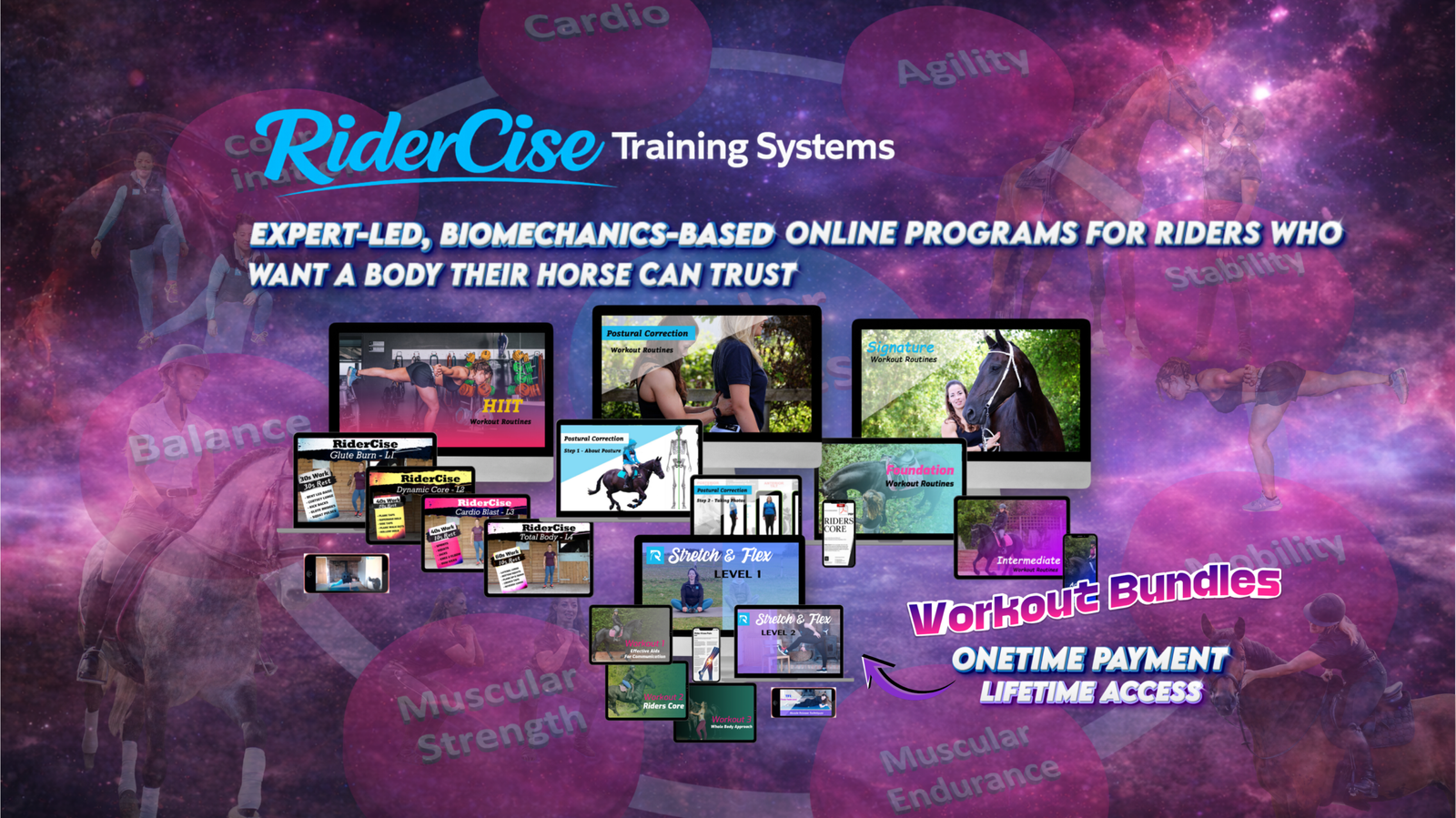
Designed to give you clear direction of where to start, when to move forwards and how to maintain your rider fitness.
Rider Fitness Workout Visual Overview
Having a visual overview of your Rider Fitness Journey helps you to map out in your mind, where you currently are and where you want to be. Broken into 3 Phases, it gives you a clear path of which Rider Fitness Workouts you should be starting with and how to progress forwards.
Postural Workouts
These workouts have been added to ensure that you are building upon a strong base. Like training a horse. If you are trying to build upon a weak base it will only lead to more problems in the future.
The Foundation Program is fantastic for re-setting your body awareness and control but over the years I have found that riders need more help to build that strong base.
Life stresses and the way we move and function can often compromise our static posture. When our static posture is altered it inhibits the ability of the core to function optimally.
We all have a core that functions as we use it to sit, stand, move and ride. But if it is not able to function correctly it means the body needs to rely more on certain muscles or use muscles not designed for that job, which leads to aches and pain, and a lack of ability to control our movement.
The Core consists of around 34+ muscles that need to work together in order for your Core to function optimally. Our static posture can cause short, tight, weak and/or lengthened muscles which inhibit those muscles to work together.
When you are struggling to use your core to move and ride, it isn’t because you don’t have strength in the Psoas or Transverse or whatever the latest ‘Buzz’ word is. Because no muscle works alone. You cannot improve function in one muscle without altering the function in another.
The Riders Core – Postural Imbalance
To help subscribers understand more about the Core and how their posture may be holding them back, there is an educational video which explains all you need to know!
The Postural Workouts
Slide 1
Slide 1
Slide 1
Slide 1
Slide 1
Slide 1
Slide 1
Slide 1
Slide 1
Slide 1
Slide 1
Slide 1
Slide 1
Slide 1
Slide 1
Slide 1
Slide 1
Slide 1
Sign Up To On Demand
You can access ALL of the RiderCise Rider Fitness Workouts for just 35p per day!
Do you consider yourself to be a Fit Equestrian or Equestrian Fit? Do you exercise off the horse to improve your riding or for general health and well-being? Is there a difference?
There is a huge array of options available to improve our general health and wellbeing. Any form of movement/exercise is beneficial (if done correctly, obviously). But when it comes to exercising to improve your riding are you aimlessly wasting time, money, and effort, or are you seeing measurable progress and specific transferable benefits?
What’s the Difference?
When you exercise in addition to your generally active lifestyle (caring for and riding horses) you will see changes and experience benefits. The reason is that you are overloading your body with different stimuli than what you are used to.
The changes and benefits you see, and experience will differ depending on what form of exercise you have chosen.
If you have started running or cycling, then you may be seeing that you are not as out of breath as much in the saddle.
Or you have started Yoga/Pilates classes and feel that you have better mobility (strength, balance, and coordination to control body movements) and can sit more balanced in the saddle.
Or perhaps you have started lifting weights and feel stronger, straighter, and can control your riding posture and give clearer effective aids.
All of the above forms of exercise focus on improving a specific component of fitness or a combination of.
There are around 11 Components to Fitness but I have listed the 7 that are relevant to riding
Component
Meaning
Example
Agility
The ability to change the position of the body quickly and control the movement
– Sitting a spook.
– Give clear effective leg aids
– Jumping position
Balance
The ability to maintain the body’s center of mass above the base of support
– Sit evenly and centrally in the saddle.
– Move with the horse through all gaits whilst maintaining correct posture
Cardiovascular
The ability of the heart, lungs and blood to transport oxygen
– Not getting out of breath during riding
– Able to breathe correctly for core engagement
Coordination
The ability to use two or more body parts together
– Riding!
– Giving seat, leg, and hands aids simultaneously
Flexibility
The range of motion (ROM) at a joint
– Altering hips to move with the horse in left/right lead canter
– Opening/closing of the knee to put the leg in front, on, and behind the girth.
Muscular Endurance
The ability to use voluntary muscles repeatedly without tiring
– Ride for longer than 10 minutes without fatigue.
– Perform repetitive tasks such as giving aids
– To jump / Event
– ANY FORM OF RIDING
Reaction Response
The time taken to respond to a stimulus
Reacting to a spook or change in direction.
By being generally active and performing a form of exercise that focuses on one of, or a combination of the above fitness components then you would be considered a fit equestrian.
How Do I Become Equestrian Fit?
To become Equestrian Fit you will need to incorporate all of the 7 components listed above, into your exercise regimen. It may sound like it’s an impossible task but all you need is variety and structure.
Instead of doing the same class, exercise routine or getting the bike out, or going for a run. Mix it up. It really is that simple. To ensure that you are continuously progressing you also need to make sure that you are overloading your body appropriately.
All that means is that you increase the intensity, sets, duration, and weight once you feel that you that what are currently doing is fairly easy. This will ensure that your body is constantly adapting. You don’t need to increase all of those, just one or the other.
Bad posture is the most common reason for an Anterior or Posterior Pelvic Tilt.
For good posture, balance, and stability in the saddle, it is essential that we have a neutral pelvis. Having a neutral pelvis allows us to maintain upper body posture stability. Lower limb control WHILST allowing movement in the hips to follow the movement of the horse.
The tilt of the pelvis is determined by measuring the angle of the Anterior Superior Iliac Spine (ASIS) and the Posterior Superior Iliac Spine (PSIS). These are bony structures on the front and back of your pelvis. You should be able to feel these with your fingers.
There are many considerations when measuring the range of ASIS and PSIS. Generally, a neutral pelvis is when there is a straight line from the PSIS to the ASIS or a slight anterior (forward) angle of 7-10 degrees.
Anterior Pelvic Tilt (APT)
An Anterior Pelvic Tilt is when your pelvis is rotated forwards causing an increased curve in the lumbar (Lower Back) and an appearance of a ‘bulging’ stomach.
What muscles does APT affect?
When you have an APT the Rectus Abdominis and External Obliques (abdominal muscles) and Glutes & Hamstrings (bum & back of legs) are typically weak / lengthened muscles.
Simultaneously. The Psoas, Iliacus (internal postural muscles), Rectus Femoris (quadriceps), Tensor Fascia Latae (Hip) and Erector Spinae (spine) muscles are strong and stiff.
How does an APT affect your riding?
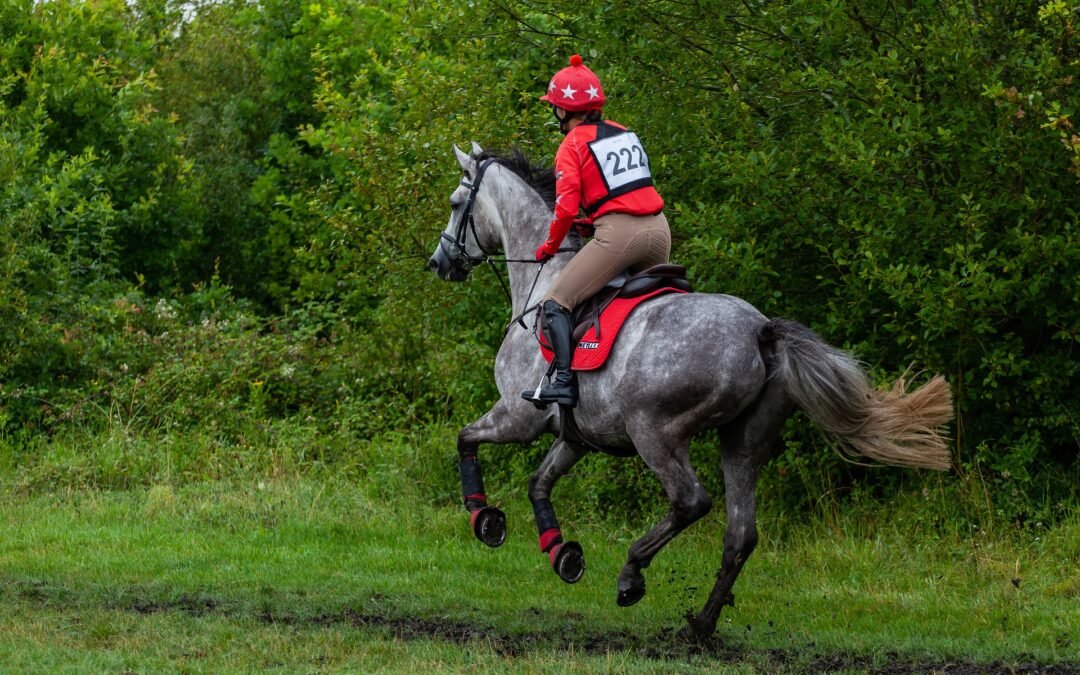
You will have a tendency to sit on your pubic bone instead of your seat bones. And because you are sitting more forward you will further increase the already dominant arch in your lower back. This reduces the suppleness of your shoulder girdle and hips. Which may result in being able to obtain an elastic contact (give and take with ease).
Due to the tight muscles in your quadriceps and TFL. You will also ride fairly short to counterbalance your seat and torso position. This makes you feel perched and unstable at times. It is most noticeable through downward transitions.
Anterior Pelvic Tilt is visible during horse riding. Photo thanks to the courtesy of EquinePhotoDesign.com
A Posterior Pelvic Tilt (PPT)
A Posterior Pelvic Tilt is when your pelvis is rotated backward which causes the back to be pulled downwards giving the appearance of a [Flat Back and Flat Bum].
What muscles does PPT affect?
When you have a PPT you would have short & tight Hamstrings (back of legs), tight abdominal muscles (no, this is not a benefit as it will also be pulling on the pelvis, upwards which will make the PPT worse), and tight Glutes (bum), Weak Hip Flexors and lower back.
How does a PPT affect your riding?
You may find that you round your shoulders and carry your hands forwards and collapse through the chest and look downwards (think slumping in a chair).
You will often feel left behind in the saddle and you can rely on your reins for balance as you are not able to engage your core and left your chest high.
Because of the slumping type of posture, the back is compromised and there is no ‘natural’ curve in the lower back which inhibits the spines’ ability to absorb shock. This can lead to pain over time and even compromise the structure of the spinal discs.
Posterior Pelvic Tilt visible during horse riding. Photo thanks to the courtesy of EquinePhotoDesign.com
Does having a non-neutral Pelvic Tilt really matter?
It really depends on the extent of the tilt and whether you have any issues with riding and/or are suffering from some pain of some sort after riding.
More often than not, pelvic tilts occur over time from lack of exercise, mobility, and poor posture. Because it is often gradual, we don’t realize the effect it has on us.
The pelvis should have the mobility to move through the anterior, neutral, and posterior positions. When it is rigid it can cause a number of issues. From increased tension in the shoulders/neck to lower back ache/pain. You may even experience ‘Sciatic Symptoms’, due to the tight glutes applying pressure on the sciatic nerve. This can lead to pain and tingling sensations down one side. As well as a possible weakness in the knee and foot. This will, of course, affect your ability to control your legs.
Sciatica can only be determined by MRI, otherwise, it is a symptom. Which can typically be treated when the cause is addressed.
How do I know if I do have a Pelvic Tilt?
It is often best to seek advice from a Soft Tissue Therapist or Sports Therapist as finding the anatomical structures on your body yourself can be difficult!
Watch these videos which explain a little more about how to test yourself or ask someone to help you.
To correct a pelvic tilt you should stretch the short and tight muscles and do a range of exercises to increase mobility and strength.
Below I have listed some exercises for you to try. The links take you to videos on the RiderCise® Facebook page. This allows you to see how to perform the movement.
In this article, I will show you the common stretches that can be performed before and after you ride to help prevent knee pain when riding.
It’s important to note that Riding itself doesn’t cause knee pain, it simply highlights an underlying issue. If you haven’t already, check out my article on the causes of knee pain in horse riders.
Overview of Causes of Knee Pain in RidersThe most common reason for knee pain in horse riders is due to muscular tension around the quadriceps. The quadriceps tendon runs over the knee cap and attaches just below.
Tightness in the hamstrings can also cause knee pain because the hamstring tendons run over the back of the knee and attach to the lower leg bones (tibia & fibular).
Because the tendons run over the knee joint they can cause pressure which makes it feel like there is a problem with the knee itself. Actual knee issues such as arthritis can be officially diagnosed by an MRI or X-Ray.
When a rider experiences knee pain when riding and/or generally the most common reaction is to limit movement and exercises. This can actually contribute to the pain you are experiencing and over time, make it worse.
Even if you have a confirmed diagnosis of arthritis in the knees. Not stretching and exercising will contribute to the pain you are experiencing.
Stretches to Prevent Knee Pain when Riding
Is it really just 2 stretches? yes! stretching out the quadriceps and hamstrings before and after riding will really help you reduce knee pain when in the saddle. If you can do these stretches daily to, whether you ride or not, then you will experience less and less pain in the knees overall.
Quadricep Stretch
There are two versions of the quadriceps stretch. There is a basic stretch for those that really struggle with their range of movement and a more advanced stretch for those that have good mobility.
Both stretches are highly effective.
Option 1 – Easier
Hold for 30 seconds on each leg
Place a hand on the wall/fence or use a broom to balance yourself.
Keep your standing leg soft at the knee (not locked out)
Bend the knee behind and grasp the front of your foot (or use a lead rope/band to help you)
Gently pull the foot towards your bottom
Make sure that your upper body remains as straight as possible
Avoid tilting the pelvis
Option 2 – Harder
Hold for 30 seconds on each leg
Place the front of your foot on a mounting block, low wall, or bench (about 1meter high)
Rest on a broom or stick in front of your body, to help balance yourself.
Slowly bend your standing knee so you dip downwards keeping the bent knee pointing downwards
Go as low as you can comfortably until you feel the stretch in the front of your bent leg
Make sure that your upper body remains as straight as possible
Avoid tilting the pelvis
Hamstring Stretch
Again there are two versions. An easier one for those that have a limited range of movement in their hip and a stretch for those with greater mobility. If you don’t feel the stretch in the back of your leg, the hamstrings, move back and forth slightly, gently, till you do. Everyone is different so you may just need to ‘adjust’ yourself slightly.
Option 1 – Easier
Hold for 30 seconds on each leg
Place one foot around 1meter in front of your body
Keep the back leg soft at the knee (not locked out)
Rest on a broom or stick to the side of your body, to help balance yourself.
Bend forward from the hip, keeping your back straight throughout
Keep foot flat on the floor or lift the toes to intensify the stretch
Option 2 – Harder
Hold for 30 seconds on each leg
Place the heel of your foot on a mounting block, low wall or bench
Keep the chest high
Keep the back leg soft at the knee (not locked out)
Rest on a broom or stick to the side of your body, to help balance yourself.
Bend forward from the hip, keeping your back straight throughout
Keep the leg straight to feel the stretch closer to the knee
Bend the knee and bend forward from the hip to feel the stretch closer to your bottom
The Golden Rule for Horses and their Riders
The golden rule of horse rider welfare and fitness, as well as horses, is ‘Lengthen, Strengthen, REPEAT. When a horse gets a muscular/tendon injury. They must of course rest first then lengthen the muscle/tendon and strengthen over time. Lengthening can be therapy and/or walking in hand to start and is built up over time. Gradually increasing the time, intensity, and complexity (such as different terrain, up and down hills, pole work, in hand core work). This rehab work is done to ensure that the muscle/tendon can deal with the demand of being a horse and riding/competing, if applicable.
For riders, we typically spend the majority of our life sitting, standing, or moving with short strides. This causes the muscles in the legs to become shortened and tight. When muscles become shortened and tight they pull on the tendons that attach to the tibia bone.
You can learn more about how muscles can cause knee pain 👉 HERE
How to Prevent Knee Pain when Riding
Being active by walking the dog, doing yard duties etc do not use your muscles or joints through their full range. It is important to perform exercises that condition your muscles within their full abilities to prevent issues from arising.
Whilst stretching these muscles will help to elevate pain/discomfort caused by tight muscle tendons pressing on the knee joint it will take time. To alleviate it quicker you should consider strengthening exercises. This will also help to prevent knee pain when riding, and in general, long term.
Do you suffer from Rider Knee Pain during and/or after time in the saddle? Or perhaps you suffer from knee pain every day and riding makes it worse? In this article, I am going to explain some reasons why you may be suffering and how you can determine the cause and manage the pain.
Causes of Knee Pain
Causes of knee pain include arthritis, strained ligaments, tendonitis, and muscular tightness. You could have any of these that are more noticeable through riding but riding itself doesn’t cause knee pain.
Arthritis
There are 3 types of Arthritis:
Osteoarthritis
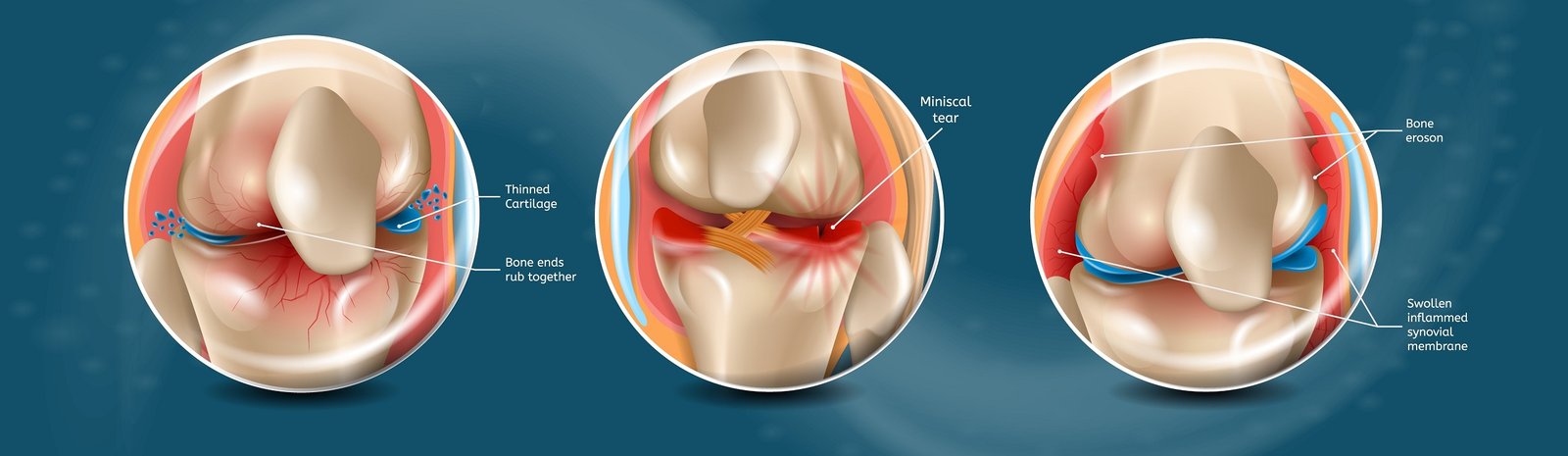
This is the most common of the types. Osteoarthritis wears down the cartilage which is the cushioning between the bones in your knee joint. Without the cartilage, the bones rub together which causes pain, stiffness and restricts movement.
Post-Traumatic Arthritis
Following a trauma like a break or an impact. The cartilage starts to thin and the bones rub together and cause the same symptoms as Osteoarthritis. It may be years after the trauma before you notice.
Rheumatoid Arthritis
This is an autoimmune disease where your unhealthy immune system triggers inflammation in your joints even though there is no need for the body to do so. It believes there is an infection, an injury or a foreign invader when there is not.
When you believe you have arthritis you will visit the doctor who will check if the joint is swollen/inflamed, the range of movement and ask a number of questions. The one key point to remember is.
To diagnose arthritis of the knee officially, you will need an X-Ray and/or MRI.
You cannot diagnose without. It is an assumption.
Meniscus Tear
The meniscus is a piece of connective tissue that sits below the thigh bone (femur) in the knee joint. It acts as a shock absorber and enhances the stability of the joint. They are often caused by sharp sudden changes in direction such as in football or running. The cartlidge also thins as we age.
In a meniscus tear, you will often experience intermittent knee pain which can be sharp. This is because when you bend and straighten the leg the flap of the tear can get caught on the knee bone. Sometimes it will stay caught for a period of time which causes constant pain until the flap returns. Other times the flap just ‘flicks’ as the knee bends and straightens which causes the sharp shooting pain. Not always, but you may also experience swelling.
There are a number of movement tests that can be performed to assess if you have a meniscus tear although these are not reliable as the tests may not move the flap at that given time. Similar to arthritis. The only way to know for sure is to have an X-ray or MRI
Ligament Sprain
Similar to a meniscus tear, you can strain your knee ligaments by sudden changes in directions, twisting of the knee, or over-reaching. A sprain may also be caused by impact.
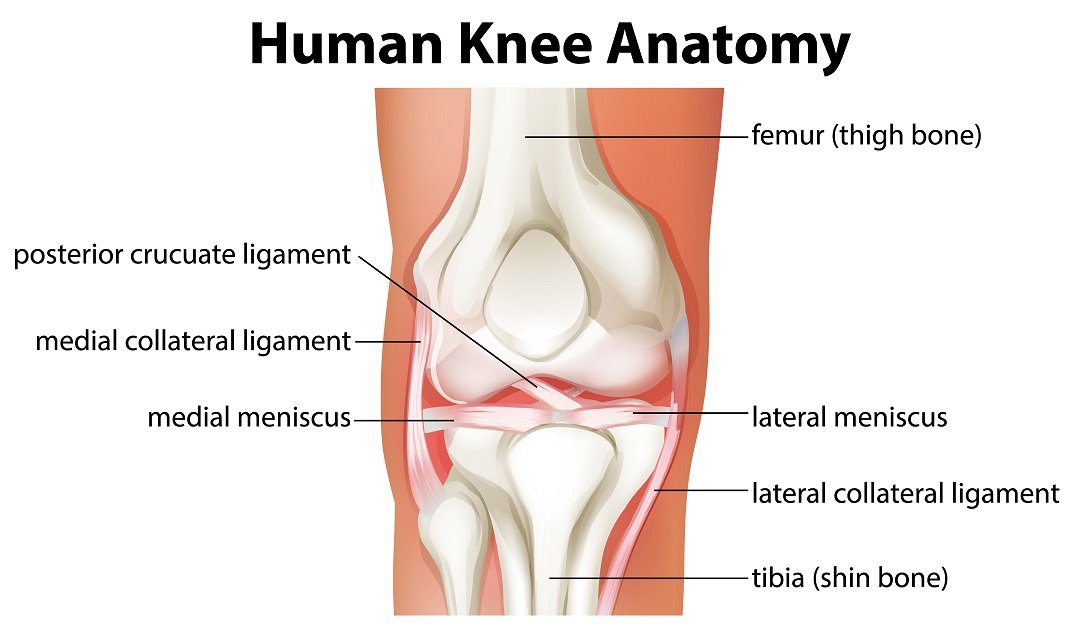
There are 4 ligaments within the knee joint.
Posterior cruciate Ligament (PCL) - Controls backward movement of the shin bone
Anterior Cruciate Ligament (ACL) - Controls rotation and forward movement of the shin bone
Medial Collateral Ligament (MCL) - Provides stability to the inner knee
Lateral Collateral Ligament (LCL) - Provides stability to the outer knee
Tendonitis
When a tendon becomes inflamed it causes swelling, pain, and discomfort. There are many causes of tendonitis such as strain, overuse, injury, or too much exercise. To determine if you have tendonitis a doctor will take a small amount of fluid from the joint to test. Tendonitis can occur anywhere in the body but for the knee to be affected it is normally associated with those that run or cycle long distances and those that play jumping sports such as basketball where the force of hitting the grounds strains the tendon.
Muscular Tightness
The quadriceps tendon (front of thigh) sits over your kneecap and your hamstring (back of thigh) attaches to the back of the knee
When these muscles, either individually or separately, become tight. The muscle shortens pulling the tendon taut across the joint which applies pressure to the knee area. This pressure can make it feel like the issue is within the knee itself. Inflammation doesn’t usually occur from muscular tightness but it is possible. Especially if you have tight muscles and riding is aggravating those tight muscles.
Tightness in the quadriceps and hamstrings can occur in many ways. Such as being inactive, sitting for long periods of time. Repetitive exercises which target these areas but are never stretched/massaged.
Muscular tightness can be assessed formally by Soft Tissue Therapist.
How Do you Find out Why You Have Knee Pain?
As you can see from the possible causes above the knee pain symptoms you may be experiencing are all similar. If you are concerned that it is possibly anything other than muscular tightness then go to your doctor and ask for an X-ray or MRI. There are other methods but these are the most common. Such tests are the only way you will know for sure.
Assuming that the doctor has cleared you, muscular tightness may be the cause of your knee pain. A Sports or Soft Tissue therapist can identify which muscles may be causing you the issues.
Alleviating Knee Pain
In case you have tendonitis then you will need to reduce activities and reduce the inflammation by applying an ice compression. If it doesn’t improve your doctor may discuss steroid injections or surgery. Because of its nature, you will need to be guided by your doctor and work with them until the issue is resolved. Be strong and if you are not getting answers. Ask them to refer you to a specialist.
If the cause of your knee pain is arthritis or muscular tightness the best way to manage pain is to actually lengthen the muscles surrounding the knee joint through stretching and massage and improve the strength in your legs. The more you move, the better it will become. Having regular Sports massage or Soft Tissue therapy (not holistic massage) will also improve the tightness in the muscles as well as aid recovery in the muscle fibers.
You can of course take pain relievers and anti-inflammatories but on the understanding that this will simply mask the problems. It will not solve them.
Will Riding Make my Knee Pain Worse?
As mentioned above. Riding doesn’t cause knee pain but it will highlight that there is an underlying issue. Without knowing what that underlying issue is and then dealing with it then yes. Riding will make the knee pain worse.
The truth is many riders don’t know the real reason for their knee pain. It has not formally been diagnosed, rather just ‘labeled’. When you have tight leg muscles and/or arthritis of the knee then not exercising and having regular sports massage only makes it worse over time. Riding will become more and more uncomfortable.
Read our next article to learn how to Prevent Knee Pain when Riding
An equestrian workout is exercise aimed to specifically improve your riding. Using a range of variety to help ‘condition’ the rider’s body for the sport.
An equestrian workout is different from general fitness. Being fit generally means having the ability to perform everyday tasks with ease.
Whilst any form of fitness is beneficial, there is a difference between being fit and fit to ride. For you to become a conditioned rider you must train the muscles riders use, in the variety of ways the muscles operate when in the saddle.
What is an Equestrian Workout - And Why It Matters
Sports like horse riding, at any level and in any discipline, require the rider to have the appropriate strength, mobility, and awareness to meet the demands of the sport.
An equestrian workout is designed specifically to prepare your body for those demands — not just to improve general fitness, but to improve how your body actually functions in the saddle.
Because there is more to riding than simply not being out of breath.
Riding requires coordination, balance, control, and the ability to move your limbs independently while maintaining stability. This is what allows you to communicate clearly and effectively with your horse.
Unfortunately, activities like running, cycling, or yoga — while beneficial for general fitness — do not provide the full stimulus needed to support riding. They don’t train the specific movement patterns, control, or muscle coordination that an equestrian workout develops.
What Does an Equestrian Workout Actually Do?
An equestrian workout focuses on conditioning the muscles and systems your body relies on when you ride.
This includes developing:
Muscular strength
Cardiovascular fitness
Mobility
Coordination and reaction
Muscle recruitment (how muscles work together)
This is what rider conditioning really is — using targeted exercise to improve how your body performs in the saddle, not just how it looks or feels off it.
Why Riders Need Equestrian Workouts Specifically
Whether you are a leisure rider or a competitor, following a structured equestrian workout approach is important — not just for you, but for your horse.
Horse riding requires multiple muscle groups to work together to keep you balanced, stable, and aligned without collapsing or relying on the horse for support.
Without this, riders often compensate by:
Pulling on the reins
Gripping with the knees or thighs
Collapsing during transitions
Losing balance in the saddle
These are not conscious choices — they are physical responses to a body that isn’t fully prepared for the demands of riding.
If your body hasn’t been conditioned correctly, it can also lead to:
Slower progress in your riding
Increased fatigue
Aches and pains after riding
An effective equestrian workout helps prevent this by preparing your body to meet those demands properly.
How Your Body Affects Your Horse
When you are not in control of your body, it directly impacts your horse.
It can lead to:
One-sidedness
Uneven muscle development
Tension or soreness
If you collapse during a transition, your body will instinctively try to stabilise itself. Most riders do this by gripping or using the reins.
This is a natural reaction — but it is not an effective one.
To stabilise correctly, your body needs coordinated activation from multiple muscles, including:
Glute medius
Transversus abdominis
Multifidus
Obliques
Diaphragm
Erector spinae
This level of control doesn’t happen automatically. It requires targeted training — which is exactly what an equestrian workout develops.
Why General Fitness Isn’t Enough
One of the biggest misconceptions is that general fitness translates directly to riding.
It doesn’t.
Running improves cardio but not rider-specific strength
Yoga improves mobility but not control or stability under load
Cycling builds strength but limits mobility and coordination
Each form of exercise has benefits — but none of them fully prepare your body for riding on their own.
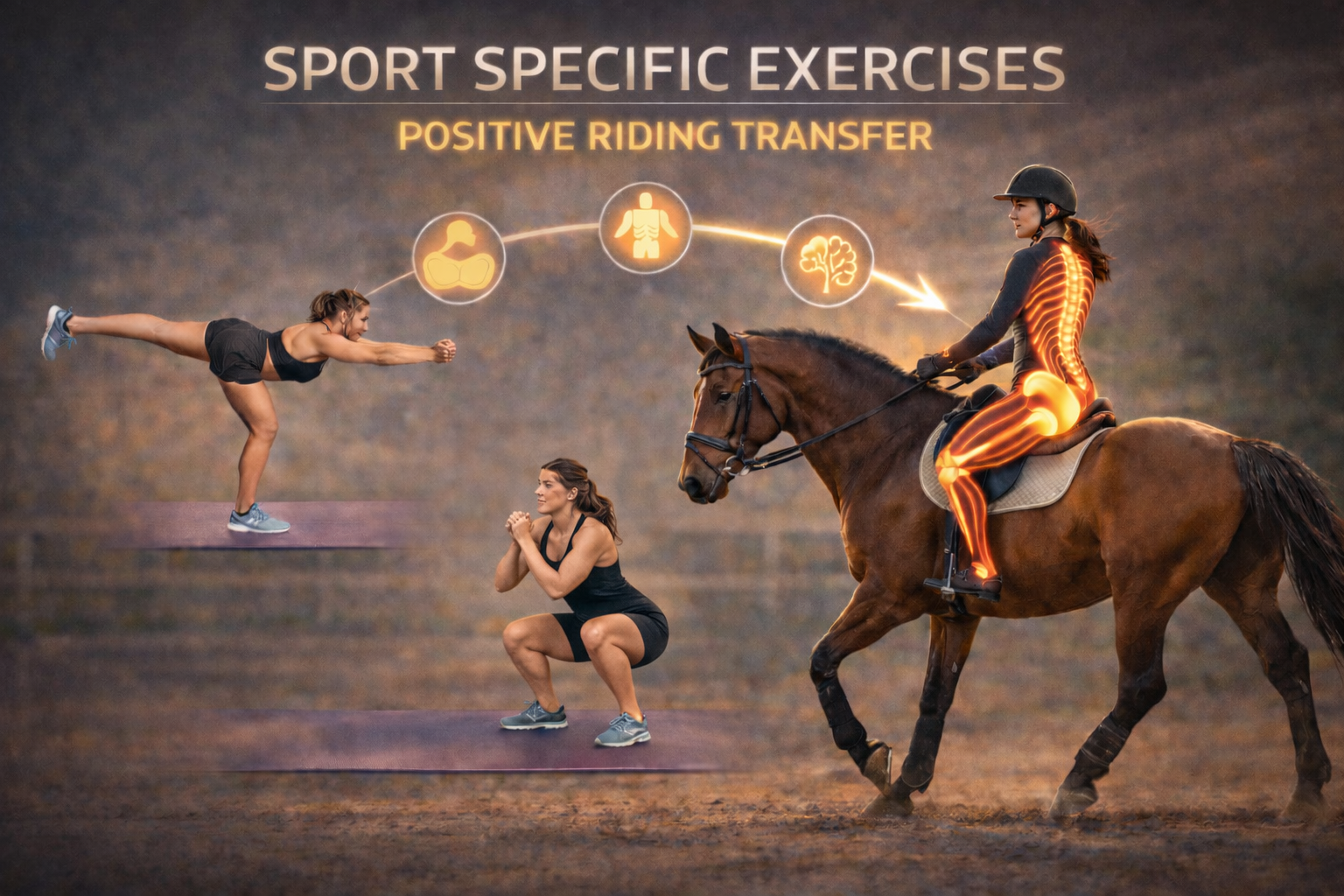
An equestrian workout bridges that gap by combining all the elements you need in a way that directly transfers to the saddle.
How to Build an Effective Equestrian Workout Routine
To become properly conditioned for riding, your training needs to develop:
Strength to maintain posture
Coordination so muscles work together
Cardio fitness to sustain performance
Mobility for independent movement
You can achieve this by combining different types of exercise — for example:
Strength training + mobility work
Cardio + coordination-based training
But the key is not just doing more — it’s doing the right type of work.
That’s what makes an equestrian workout different.
It is structured, specific, and designed to improve how your body performs when you ride.
The Bottom Line
Riding well places a significant demand on your body.
If your body isn’t prepared for that demand, it will compensate — and those compensations are what show up in your riding.
An equestrian workout doesn’t just make you fitter.
It improves your control, your balance, your communication, and ultimately, your partnership with your horse.
Because better riding isn’t just about what you do in the saddle.
It’s about what your body is capable of producing when you’re in it.
Start Understanding Your Body First
If you want to improve your riding, the first step isn’t doing more — it’s understanding what your body is currently doing and why.
✔ What I look for when assessing riders ✔ How your movement patterns affect your riding ✔ Why your body responds the way it does in the saddle
Ready for a Structured Equestrian Workout?
If you’re ready to go beyond awareness and start improving how your body actually performs in the saddle, my rider-specific programs are designed to give you that structure.
These are not generic workouts. They are targeted equestrian workouts built to improve:
✔ Strength ✔ Stability ✔ Coordination ✔ Balance ✔ Control