You’ve had the lessons. You’ve heard “sit up,” “use your core,” “heels down” more times than you can count. Yet the moment your horse spooks, changes tempo, or drifts through a corner, you’re grabbing mane, gripping with your knees, or catching yourself falling to one side. If that sounds familiar, you’re not alone. You’re not doing anything wrong, either. You’re missing a piece most balance exercises for horse riders never touch: proprioception.
Why Riders Feel Wobbly in the Saddle (and Why Fitness Alone Won’t Fix It)
Here’s the truth most fitness plans won’t tell you. A wobbly seat usually isn’t about weakness. It’s a learned habit.
Your body is smart. Over years in the saddle, it finds ways to feel safe, even if those ways look messy from the ground. Gripping with your knees. Bracing through your lower back. Collapsing one hip in transitions. These aren’t laziness. They’re protective patterns your nervous system built to stop you feeling like you’ll fall off.
Most rider instability isn’t caused by low fitness. Your body has simply learned to stabilise and protect itself over years of riding. That’s why isolated drills, done on their own, rarely fix a wobbly seat for good.
You can do a hundred crunches and still feel unsafe at trot. You can be strong in the gym and still lose a stirrup on a sharp turn. Strength alone doesn’t teach your body when and how to use that strength in the saddle. That connection is proprioception’s job.
What Proprioception Has to Do With Your Seat
Proprioception is your body’s sense of where it is in space, without needing to look. It’s what lets you know your leg has drifted back without glancing down, or that your weight has shifted onto one seat bone before your instructor even says a word.
For riders, proprioception is everything. It’s the difference between reacting after you’ve already lost your balance and adjusting before your horse even notices. A rider who grips with their knees or collapses through one hip under transitions is often compensating for weak proprioceptive feedback, not a lack of effort. It’s a pattern you see constantly in riders who plateau despite years of regular lessons.
The good news? You can train proprioception. That’s what the drills below are built to do.
Balance Exercises for Horse Riders You Can Do Off the Horse
Good news: you don’t need a horse, or even a riding arena, to start rebuilding your balance. These are the best balance exercises for horse riders because they train your body to recognise and correct small shifts in weight, exactly what your horse asks of you every stride.
Single-Leg and Unstable-Surface Drills for Proprioception
These drills challenge your body to stabilise on a smaller, less predictable base, just like your seat has to do in the saddle.
🦵 Single-leg stand: Stand on one leg for 30 seconds, eyes open, then eyes closed. Closing your eyes removes visual feedback, so your body has to rely on proprioception alone.
🌀 Wobble cushion or balance pad work: Stand or do gentle squats on an unstable surface. Your ankles, hips and core all have to fire together to keep you upright.
🔄 Single-leg reach: Balance on one leg and reach the opposite hand towards the floor, then return to standing. This mimics the small corrections your seat makes when your horse shifts underneath you.
↔️ Lateral step-overs on an unstable surface: Step sideways over a low object while balancing on a wobble pad. This builds the side-to-side stability you need for lateral work.
Core and Pelvis Control Exercises for Seat Stability
Balance isn’t just about your legs. Your seat stability depends on how well your pelvis and core respond, moment to moment, in the saddle.
🎯 Controlled pelvic tilts: Sitting or lying down, gently rock your pelvis forward and back, feeling the small muscles that control your seat bones. This is the same movement that lets you follow your horse’s motion instead of blocking it.
🐛 Dead bugs: Lying on your back, slowly extend opposite arm and leg while keeping your lower back pressed into the floor. This trains core control without gripping or bracing.
🧘 Bird dogs on an unstable surface: From all fours on a cushion or mat, extend opposite arm and leg. This challenges balance and core stability together, much like you need when your horse is moving unpredictably beneath you.
Aim for two to three short sessions a week. Consistency matters more than intensity here. You’re retraining a habit, not building brute strength. Little and often beats one long, exhausting session.
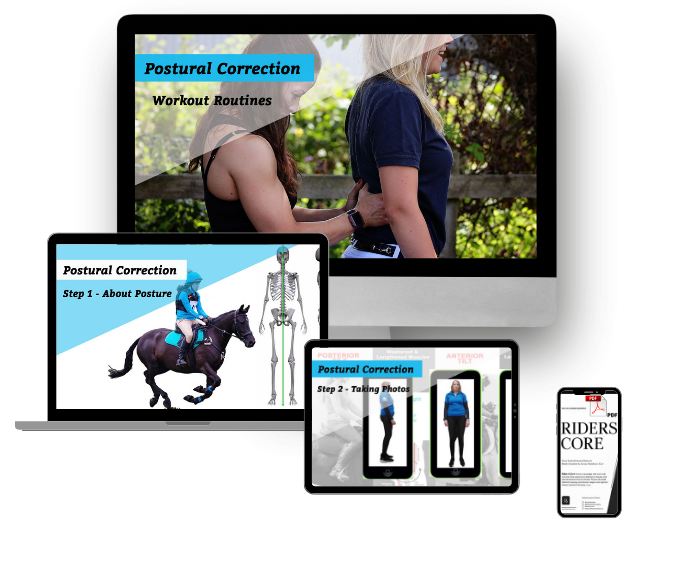
Your core consists of over 35 muscles, it is not just abdominals. This is something that is explained in depth in the Rider Core Mini Course.
How Proprioception Training Improves Balance Riding in the Saddle
These drills aren’t just gym exercises. Each one has a direct payoff once you’re back in the saddle.
Quieter hands come from a stable seat, not a stronger grip on the reins. When your pelvis and core can absorb your horse’s movement, your hands stop bracing for balance and can finally stay soft and independent.
Fewer lost stirrups happen when your ankles and hips have practised reacting to instability, rather than freezing when it happens. The single-leg and wobble-pad drills train exactly that instinct.
Better transitions come from a body that can shift its centre of gravity smoothly, instead of throwing itself backwards or forwards. Pelvic control work builds that adjustment before you ever ask for the transition.
Lateral work, leg yield, shoulder-in, half-pass, asks your seat to stay balanced while your horse moves sideways underneath you. Lateral step-overs and single-leg reaches build the exact stability that lateral work demands.
Improving your balance while riding isn’t about trying harder in the saddle. It’s about giving your body the proprioceptive skills it needs before you even get on.
Building a Structured Stability Training Routine With the Signature Bundle
Here’s the problem with piecing together random balance-board videos from the internet: there’s no progression, no rider-specific focus, and no way of knowing if you’re actually getting better or just repeating the same plateau.
RiderCise programmes are built specifically around the physical demands of riding, unlike generic gym or Pilates plans. Founder Clare works directly with riders who plateau despite regular lessons. That’s exactly why structure matters more than random effort.
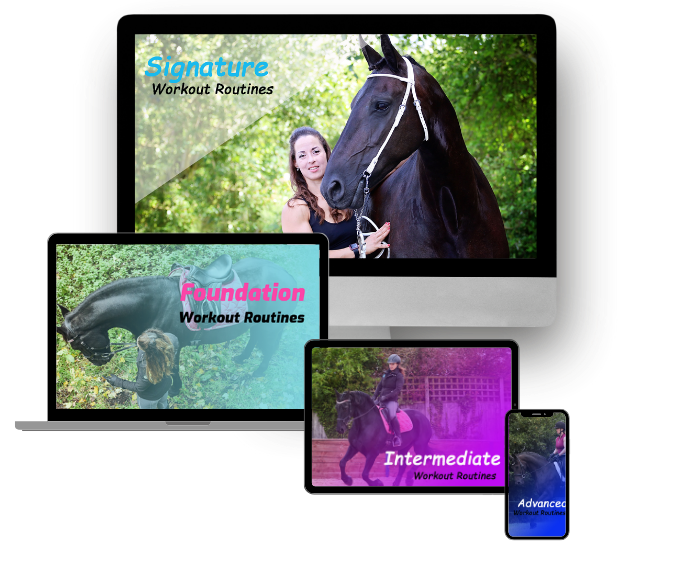
The Signature Workout Bundle takes the drills above and builds them into a progressive plan. It doesn’t leave you guessing what to do next once single-leg balance starts to feel easy.
What’s Included and Who It’s For
The Signature Bundle is built for riders who are done with generic fitness advice that ignores what actually happens in the saddle. It combines stability, core and proprioception work into a structured programme you can follow at home, with lifetime access so you can revisit and progress at your own pace.
It’s for you if you’ve had years of lessons but still feel wobbly in transitions. It’s for you if you’re strong in the gym but weak in the saddle. It’s for you if you’re ready to stop guessing and start training with a plan built for riders, not gym-goers.
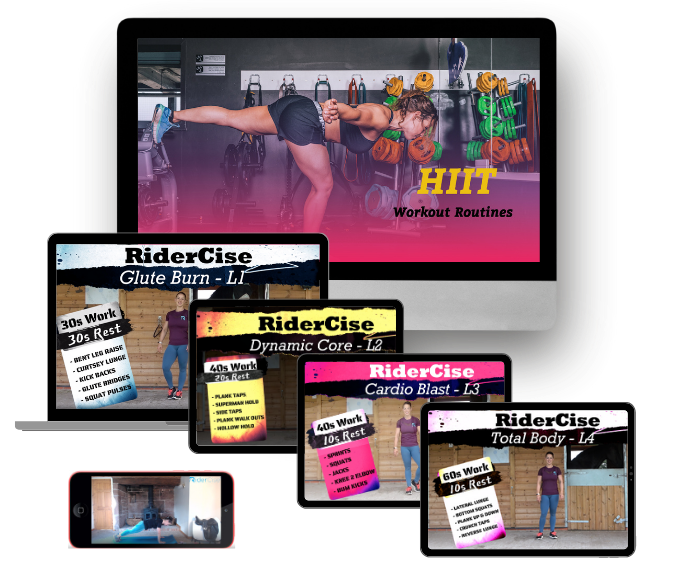
Pair it with work on improving your riding position off the horse for a fuller picture of how your body holds itself, both on and off your horse. If you also carry tension or discomfort in your back, exercises to ease riding-related back pain tackle a closely related issue. And if your goal is overall fitness alongside stability, HIIT workouts to build overall match fitness round out your training week.
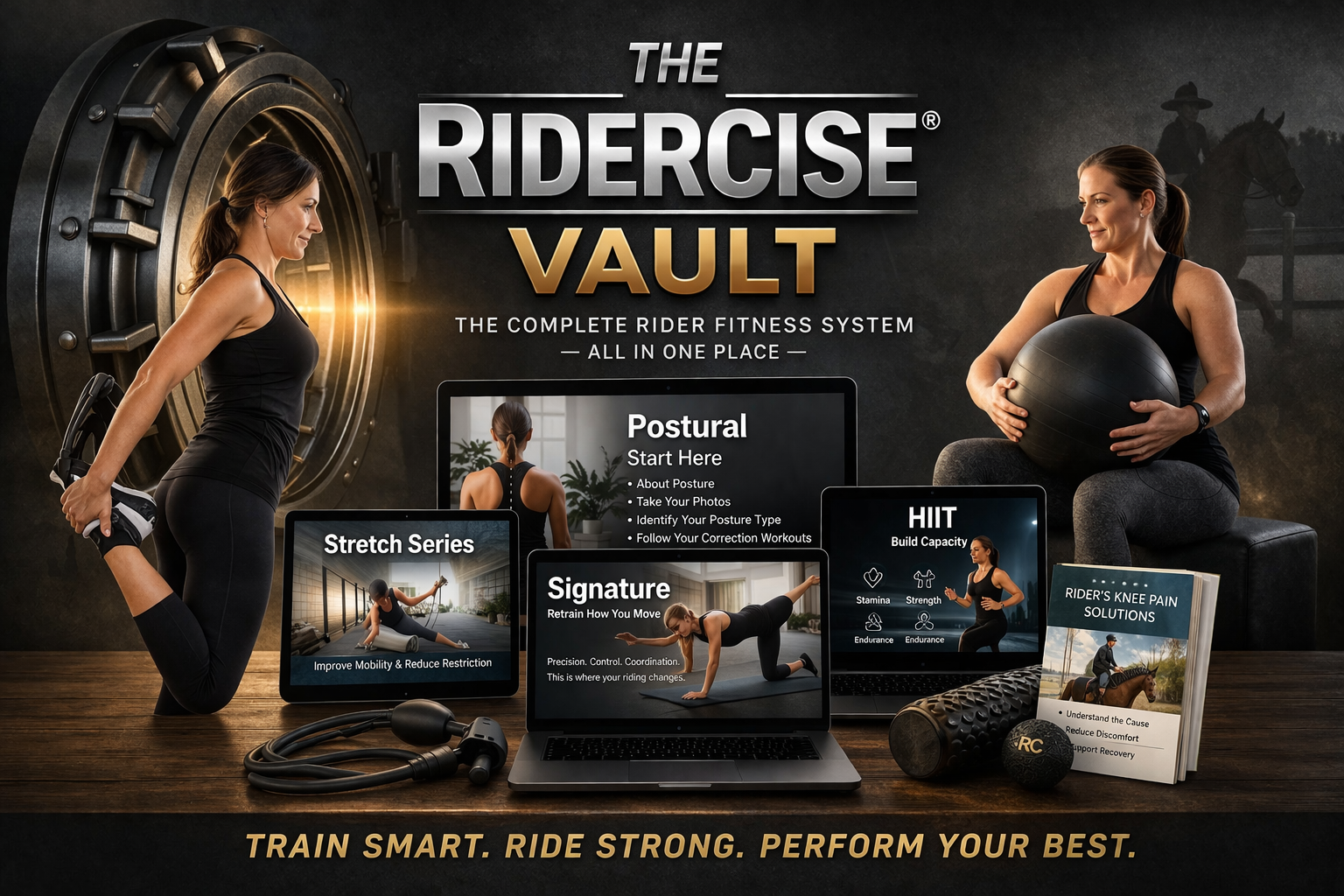
Not sure where the Signature Bundle fits among everything RiderCise offers? The full range of RiderCise workout bundles gives you the full picture before you choose.
Common Mistakes That Keep Riders Wobbly Despite Practising
You’re putting in effort. So why isn’t it working?
Overtraining generic gym balance work. Standard balance-board routines, the kind built for footballers or general fitness, don’t account for how a rider’s seat needs to move. Riding asks for controlled instability, not rigid balance. Train the wrong pattern and you’ll get better at standing still, not at absorbing your horse’s motion.
Ignoring asymmetry. Almost every rider is stronger, more stable, or more coordinated on one side. Do drills evenly on both sides without addressing that imbalance, and your weaker side stays weak. That’s usually the side your instructor keeps correcting.
Stopping once basic balance improves. Feeling steadier standing on one leg at home doesn’t automatically mean you’ll feel steadier at canter. Riders often stop progressing their off-horse training the moment it starts feeling easy. They miss the harder proprioceptive challenges that would actually transfer to the saddle.
The fix for all three is the same: rider-specific progression, not random repetition. That’s the gap a structured programme is built to close.
Your Next Step: From Wobbly to Secure in the Saddle
You know the pattern now. Instability isn’t a character flaw or a fitness failure. It’s a habit your body learned to protect itself. Proprioception is how you unlearn it.
Off-horse drills give you the raw material. A structured plan gives you the progression. Consistency, two to three sessions a week, gives you the results.
If you want to understand the biomechanical “why” behind your wobble before you dive into training, the Rider Core Mini Course walks you through it. If you’re ready to start building strength, balance and stability in a structured way, the Signature Workout Bundle is where that work begins.
Your horse feels every wobble, every brace, every grip. Give them a rider who’s put in the work to stay steady, whatever they throw at you.