You’ve had the lesson. Your instructor said “sit taller,” “stop gripping,” “use your core”, again. For a stride or two, it worked. Then your body did what it always does, and you were back to bracing, tipping, or losing a stirrup.
If that sounds familiar, you’re not failing at riding. You’re missing the piece that no lesson, on its own, can give you: strength and control built off the horse.
Why Coaching Alone Often Can’t Fix Riding Position Problems
Good coaching matters. A sharp instructor can spot the moment your shoulder drops or your hip collapses, and call it before you even feel it. But spotting a fault isn’t the same as fixing it.
Correcting position purely through lesson-time cues asks your body to do something it hasn’t been trained to do. Gripping, bracing, collapsing, these are often the way your body has learned to cope with a strength or stability gap. Tell it to stop without addressing that gap, and it will simply revert once your concentration slips.
That’s why so many capable, committed riders feel stuck. They’re doing the work in lessons. They’re listening. They’re trying. The problem isn’t effort.
The Limits of ‘Sit Taller’ and ‘Use Your Core’ Cues
“Sit taller” assumes your postural muscles can hold that taller position for a whole session. For many riders, they can’t. Not yet. “Use your core” assumes you know which muscles that means, and that they’re strong enough to fire on demand at trot, canter, or over a fence.
Most rider position problems aren’t caused by lack of effort or fitness. They come from how your body has learned to stabilise and protect itself over time. That’s why coaching corrections alone often don’t stick. Your instructor can give you the cue. Only consistent, targeted training off the horse builds the capacity to actually hold it.
What’s Really Behind Common Riding Position Problems
To fix riding position for good, you need to understand what’s driving it in the first place. Position faults are rarely random. They’re your body’s best attempt at managing a weakness, an old injury, or a habit built up over years of sitting, driving, and desk work.
Gripping, Collapsing, and Losing Stirrups Explained
Gripping with the knee usually means the deeper stabilising muscles of the hip and thigh aren’t doing their job, so you clamp with whatever muscle is available instead. Collapsing through one hip is often a sign of asymmetric strength or an old injury that never fully resolved. Losing a stirrup repeatedly can point to weak ankle and calf stability, or a seat that isn’t independent of the leg.
A rider who grips with the knee, collapses through one hip, or loses a stirrup repeatedly is usually compensating for a strength or mobility limitation. Not “not concentrating.” These aren’t character flaws. They’re physical patterns, and physical patterns respond to physical training.
How the Body Learns to Compensate in the Saddle
Your body is efficient. If a muscle group is weak, it recruits another to get the job done, even if that’s the wrong muscle for the task. Over months and years in the saddle, that compensation becomes automatic.
Add in a desk job, an old fall, or simply years without targeted strength work, and it’s easy to see why so many riders develop the same handful of faults. This is the real story behind rider posture correction: it’s a strength and movement issue first, a discipline issue second.
How to Improve Riding Position With Off-Horse Strength Training
This is the gap most position advice skips entirely. Coaches teach you what correct looks like. Almost none of them give you a plan to build the strength to hold it. That’s where a dedicated off-horse routine comes in. It’s genuinely how you improve riding position for the long term, not just for one lesson.
Core and Postural Exercises for Riders
Riders don’t need a generic six-pack workout. You need deep core activation, the stabilising muscles that hold your trunk upright without you thinking about it, stride after stride.
You also need glute and hip stability work, so one side of your pelvis stops doing more than the other. And you need targeted postural exercises for riders that train your back and shoulders to stay open and tall under load, rather than rounding forward as you tire.
Done consistently, this combination is what lets “sit taller” finally become something your body can sustain. Not just something you’re told.
Mobility Work for a More Independent Seat
Strength without mobility only gets you halfway. Tight hips lock you out of a deep, following seat. A stiff thoracic spine keeps your shoulders rounded no matter how many times you’re told to open your chest.
Mobility work through the hips, spine, and ankles frees up the range of motion your body needs to absorb movement rather than resist it. That’s the foundation of a truly independent seat, one that doesn’t rely on gripping to stay in place.
Building a Simple Off-Horse Fitness Routine to Fix Your Riding Position
You don’t need hours in a gym. You need consistency, and a plan built around what riding actually demands of your body.
Short, focused sessions a few times a week will do more for your position than an extra lesson alone. Combine core activation, hip and glute stability, and mobility work. The key is progression: as one pattern becomes easier, the exercises should ask a little more of you, so your body keeps adapting rather than plateauing.
This is also where consistency compounds. A single strong session won’t undo years of compensation. A structured, repeated routine will. And it will show up in your riding faster than you’d expect, because you’re finally training the cause, not just correcting the symptom in the saddle.
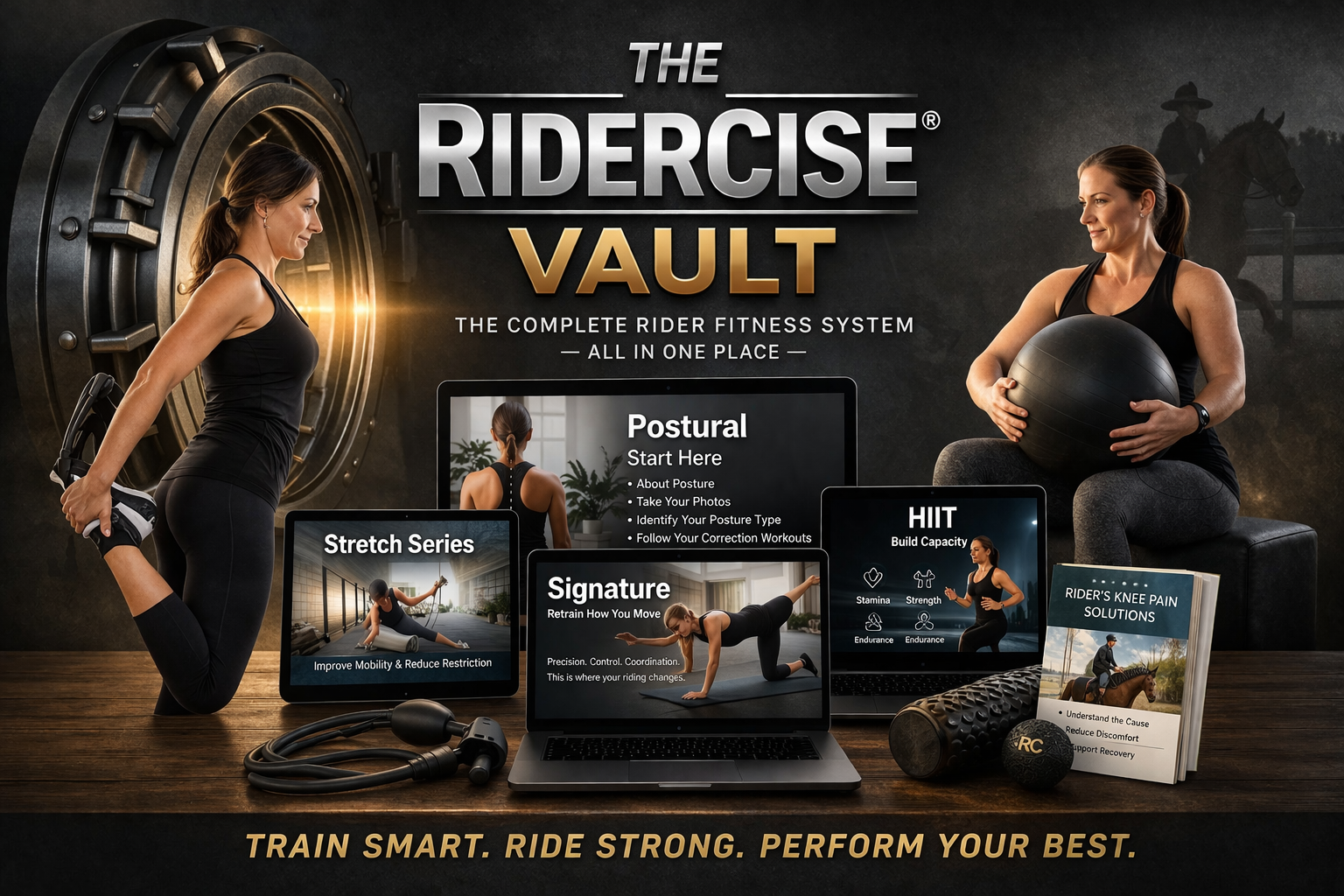
If you want a broader view of how different training options fit together, it’s worth exploring RiderCise’s full range of rider fitness bundles to see where your own routine could start.
When to Get Structured Support for Rider Posture Correction
Trying to piece together your own programme from articles and old memories of Pilates class is exhausting, and it rarely targets the exact patterns riding creates. Riders who try generic Pilates or yoga programmes often report little lasting change in the saddle. Those programmes aren’t built around the specific muscle patterns and asymmetries riding creates.
Signs You’d Benefit From a Dedicated Programme
You’ll likely benefit from a structured, riding-specific programme if:
🐴 Your instructor gives you the same correction lesson after lesson, with no lasting change
🐴 You know your position isn’t symmetrical, but you’re not sure why
🐴 You’ve tried general fitness classes and seen little translate to the saddle
🐴 You lose your stirrup, grip, or collapse under fatigue rather than from day one
🐴 You want to feel stronger and more in control, not just “less told off” in lessons
RiderCise built its Rider Core Mini Course specifically for riders who’ve heard “sit taller” or “use your core” over and over in lessons, with no lasting change. It’s a widespread pattern, not an individual failing. If that’s you, the Rider Core Mini Course is a focused way to start.
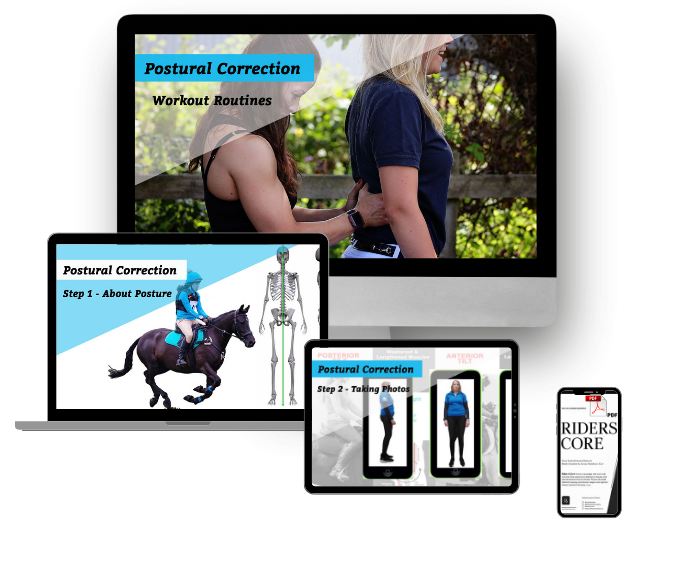
For riders ready to build strength and postural control together, RiderCise structures its Postural Workout Bundle around the specific stabiliser muscles and postural habits riders need off the horse to translate into a straighter, more balanced seat on the horse. Explore the Postural Workout Bundle if you recognise your own position problems in this article.
If your position issues are longstanding, tied to an old injury, or feel more complex than a self-paced programme can address, a bespoke coaching programme gives you personalised guidance built around your body specifically.
Frequently Asked Questions About Improving Your Riding Position
Why does my riding position keep breaking down even though I take regular lessons?
Lessons correct what your instructor sees in the moment, but they can’t build the strength and stability your body needs to hold that correction on its own. Without off-horse training, the old compensation pattern simply returns once you tire or stop concentrating.
What off-horse exercises actually improve riding position and equitation?
Exercises that target deep core activation, glute and hip stability, and thoracic and hip mobility make the biggest difference. These build the specific strength and range of motion riding demands, rather than general fitness alone.
How is fixing riding position different from general fitness like Pilates or yoga?
General Pilates or yoga programmes build overall strength and flexibility, but they aren’t designed around the specific asymmetries and compensation patterns riding creates. Riding-specific training targets those patterns directly, which is why it tends to translate into the saddle faster.
How often should I do postural exercises to see a change in the saddle?
Consistency matters more than intensity. Short, focused sessions done several times a week, with progression built in over time, tend to produce steadier, longer-lasting change than occasional long workouts.
Can poor riding position be corrected at any age or riding level?
Yes. You can train strength, stability, and mobility regardless of age or experience. The key is a programme built around your current body, not a generic one-size-fits-all routine.
What are the most common riding position problems and what causes them?
Gripping with the knee, collapsing through one hip, and losing stirrups are among the most common issues. Weak stabilising muscles, old asymmetries or injuries, and years of compensation usually cause them, not a lack of effort or focus.
Your instructor can see what’s wrong. Off-horse strength training is how you actually fix it. For good, not just for one lesson at a time.