You love your horse, but the thought of riding sometimes fills you with dread rather than joy. That disconnect is exhausting, and it feels like a personal failure. It rarely is. True confidence in the saddle is built on physical trust, and that only develops when your body feels stable enough to stop protecting itself from perceived danger.
Most rider problems aren’t caused by lack of effort or fitness. They come from how your body has learned to stabilise, protect and cope over time. Until you address those underlying physical patterns, no amount of positive self-talk will fully silence the anxiety that shows up when you pick up the reins. Confidence-building exercises for nervous riders have to target the neuromuscular system first. That’s what creates the foundation of safety that lets your mind finally relax.
Why Nervous Rider Confidence Starts With Physical Stability
Your brain constantly monitors your physical environment for threats. When it detects instability in the saddle, it triggers a protective tension response that mimics fear. What you interpret as psychological anxiety is often just your nervous system reacting to genuine physical insecurity. That’s why mindset work on its own isn’t enough. It ignores the sensory data driving the panic.
The Link Between Body Awareness and Fear of Falling Off Horse
The fear of falling off a horse is frequently a rational response to unconscious physical instability, not an irrational phobia. When your deep stabilisers fail to engage, your larger muscle groups compensate by gripping or bracing. That pushes you further out of alignment, which confirms your brain’s suspicion that you’re unsafe. Improving proprioception through targeted drills gives your nervous system accurate information about where your limbs are in space, and that directly reduces the need for defensive tension.
Why Mindset Work Alone Rarely Fixes Riding Anxiety
Riders who have been told to “sit taller” or “relax” repeatedly, without lasting change, often lack the underlying physical capacity to execute those cues. You cannot think your way out of a movement pattern that exists because your body lacks the strength or mobility to hold position under pressure. Visualisation and breathing techniques help you manage acute stress, but they don’t build the structural integrity you need to feel genuinely secure when the horse moves unexpectedly.
Nervous rider confidence needs physiological evidence of safety before psychological reassurance can take hold.
Ground-Based Balance Drills for Confidence in the Saddle
Practise balance without the variable of a moving horse and you isolate instability in a low-stakes environment, where your nervous system can learn new patterns without tipping into flight response. These specific balance exercises for saddle stability bridge the gap between static strength and dynamic riding demands. They give you tangible proof that your body can stay centred even when it’s challenged.
Single-Leg Stability to Reduce Gripping
Gripping with the knee or thigh is almost always a compensation for poor single-leg stability and weak glute engagement. Standing on one leg while keeping the pelvis neutral forces your foot and hip to communicate properly, which replicates the independent stabilisation you need to keep your leg long and draped around the horse’s barrel. Master this off the horse and you remove the desperate need to clamp on when you feel unbalanced, a primary driver of panic in anxious riders.
Pelvic Control Exercises for Independent Aids
Your pelvis is the centre of gravity and the primary interface for talking to your horse, yet many riders have no conscious control over its position. Tilting and rotating the pelvis deliberately, while keeping the ribcage stacked, teaches you to dissociate upper and lower body movement and stops the collapsing that leads to insecurity. That dissociation is essential for applying independent aids without losing your own balance. It turns vague feelings of wobbliness into precise, confident adjustments.
You deserve to feel capable and coordinated in your training, not perpetually frustrated by a body that seems to fight against your intentions.
Core Strength as the Foundation for Building Rider Confidence
Traditional abdominal workouts often make riding anxiety worse because they train flexion rather than the anti-movement stability you need to stay centred on a spooking horse. True rider core strength is the ability to resist displacement and hold neutral alignment against external forces. That’s the physical anchor that lets your nervous system come down off high alert.
Anti-Rotation Drills for Security During Spooks
When a horse shies or bucks, the force on your seat is mostly rotational, so it demands a core that resists twisting rather than one that generates it. Pallof presses and similar anti-rotation exercises train the obliques and transverse abdominis to lock the torso in place without holding your breath or stiffening the spine. This kind of strength gives you a subconscious knowledge that you can absorb sudden lateral movement without being dislodged, which directly counters the anticipation of disaster.
Deep Core Activation vs Surface Abs
Surface-level rectus abdominis muscles give you visible definition but contribute little to saddle security, because they’re built for movement, not sustained postural support. Activating the transverse abdominis and pelvic floor gives you the internal corset effect that supports the lumbar spine and stabilises the pelvis through the rhythm of trot and canter. Focus on this deep layer and you prevent the hollow-back posture that signals vulnerability to both your horse and your own brain, swapping chronic back tension for sustainable support.
Generic fitness doesn’t address these specific stabilisation demands. If a rugby player trained like a golfer, they’d get hurt, riding fitness works the same way.
Overcome Riding Anxiety Through Postural Alignment
Your posture communicates your emotional state to your horse and your nervous system at the same time, so a collapsed chest physically reinforces feelings of fear and defensiveness. Correcting alignment off the horse interrupts that negative feedback loop, and practising improving riding position off the horse lets openness become your default setting rather than a forced correction.
Correcting Rounded Shoulders to Open the Chest
Forward-rounding shoulders compress the diaphragm and restrict breathing, which physiologically mimics the respiratory pattern of anxiety and keeps your sympathetic nervous system switched on. Strengthen the rhomboids and stretch the pectorals and you build the structural capacity to keep the sternum lifted without muscular fatigue, signalling safety to your brain through expanded lung capacity. This open position also puts your centre of mass directly over the stirrups, which mechanically improves balance and cuts the sensation of tipping forward.
Hip Flexor Mobility for a Secure Seat
Tight hip flexors pull the pelvis into an anterior tilt and drag your upper body forward, and that constant physical precariousness fuels mental worry. Release that tension through targeted mobility work and your leg can hang vertically, letting your seat bones find their deepest point of contact in the saddle. Without this release, even the strongest core can’t maintain correct alignment, and you may benefit from exercises to reduce back pain from riding to address the compensatory strain that builds up in the lumbar spine.
Alignment isn’t just aesthetic. It’s the physical language of safety that your nervous system understands before your conscious mind does.
Translating Off-Horse Fitness Into Saddle Security
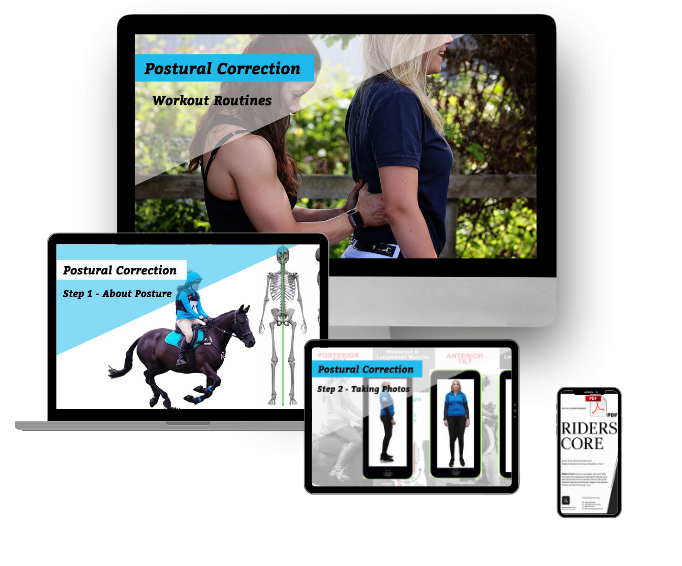
Understand the biomechanical purpose behind each exercise and your workout routine stops being a chore and becomes a deliberate confidence-building strategy. Clare’s approach focuses on helping you understand your habits, reactions and physical limitations, so you stop blaming yourself and find a direct path toward balance, with every rep serving your riding goals. That clarity cuts out the guesswork that fuels anxiety and replaces uncertainty with a structured plan aimed at your specific physical barriers to confidence.
A Structured Approach to Confidence-Building Exercises for Nervous Riders
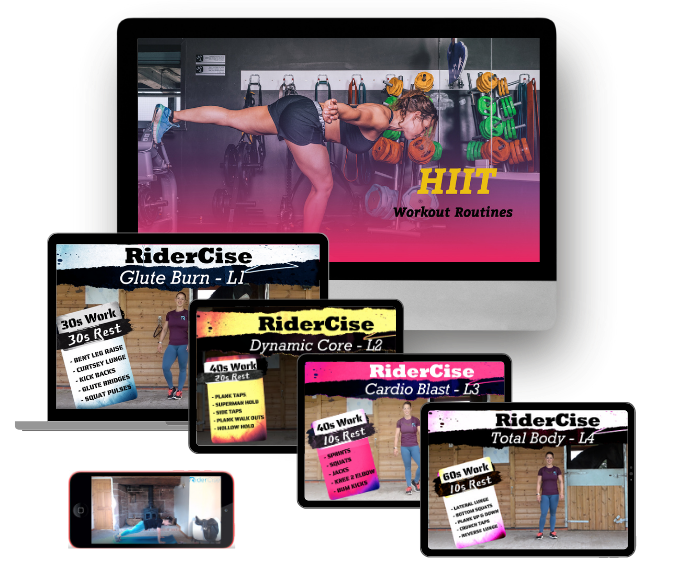
Confidence-building exercises for nervous riders fail when they’re sporadic or overly intense, because exhaustion degrades form and reinforces old compensatory patterns. A progressive framework that prioritises neuromuscular re-education lets your body learn correct movement without triggering the protective guarding that undermines progress.
Why Consistency Beats Intensity for Anxious Riders
Your nervous system needs frequent, low-threshold repetition to rewrite motor patterns. It doesn’t respond to occasional bouts of high-intensity effort that leave you sore and discouraged. Short, focused sessions performed regularly build the neural pathways for automatic stability, while infrequent marathon workouts reinforce the same boom-bust cycle as riding anxiety itself. This consistent exposure to correct movement builds trust in your body’s capabilities far more effectively than pushing through pain or fatigue.
Choosing the Right Programme for Your Current Level
Start at the right level and you avoid the frustration and injury risk that come when ego overrides your current physical capacity. Before committing to a full training programme, understand your body’s protective patterns to work out whether your limitations come from weakness, stiffness, or learned guarding responses. That foundational understanding makes sure your training addresses root causes, not symptoms, so every minute of exercise counts toward genuine, lasting confidence in the saddle.