Eventing asks your body to do things no other equestrian discipline demands in quite the same way. You’re not just holding a position. You’re managing kinetic energy across three phases while absorbing ground reaction forces that change every second. Fitness for eventing riders isn’t about how far you can run or how much you can lift. It’s about whether your body can organise itself efficiently under fatigue and impact. If you’ve ever felt secure in the warm-up arena only to collapse over a fence combination halfway round the cross country course, the issue is rarely your courage or your horse’s scope.
Most rider problems aren’t caused by lack of effort or fitness. They come from how the body has learned to stabilise, protect, and cope over time.
Why Cross Country Fitness Demands More Than Just Riding
Cross country fitness requires different conditioning than dressage or showjumping, because the variables are uncontrolled and the consequences of physical failure are immediate. In dressage, you work in a contained environment where the aids are subtle and the floor is predictable. Showjumping adds height and speed but still happens on prepared ground with known distances. Cross country brings uneven terrain, fixed obstacles, variable light, and fatigue that builds with every minute you spend in two-point or landing positions. Your body has to process proprioceptive data at speed while generating force asymmetrically, often when one side is already working harder than the other to compensate for a turn, a slope, or a previous imbalance.
The Unique Physical Load of Eventing
The load profile of cross country is intermittent and high-impact. You alternate between relative ease and moments of extreme demand: galloping uphill, braking before a drop fence, stabilising after an awkward landing. These spikes need anaerobic capacity and eccentric strength that steady-state riding never builds. When your muscles fatigue during these peaks, your nervous system defaults to whatever movement pattern feels safest, usually the one you’ve used most often, even if it’s biomechanically inefficient. That’s why you might feel fine hacking but lose your lower leg over a ditch. The specific demand exceeded your trained capacity, and your body reverted to protection rather than performance.
Identifying Your Personal Stability Leaks
You need to tell the difference between genuine cardiovascular fatigue and protective bracing that masquerades as tiredness. Protective patterns show up when your brain perceives instability, and muscles tighten restrictively rather than engage dynamically. If your back aches after twenty minutes of cross country but disappears the moment you dismount, or your shoulders round despite conscious correction, you’re likely guarding rather than lacking endurance. You need to understand your body’s protective responses before strength training will do any good. Without that awareness, exercises reinforce compensation instead of correcting it. Pay attention to when discomfort arises relative to specific movements or terrain features. That timing reveals the real deficit.
Strength Training for Eventers: Stability Over Bulk
Functional strength for eventing looks nothing like bodybuilding or generic gym work, because the goal is integrated stability, not muscle size. Eventers build strength without bulk by prioritising neuromuscular control and multi-planar loading over hypertrophy. Bulky muscles come from high-volume isolation work designed to maximise cross-sectional area. Rider strength comes from teaching existing muscle tissue to coordinate under load. A bicep curl builds arm size. A single-leg Romanian deadlift with rotation teaches your posterior chain, adductors, and core to cooperate in a pattern that mirrors catching your balance after a stumble.
Functional Strength vs General Gym Work
If a rugby player trained like a golfer, they’d get hurt. Eventers training with generic yoga or Pilates miss the specific impact and stabilisation demands of cross country in the same way. Traditional gym programmes often lean on bilateral, sagittal-plane movements like squats and presses that don’t replicate the rotational, asymmetrical, reactive nature of riding. Yoga improves flexibility and mind-body connection but rarely gives you the progressive overload needed to strengthen connective tissue against impact. Pilates builds deep core awareness but typically lacks the dynamic, weight-bearing component landing forces demand. Your strength work has to bridge that gap by combining stability challenges with loads that prepare your joints for the reality of cross country.
Targeting the Posterior Chain and Adductors
Your posterior chain and adductors are the primary shock absorbers and stabilisers during cross country, yet they’re frequently undertrained or poorly coordinated. The glutes, hamstrings, and spinal erectors have to work together to decelerate your upper body over fences, while your adductors hold medial-lateral stability in the saddle. Weakness or inhibition anywhere in that chain forces other structures to compensate, which is how you end up with lower back pain, knee pinching, or collapsing through the inside shoulder. Strengthening these areas means exercises that demand simultaneous engagement rather than isolation, such as lateral lunges with overhead reaches or hinge patterns with anti-rotation components. Without that integration, strength stays theoretical. It doesn’t transfer when you need it most.
Building Stamina for Eventing Through HIIT
HIIT beats steady-state cardio for cross country stamina because the sport itself is interval-based, not continuous. A five-minute cross country course contains multiple anaerobic bursts interspersed with active recovery, which mirrors the structure of high-intensity interval training far more closely than a thirty-minute jog does. Steady-state cardio builds aerobic base capacity, valuable for general health and recovery, but it doesn’t train your body to buffer lactate, recover quickly between efforts, or hold technical precision while your heart rate swings. When you approach a complex combination after a long gallop, whether you can think clearly and react precisely depends on how well your system handles repeated intensity spikes, not your resting VO2 max.
Why Steady-State Cardio Falls Short
Long-distance running or cycling builds endurance in a linear, predictable context that lacks the cognitive and stabilisation demands of riding. You can be aerobically fit yet completely unprepared for the metabolic chaos of cross country, because your body has never practised recovering while processing spatial information and holding postural integrity at the same time. Steady-state work also tends to reinforce forward-flexed, repetitive movement patterns that can make the very postural issues eventers struggle with in the saddle worse. Base fitness still matters. But relying only on traditional cardio leaves you exposed at exactly the moments events are won or lost.
Structuring Intervals Around XC Demands
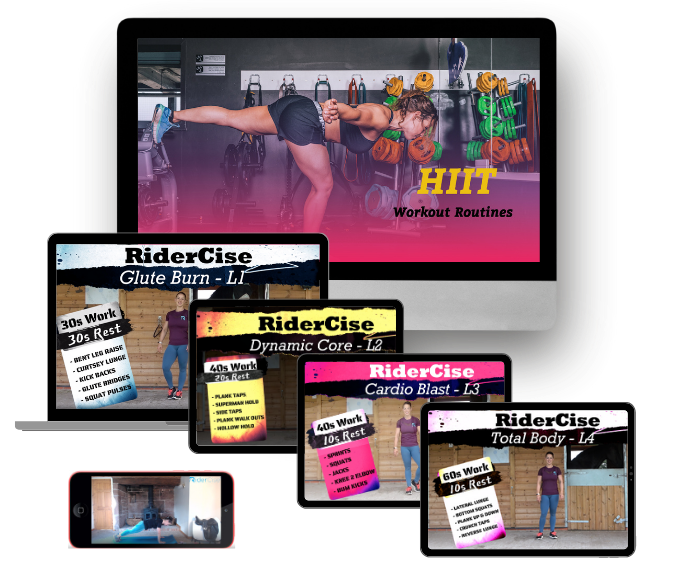
Effective HIIT workouts for equestrians replicate the work-to-rest ratios and movement patterns of actual cross country courses rather than arbitrary timer intervals. That means exercises that challenge balance, coordination, and decision-making during high-output phases, followed by active recovery that keeps you engaged without asking for maximal effort. The HIIT Workout Bundle is built to replicate the interval demands of cross country specifically, so it builds match-fitness rather than general endurance. Sessions should progress from shorter, simpler intervals to longer, more cognitively demanding ones as your capacity improves. Movement quality always comes before raw output.
Off-Horse Fitness Training That Transfers to the Saddle
Off-horse work only transfers if it mimics the neuromuscular demands of riding. Otherwise it builds fitness that disappears the moment you mount. Generic core planks or leg raises might strengthen abdominal muscles in isolation, but they don’t teach your body to stabilise while absorbing motion, shifting weight, or responding to unpredictable stimuli. Transfer happens when exercises replicate the sensory and motor challenges of riding closely enough that your nervous system recognises the pattern as relevant. That’s why improving riding position off the horse demands specificity, not volume.
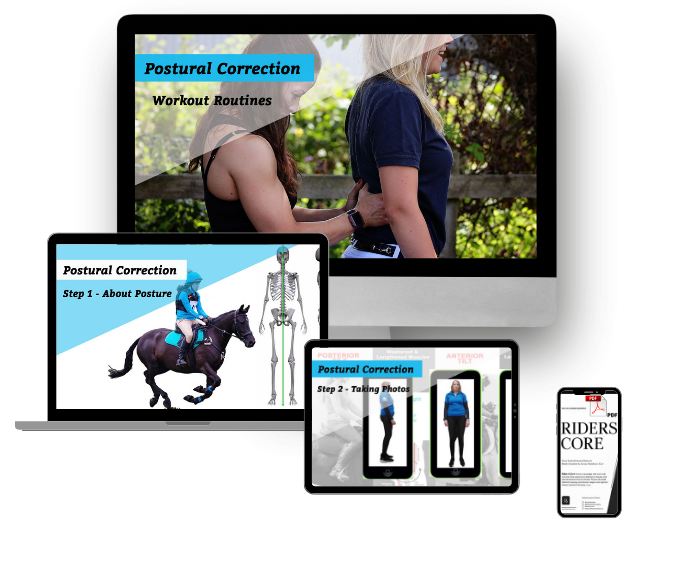
The Rider Core Mini Course is the foundational first step to improving how your body works in the saddle, because before you can effectively change your riding, you need to understand what is actually creating the challenges you experience. The course teaches you how posture, stability, your core system and learned movement patterns influence the way you balance, move and respond to your horse — helping you understand why issues such as gripping, bracing, collapsing, losing your stirrups, inconsistent contact or struggling to maintain your position can keep returning despite more lessons or trying harder. By giving you the knowledge to recognise what your body is doing, why it is doing it and what needs to change, the course removes much of the guesswork from improving your riding. Instead of repeatedly trying to correct the symptom you feel in the saddle, you can begin addressing the underlying patterns that are producing it — giving you a much stronger foundation from which to improve your stability, control, coordination and ultimately your effectiveness as a rider.
Common Fitness Mistakes That Hold Eventers Back
Pushing through pain or fatigue without understanding its source reinforces the very patterns holding your riding back. Struggle is rarely about insufficient effort. It almost always signals an unaddressed physical coping mechanism your body uses to create artificial stability. When you ignore these signals and train harder, you strengthen the compensation instead of resolving the dysfunction underneath it. That’s particularly dangerous for eventers, because the margin for error on cross country is so narrow, and protective patterns that work in the gym fail catastrophically under competitive pressure.
Ignoring Protective Movement Patterns
Protective bracing often shows up as chronic tension, restricted range of motion, or recurring discomfort that improves temporarily with stretching or manual therapy but returns as soon as you ride. If you consistently get tight hip flexors, a stiff thoracic spine, or gripping knees despite regular mobility work, your body is using that tension to substitute for missing stability elsewhere. Fixing it means identifying what the protection is guarding against, whether that’s weak glutes, poor foot grounding, or inadequate rotational control. Specific exercises to reduce back pain target these root causes rather than just easing symptoms.
Overtraining Without Biomechanical Awareness
More training doesn’t equal better riding if the training reinforces faulty mechanics. Eventers who pile on mileage, reps, or sessions without assessing movement quality accumulate fatigue while embedding inefficient patterns deeper into their neuromuscular system. That leads to plateaus, injuries, and frustration, because the body gets better and better at doing the wrong thing. Sustainable progress needs regular checkpoints where you ask whether your training is improving movement efficiency or just increasing your tolerance for poor movement. Sometimes the most useful session is the one where you stop, reassess, and rebuild a fundamental pattern properly.
Creating a Sustainable Rider Endurance Training Plan
Sustainability comes from clarity and understanding, not punishment or excessive volume. Your training plan should reflect your competition calendar, your current physical capacity, and your horse’s feedback, not arbitrary benchmarks or whatever’s trending on social media. An off-season plan and a competition-season plan differ fundamentally in emphasis. Off-season work addresses foundational weaknesses, builds general capacity, and experiments with new movement patterns. Competition-season work maintains gains, sharpens sport-specific readiness, and prioritises recovery. Trying to peak year-round guarantees burnout or injury, because adaptation needs variation.
Periodising Around the Competition Season
Structure your annual training into distinct phases that match your competitive goals and your personal life. Base preparation focuses on correcting imbalances and building work capacity through controlled, progressive loading. Pre-competition shifts towards sport-specific intervals and integrated strength that mirrors cross country demands. During competition season, volume drops significantly while intensity stays high but infrequent, so you’re fresh for events. Active recovery periods follow major competitions to allow a physiological and psychological reset. This cyclical approach respects your body’s need for stimulus and rest, and it prevents the staleness that comes from monotonous training.
Listening to Feedback From Your Horse
Your horse gives you a real-time, honest read on your physical effectiveness that no mirror or coach can match. Changes in his way of going, his willingness to accept contact, or his consistency over fences often reflect shifts in your balance, symmetry, or fatigue management before you notice them yourself. If he starts drifting left over combinations or gets resistant to transitions late in a schooling session, look at your own physical state before you pin it entirely on him. This feedback loop keeps your training grounded in outcomes that actually matter, rather than abstract metrics, so your fitness work serves the partnership instead of becoming an end in itself.
Choosing the Right Programme for Your Eventing Goals
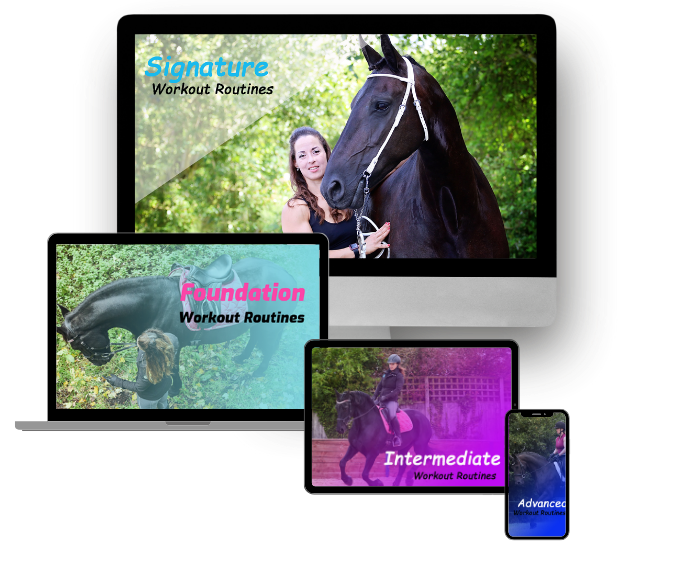
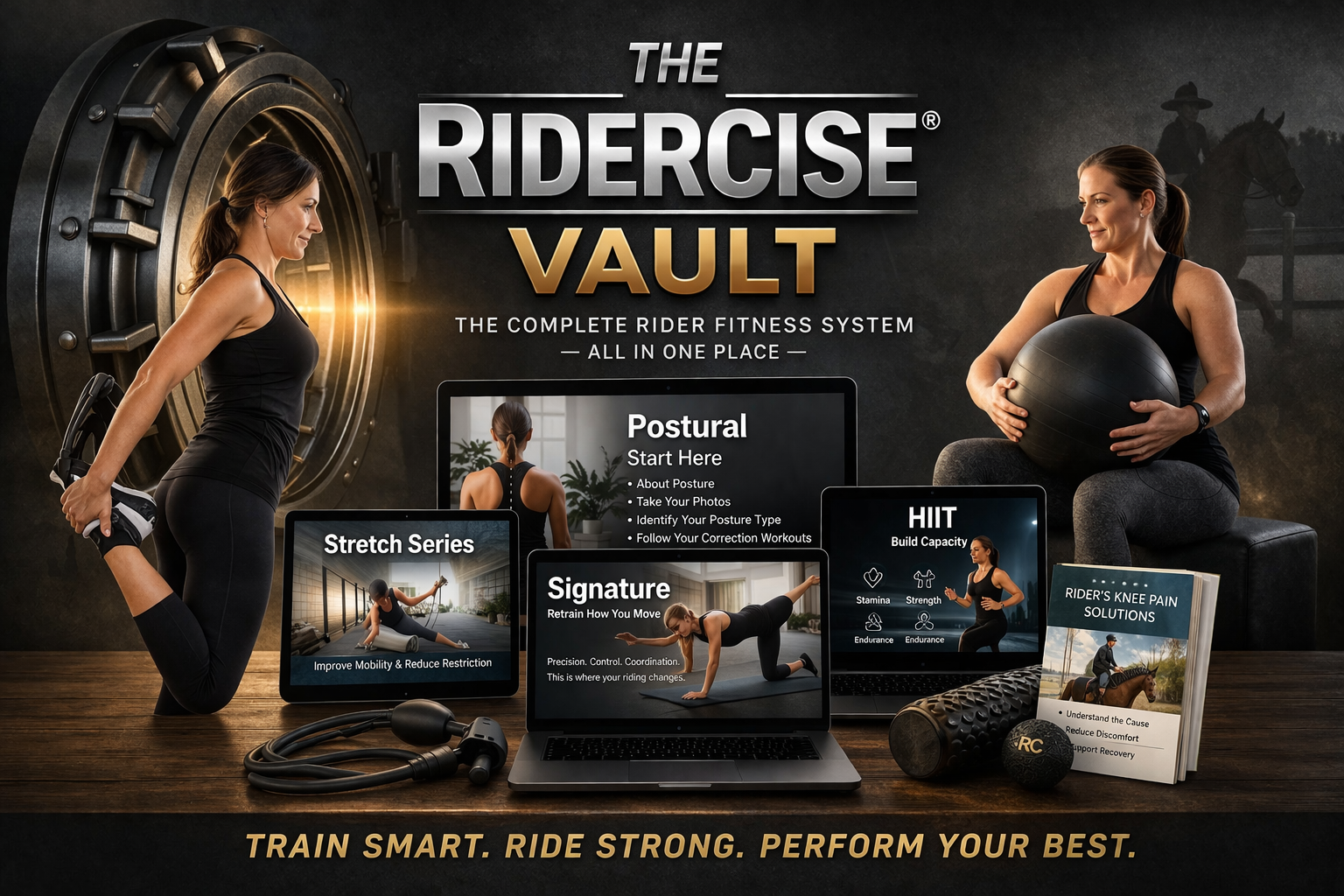
Which programme is right depends on your current level of self-awareness and your specific cross country challenges. If you know your stamina fails before your strength does, the HIIT Bundle gives you structured interval protocols built for equestrian demands. If positional insecurity is undermining both your confidence and your horse’s performance, start with foundational core work before you add intensity. For riders who want strength, stamina, and mobility resources in one place, the comprehensive rider fitness library covers the full spectrum of rider-specific programming. Honest assessment of where you actually are, not where you wish you were, is what determines which path gets you results fastest.
Be the rider your horse deserves.