This Is What's Actually Happening When You Ride
What Muscles Does Horseback Riding Use? the short answer, all of them! But there is a misconception about how your muscles should work and what is actually required for true stability.
Sit on a horse and stay still, and you will not stay still for long.
The moment the horse walks on, your body is already working: absorbing, adjusting, recovering, absorbing again. It happens so quickly, and so far below conscious awareness, that most riders never think of riding as work in this sense at all. They think of it as sitting on something that moves, and of their own job as staying balanced on top of it.
In reality, what’s happening underneath that description is far more active than it looks.
Riders searching for what muscles does horseback riding use are usually trying to answer a much bigger question than they realise.
What Muscles Does Horseback Riding Use?
There isn’t one “riding muscle.”
Every stride a horse takes sends a wave of force up through the saddle and into the rider. The hindquarters push, the back lifts and rounds, the shoulders swing, the head and neck oscillate, and all of that movement has to go somewhere. It goes into you. Your pelvis feels it first, then your spine, then your ribcage, shoulders and head, each absorbing a slightly different version of the same wave a fraction of a second apart.
Riding asks multiple areas of your body, legs, pelvis, spine, trunk and shoulders, to coordinate simultaneously rather than any single muscle group doing the work alone. None of this is optional, and none of it is happening once. It’s happening again on the very next stride, differently, because no two strides deliver exactly the same force in exactly the same way.
Riding is not a static position that you find and then hold. It is a continuous negotiation with force that never actually stops.
What looks, from the ground, like a rider sitting quietly in the saddle is, from the inside, a body making hundreds of small adjustments a minute to stay with a horse that is never entirely still. The quiet is the output. The work is what produces it.
Absorption Comes First
Anyone asking what muscles does horseback riding use has to start here.
The first job your body has, every stride, is to absorb what the horse is generating underneath you.
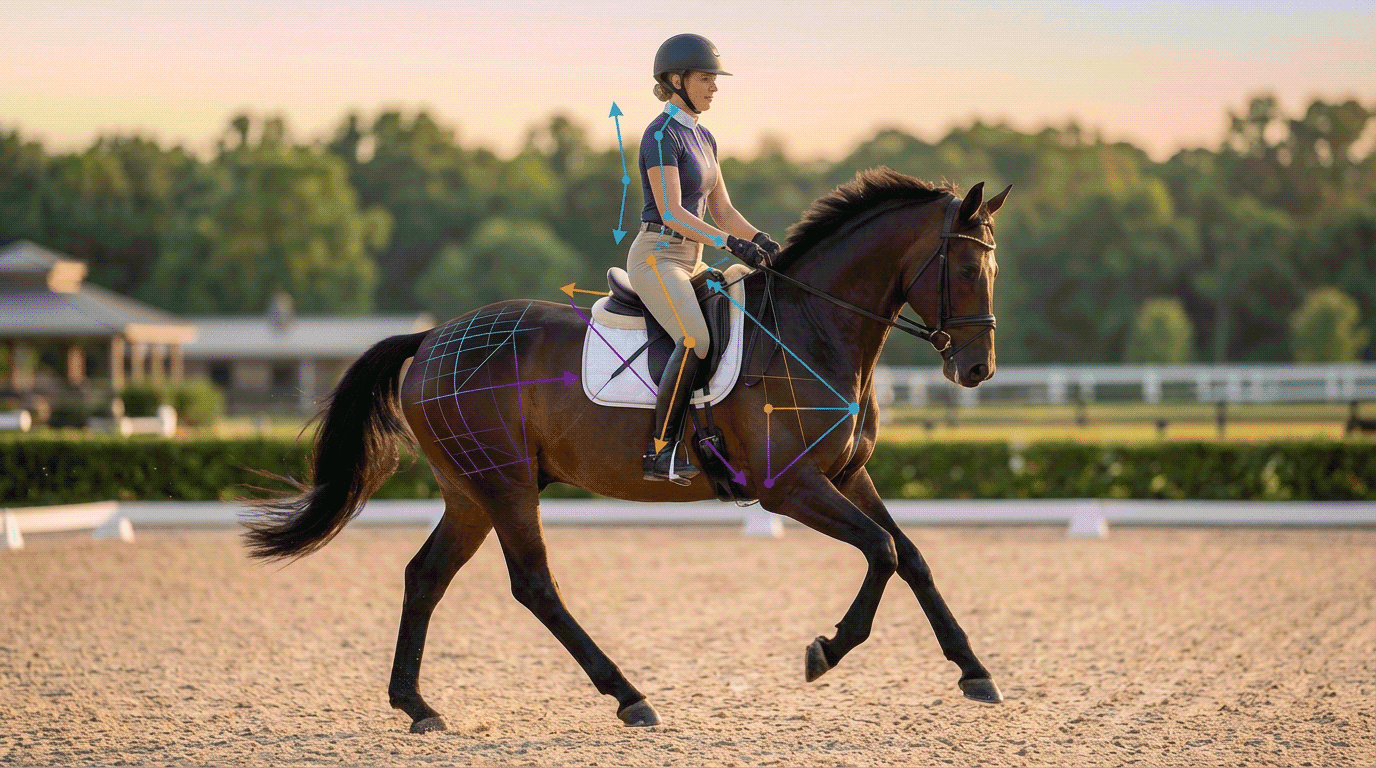
Think of what happens when you land from a small jump, or step off a kerb without expecting it: something in your legs and torso softens on impact rather than transmitting the full jolt straight up through you. Riding asks your body to do a version of that continuously, at speed, in a seated position, without you consciously deciding to do it stride by stride.
Your joints, particularly through the pelvis, hips and lower spine, need to be able to give slightly and then recover, over and over, for the movement to pass through you rather than jar you.
When that absorption isn’t happening well, riders usually feel it as bounce, as a jolt through the seat that doesn’t quite settle, or as a sense of being thrown upward rather than carried.
It’s tempting to interpret that as a technique problem, something to fix by trying to sit differently. Often, though, it’s closer to the body not currently having an efficient way of taking in that force, so the force goes somewhere else instead, usually straight up through a rider who is gripping or bracing in an attempt to control it.
Then Comes Stabilisation
Absorbing force is only half of the answer to what muscles does horseback riding use. Immediately after, your body has to stabilise, holding you in a workable position relative to the horse even as the ground beneath you, the saddle, effectively, keeps moving.
This is different from being still. A rider who is genuinely stable can allow quite a lot of movement to happen through their body while their position over the horse’s centre of gravity barely changes. A rider without that stability tends to either grip hard to manufacture a feeling of security, or lose their position gradually over a few strides and have to reset it.
Stabilising well requires more than one part of the body to be doing something at once. The deep muscles around the spine and pelvis are working to keep your torso organised over a moving base, your legs are doing something related but distinct to stay connected to the horse’s sides, and your upper body is managing its own weight so it doesn’t add extra, unhelpful movement into the system.
None of these are working in isolation. They’re coordinating.
What Muscles Does Horseback Riding Use to Stay Coordinated?
Riders are told to “use their core,” or to “sit up,” as though there is one area of the body responsible for control and the rest is passive.
In practice, staying with a moving horse asks several regions of the body to work together in a specific, changing sequence: legs responding to the horse’s rhythm, the pelvis translating that into the torso, the upper body staying quiet enough not to interfere, and all of it adjusting according to what the horse does next.
Riding a transition, a change of direction, or simply a horse that speeds up slightly asks that whole coordinated system to reorganise itself, sometimes within a single stride.
A rider can be perfectly capable of holding a strong position on the ground and still feel unstable on a horse.
This is why isolated strength doesn’t automatically transfer into better riding. The saddle is asking for coordination between multiple areas under continuously changing conditions, not strength in any one area held still. It’s a considerably more complex demand than it looks from the ground, and considerably more complex than most riders have ever been told.
Reorganisation, Every Single Stride
The final piece is the one most explanations of what muscles does horseback riding use leave out entirely: this whole process, absorption, stabilisation and coordination, has to happen again on the next stride, because the next stride is never quite identical to the last one.
The horse shifts its balance, changes tempo fractionally, meets uneven ground, spooks slightly at something in the hedge. Your body has to reorganise its response accordingly, continuously, for as long as you’re moving.
This explains something riders often experience but rarely name. The sense of “just about holding it together,” of feeling secure for a few strides and then losing that feeling for no obvious reason, isn’t usually a concentration lapse.
It’s what happens when a body that can manage a certain amount of reorganisation meets a moment that asks for slightly more than it currently has readily available. The horse changed the demand. The rider’s system had to find a new answer to it, on the spot, and on that particular stride it didn’t quite manage to.
Why This Matters
None of this is presented to riders very often, and its absence leaves a strange gap in how riding is usually taught, and in how what muscles does horseback riding use is usually answered.
Riders are given positions to hold and told to try harder to hold them, without ever being shown what their body is actually being asked to do underneath that instruction. Once you see riding as this continuous cycle, force coming in, the body absorbing it, stabilising against it, coordinating a response, and then doing all of it again on the next stride, a lot of familiar frustrations stop looking like personal failings and start looking like exactly what you’d expect from a genuinely complex physical task.
It also reframes what “improving” actually means.
It isn’t about finding the right position and gripping onto it more successfully.
It’s about the body becoming more efficient at this whole cycle: absorbing more smoothly, stabilising with less effort, coordinating more readily, and reorganising faster when the horse changes what it’s asking.
That’s a different kind of progress to the one most riders have been chasing, and it’s a considerably more honest description of what’s happening every time they get on.
Ready to Understand Your Body?
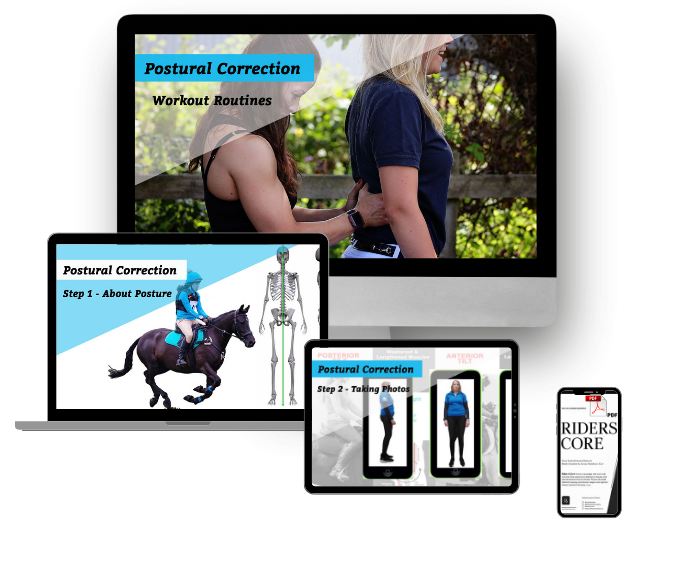
If this article has made you realise how much your body is actually doing every stride, without you ever consciously directing it, and you want a proper answer to what muscles does horseback riding use, the Rider Core Mini Course is the natural next step.
It explains how your body creates stability, how it coordinates across multiple areas at once, and why the sensations you feel in the saddle, bounce, gripping, losing your position, are the visible result of exactly the process described above.
Rather than simply giving you more exercises, it helps you understand what your body is actually doing, so every exercise, every lesson and every correction has a clear purpose.
Because once you understand how your body is organising itself…
You can finally start changing it.

Watch the Supporting Video
Watch the supporting RiderCise® YouTube video to find out more about the muscles used in the saddle and what creates true stability.
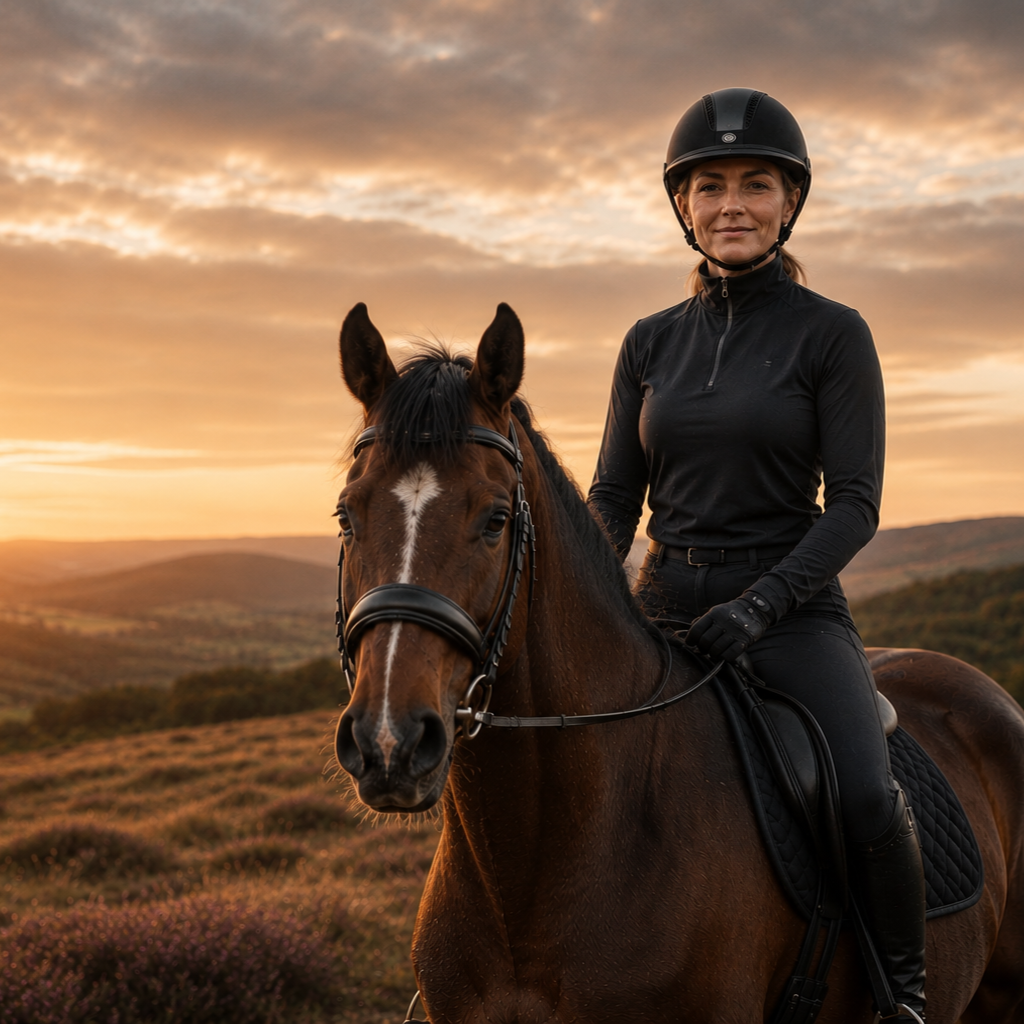
Discover the Rider Core Mini Course
The Rider Core Mini Course helps you understand what your body is doing before you begin trying to correct or strengthen it, giving you a clearer foundation for choosing the right horse riding exercise and improving the way your body supports you while riding.