
How to Improve Your Riding Starts with Understanding Posture
If you’ve ever searched for how to improve your riding, you’ve probably come across the same advice time and time again.
– Sit taller.
– Keep your shoulders back.
– Engage your core.
– Stop collapsing.
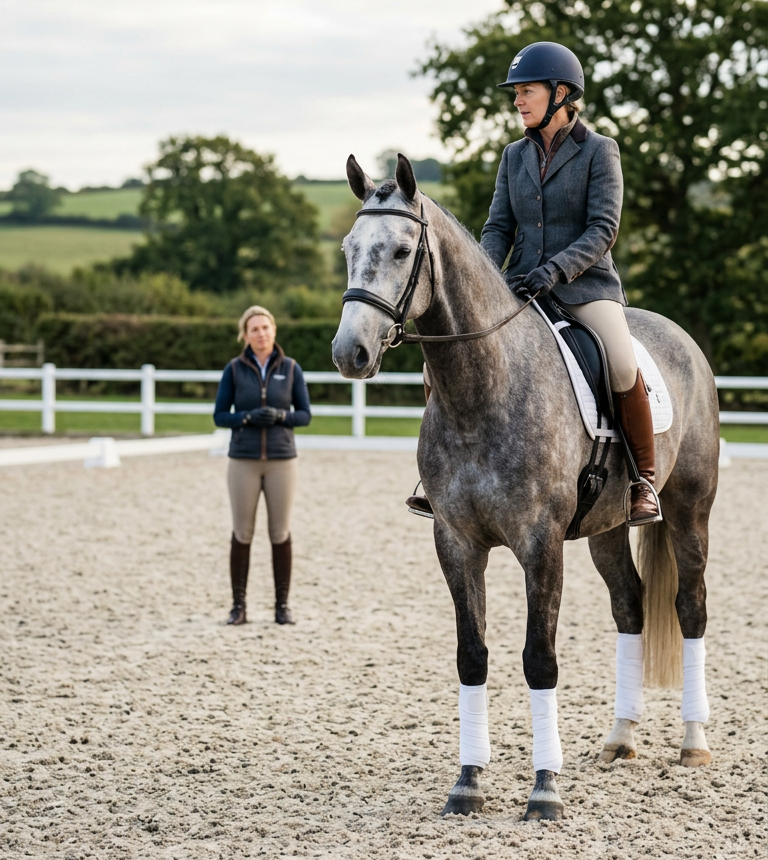
They’re all well-intentioned instructions, and in the right context they can be useful. But for many riders, they also become one of the most frustrating parts of learning to ride.
The reason is simple.
Most riders already know what good posture is supposed to look like.
They know where their shoulders should be. They know they shouldn’t collapse through one side or round their back. They know they should sit tall rather than fold forwards.
The problem isn’t knowing what to do.
The problem is being able to keep doing it once the horse starts moving.
That’s why so many riders find themselves caught in the same cycle. They hear the correction, they immediately adjust their position, everything feels better for a few moments… and then, almost without noticing, the old position gradually returns.
The shoulders begin to tighten.
The lower back starts working harder.
The leg grips more than it did before.
The body slowly settles back into the same organisation it has adopted hundreds of times before.
Eventually, many riders stop questioning the instruction and start questioning themselves.
– “Maybe I’m just weak.”
– “Perhaps I don’t have enough core strength.”
– “Maybe I simply don’t have good posture.”
It’s an understandable conclusion to reach, but it often isn’t the right one.
Learning how to improve your riding isn’t simply about holding yourself in a better position. It’s about understanding why your body keeps returning to the same position in the first place.
Good riding posture isn’t a position you hold.
It’s something your body has to recreate continuously while the horse is moving underneath you.
That single idea changes the way we should think about posture completely.
Riding Posture Is Constantly Changing
When most people think about posture, they picture standing still.
Perhaps they’re imagining standing in front of a mirror, sitting upright at a desk, or lining their ears, shoulders, hips and heels into one neat vertical line. In all of those situations, the body organises itself once and then only has to make relatively small adjustments to remain balanced.
Horse riding asks something entirely different.
The moment your horse takes a step, your posture is no longer fixed. Your pelvis begins responding to movement every stride. Your spine subtly reorganises to maintain balance. Your ribcage rotates, your hips absorb force, and your centre of gravity is constantly changing as the horse moves beneath you.
Even during a relaxed walk, your body is making hundreds of small adjustments every minute without you consciously thinking about them.
As the pace increases, so does the demand.
Transitions require quicker organisation. Sitting trot increases the amount of force travelling through the pelvis and spine. Circles change how your body manages balance. Lateral work asks each side of the body to contribute differently. Every movement places slightly different demands on your ability to remain organised while still allowing the horse to move freely underneath you.
That is why many riders can appear beautifully balanced in halt but struggle to maintain exactly the same position once movement increases.
They haven’t forgotten what good posture looks like.
– The task itself has changed.
Maintaining posture while sitting still and maintaining posture while managing continuous movement are two completely different physical skills.
Understanding that difference is one of the biggest steps towards understanding how to improve your riding, because it shifts the focus away from trying harder and towards understanding what your body is actually being asked to do.
Finding your position is one skill. Sustaining it while the horse is moving is another.
Those two abilities are often mistaken for the same thing, yet they rely on very different physical qualities.
The Difference Between Holding Position and Managing Movement
Imagine carrying a full glass of water while standing completely still.
Now imagine carrying that same glass while walking across uneven ground.
The objective hasn’t changed. You still want to keep the water in the glass. But the way your body achieves that goal changes dramatically because the environment has changed.
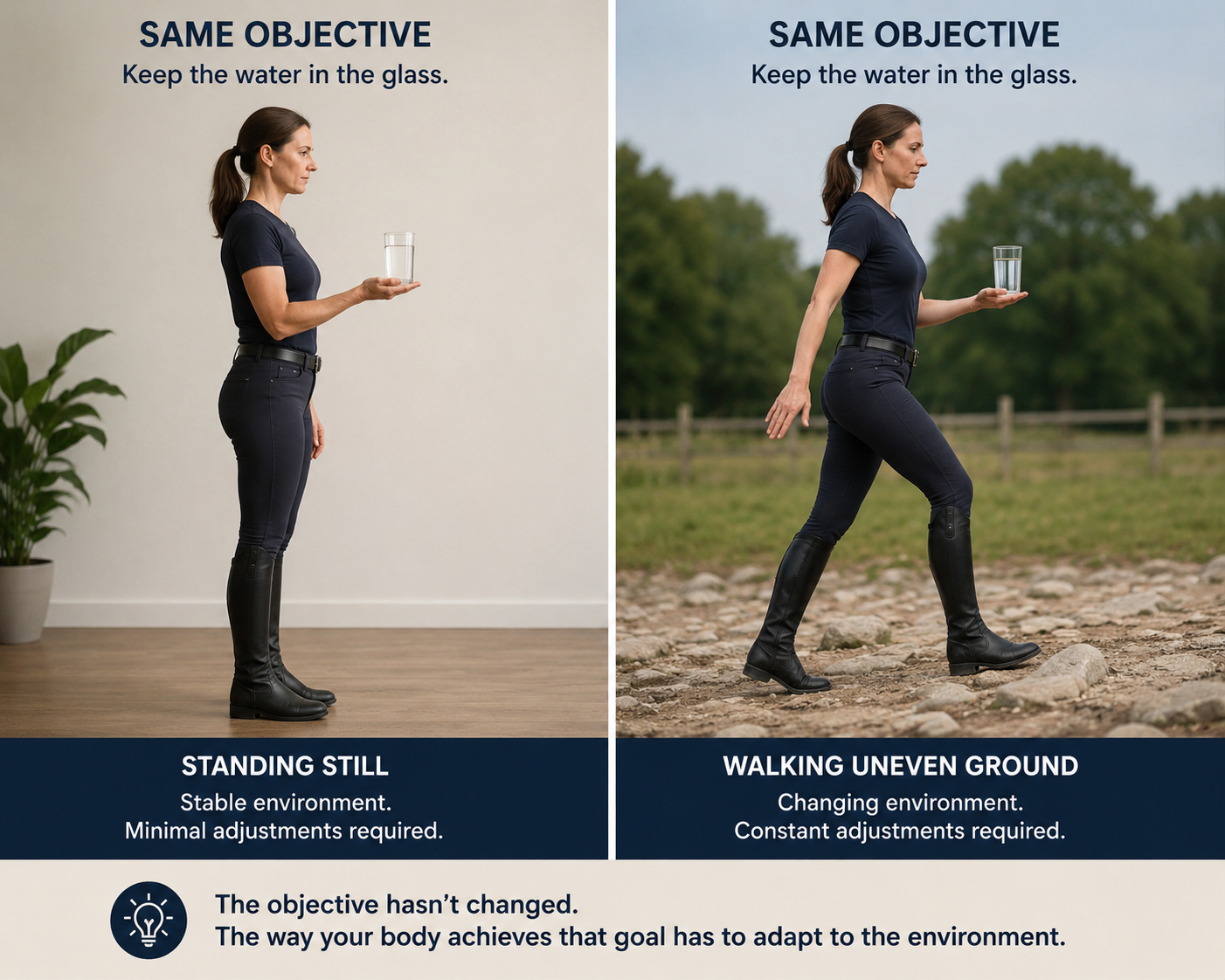
Horse riding works in much the same way.
Your body isn’t trying to hold itself still.
It’s trying to remain organised while responding to constant movement.
Every stride requires the body to absorb force, maintain balance, control breathing, coordinate the limbs independently and keep the pelvis following the horse without allowing the upper body to lose organisation.
That’s an extraordinary amount of work.
When riders are told to “sit taller“, they often respond by thinking about the visible position.
- KThey lift the chest.
- KThey straighten the back.
- KThey pull the shoulders into place.
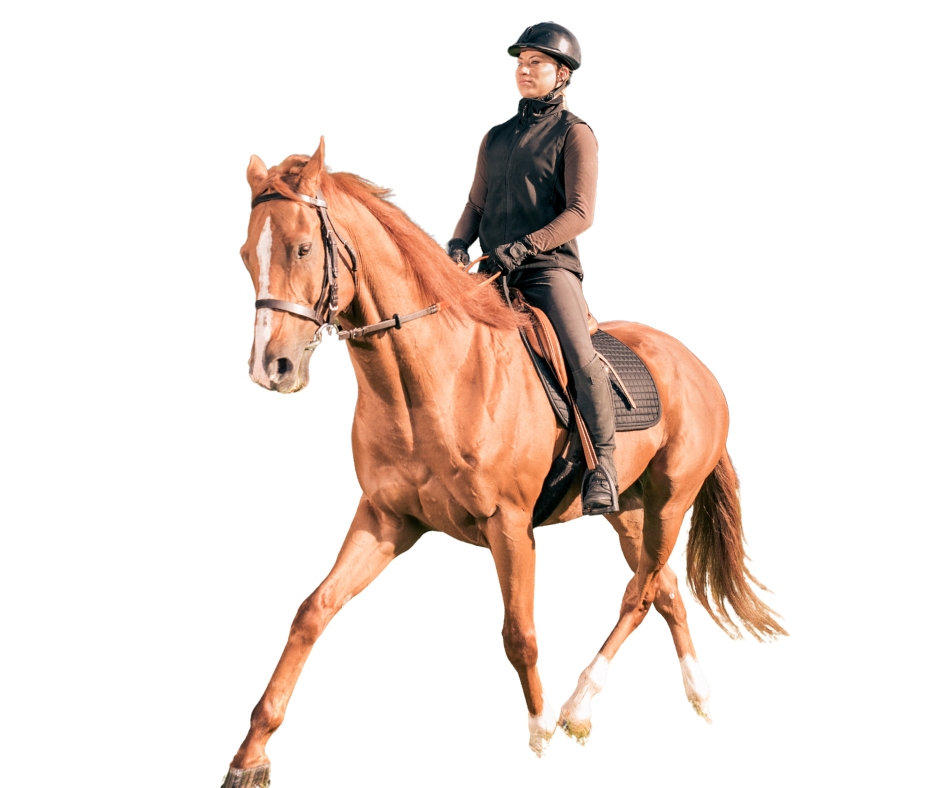
Visually, that may improve posture for a short period of time.
Functionally, however, nothing underneath has necessarily changed.
If the body cannot repeatedly manage the movement demands being placed upon it, it will gradually return to the organisation it already knows.
Not because the rider has stopped trying.
But because the body is always looking for the most familiar way to manage the task in front of it.
Your riding position is the result of how your body manages movement, not simply where you try to place it.
How to Improve Your Riding by Replacing Stiffness with Stability
One of the biggest misconceptions in riding is that the habits we develop in the saddle are conscious choices.
In reality, many of them are learned over months or years without us ever noticing.
Think about how often your body has been asked to solve a problem while riding.
Perhaps you lost your balance during a transition and instinctively gripped with your knees. Maybe your horse became sharp, so you tightened through your hips before every upward transition. Perhaps sitting trot felt uncomfortable, so you unknowingly started bracing through your lower back because it felt more secure than allowing your pelvis to move.
Those strategies weren’t necessarily taught. – They were learned.
Your body discovered a way of creating enough stability to complete the task, and because it worked, it quietly repeated it the next time.
Instruction can contribute as well.
- K"Sit still."
- K"Hold yourself up."
- K"Don't move so much."
- K"Keep your hands steady."
- K"Tighten your core."
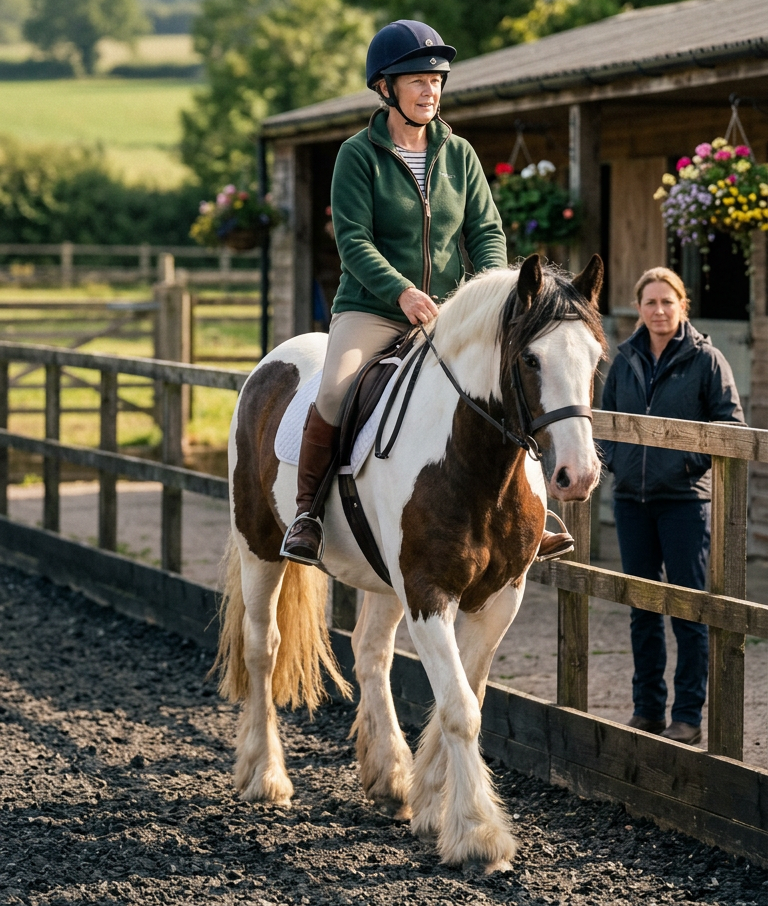
Many riders respond to these instructions in the only way they know how. They reduce movement instead of improving the quality of movement. They become stiffer because stiffness feels more secure. They hold their breath because it creates a sense of control. They grip with their thighs because, in that moment, it makes them feel more stable in the saddle.
At first, these strategies can appear to work. The rider may look quieter, feel more secure, or even receive positive feedback because the visible symptom has improved. The problem is that the body doesn’t distinguish between a temporary solution and an efficient one. If a particular strategy helps achieve the outcome, even briefly, it is likely to be repeated the next time the rider faces the same challenge.
Over time, what started as a conscious adjustment gradually becomes an automatic movement strategy. By that point, the rider isn’t consciously making those decisions anymore—they’re simply repeating the movement strategy their body has learned to trust.
Why Posture Often Gets Worse As the Ride Goes On
This also explains why so many riders describe feeling comfortable during the first ten minutes of a lesson before everything gradually becomes harder.
At the beginning of the ride, the body is fresh. It can organise movement efficiently, maintain balance more easily and cope with the demands being placed upon it.
As the ride progresses, however, those demands continue.
Every transition, every corner, every change of pace and every stride requires the body to keep reorganising itself.
Eventually, fatigue begins influencing how efficiently that organisation can be maintained.
The smaller muscles responsible for fine control begin contributing less effectively. Breathing often becomes shallower. Coordination becomes less precise. Rather than maintaining smooth, efficient movement, the body starts looking for larger muscles that can take over.
This is when riders often notice the thighs becoming tighter, the shoulders beginning to lift, the lower back working harder or the pelvis feeling less able to follow the horse naturally.
The body isn’t deliberately abandoning good posture.
It’s finding another way of completing the task.
Unfortunately, that often creates even more stiffness.
The rider now feels as though they are fighting both themselves and the horse.
Stability and stiffness are not the same thing.
One allows movement.
The other restricts it.
Why Trying Harder Isn't Always the Answer
For years, riders have been encouraged to work harder at maintaining their position.
- KConcentrate more.
- KHold your posture.
- KEngage your core.
- KSit taller.
The problem is that effort isn’t always the missing ingredient.
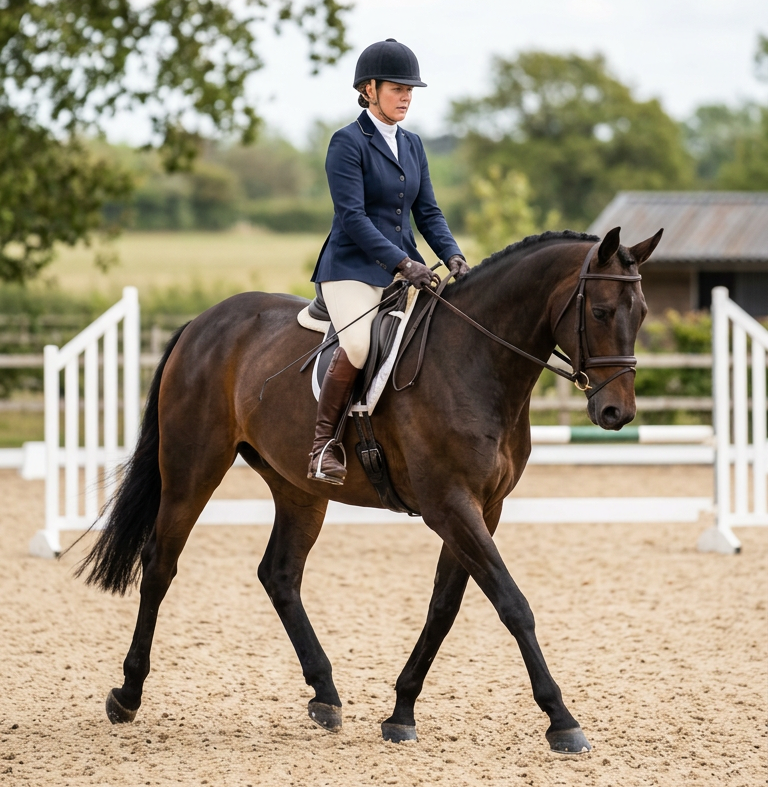
If the body doesn’t yet have the ability to organise movement efficiently under increasing demand, adding more effort simply asks it to work harder using the same movement strategies it already relies upon.
That’s why some riders feel exhausted after trying to “sit correctly” for an entire lesson.
They’re not simply riding. They’re constantly managing themselves.
The irony is that the riders who often look the quietest in the saddle aren’t necessarily trying the hardest.
Their bodies have simply developed more efficient ways of organising movement.
Good posture becomes something that emerges naturally from good movement rather than something that has to be consciously manufactured every stride.
That is a very different way of thinking about how to improve your riding.
Instead of asking:
“How do I hold myself better?”
The question becomes:
“How do I help my body organise movement more efficiently?”
👉 That subtle change shifts the focus from appearance to function, and from force to coordination.
What This Means for Your Riding
If you’re genuinely looking for how to improve your riding, it’s worth remembering that your position is not the starting point.
Your position is the result.
It reflects how well your body manages movement, balance, stability and coordination while responding to the horse underneath you.
When those systems work well together, good posture becomes easier to maintain.
When they don’t, the body naturally falls back on the movement strategies it knows best, whether that’s gripping, bracing, collapsing or becoming rigid.
This is why rider-specific training is so different from simply becoming fitter.
It’s not about building stronger muscles for the sake of it.
It’s about improving the body’s ability to organise movement under the unique demands of riding.
That means developing postural endurance, pelvic control, coordination, breathing, balance and movement awareness in a way that directly transfers to the saddle.
Because ultimately, riding isn’t a static sport.
It’s a continuous conversation between your body and your horse.
The better your body becomes at managing movement, the easier good posture becomes.
Final Thoughts
Being told to “sit taller” isn’t completely wrong.
It’s simply incomplete.
Without understanding what your body is actually trying to achieve underneath that instruction, posture becomes something you continually chase rather than something you naturally develop.
The next time you hear that familiar correction, remember this:
Good riding posture isn’t about forcing your body into a position and hoping it stays there.
It’s about improving the way your body responds to movement, stride after stride, until maintaining that position becomes less about effort and more about organisation.
That’s one of the most important shifts any rider can make.
Because learning how to improve your riding isn’t about trying harder.
It’s about understanding your body well enough that it no longer needs to fight the movement beneath you.
Want to Learn How to Improve Your Riding?
If this article gave you a different perspective on why your position doesn’t always stay where you want it to, the RiderCise® Rider Core Mini Course explores the movement systems that underpin balance, stability, posture and coordination in the saddle.

Rather than simply telling you what to do, it helps you understand why your body behaves the way it does. Once you understand that, improving your riding becomes a logical process instead of a constant cycle of corrections.
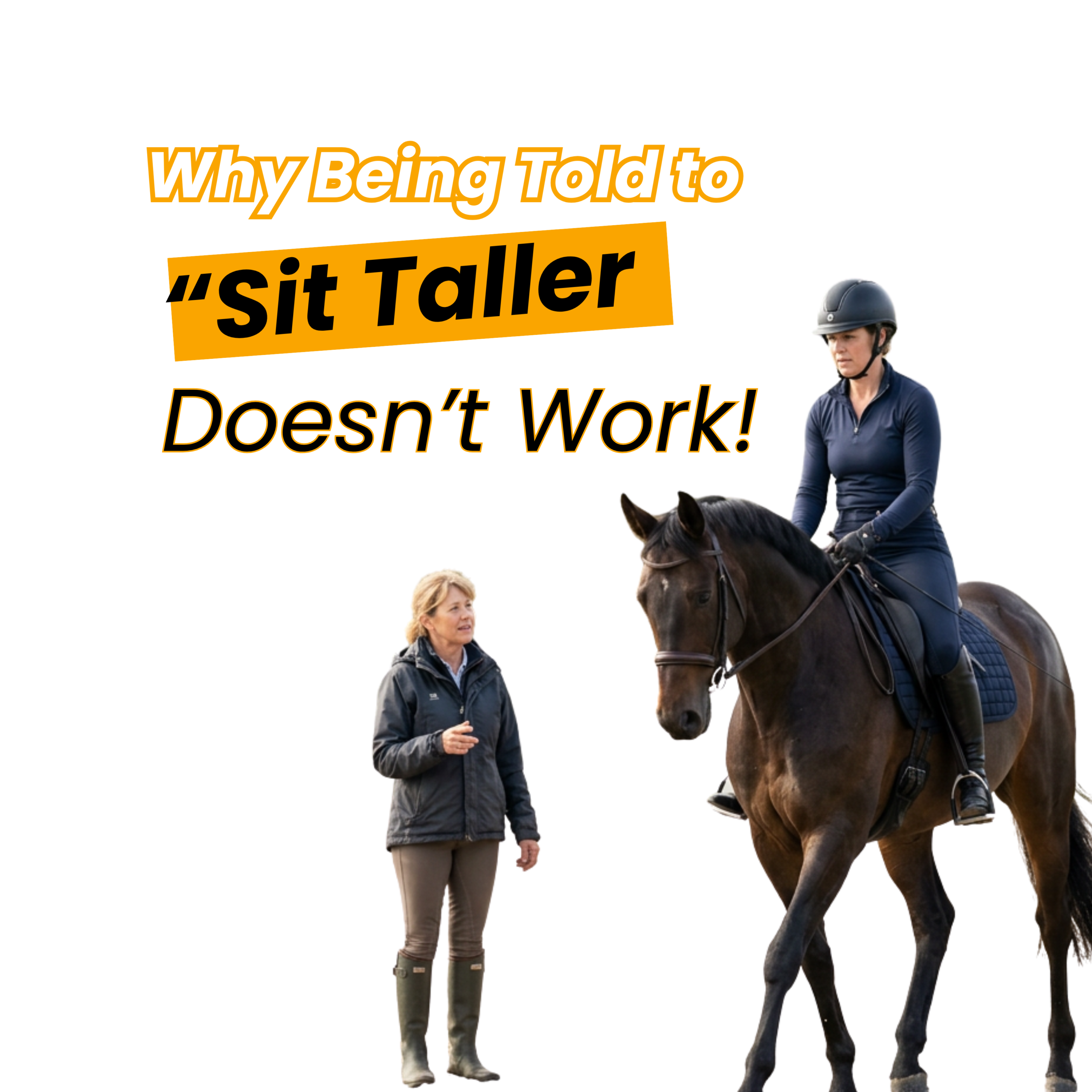
Watch the Supporting Video
Watch the supporting RiderCise® YouTube video for this Article.
👉 Join my mailing list and access the How I Assess Riders video, where I break down exactly what I look for and how these patterns show up before they ever appear in the saddle.
Because once you understand the cause…you stop trying to fix the symptom.
And that’s when real progress begins.
If you’re already on my mailing list and would like it resent, email me at clare@ridercise.co.uk and I’ll send it over.