
An equestrian workout is exercise aimed to specifically improve your riding. Using a range of variety to help ‘condition’ the rider’s body for the sport.
An equestrian workout is different from general fitness. Being fit generally means having the ability to perform everyday tasks with ease.
Whilst any form of fitness is beneficial, there is a difference between being fit and fit to ride. For you to become a conditioned rider you must train the muscles riders use, in the variety of ways the muscles operate when in the saddle.
What is an Equestrian Workout - And Why It Matters
Sports like horse riding, at any level and in any discipline, require the rider to have the appropriate strength, mobility, and awareness to meet the demands of the sport.
An equestrian workout is designed specifically to prepare your body for those demands — not just to improve general fitness, but to improve how your body actually functions in the saddle.
Because there is more to riding than simply not being out of breath.
Riding requires coordination, balance, control, and the ability to move your limbs independently while maintaining stability. This is what allows you to communicate clearly and effectively with your horse.
Unfortunately, activities like running, cycling, or yoga — while beneficial for general fitness — do not provide the full stimulus needed to support riding. They don’t train the specific movement patterns, control, or muscle coordination that an equestrian workout develops.
What Does an Equestrian Workout Actually Do?
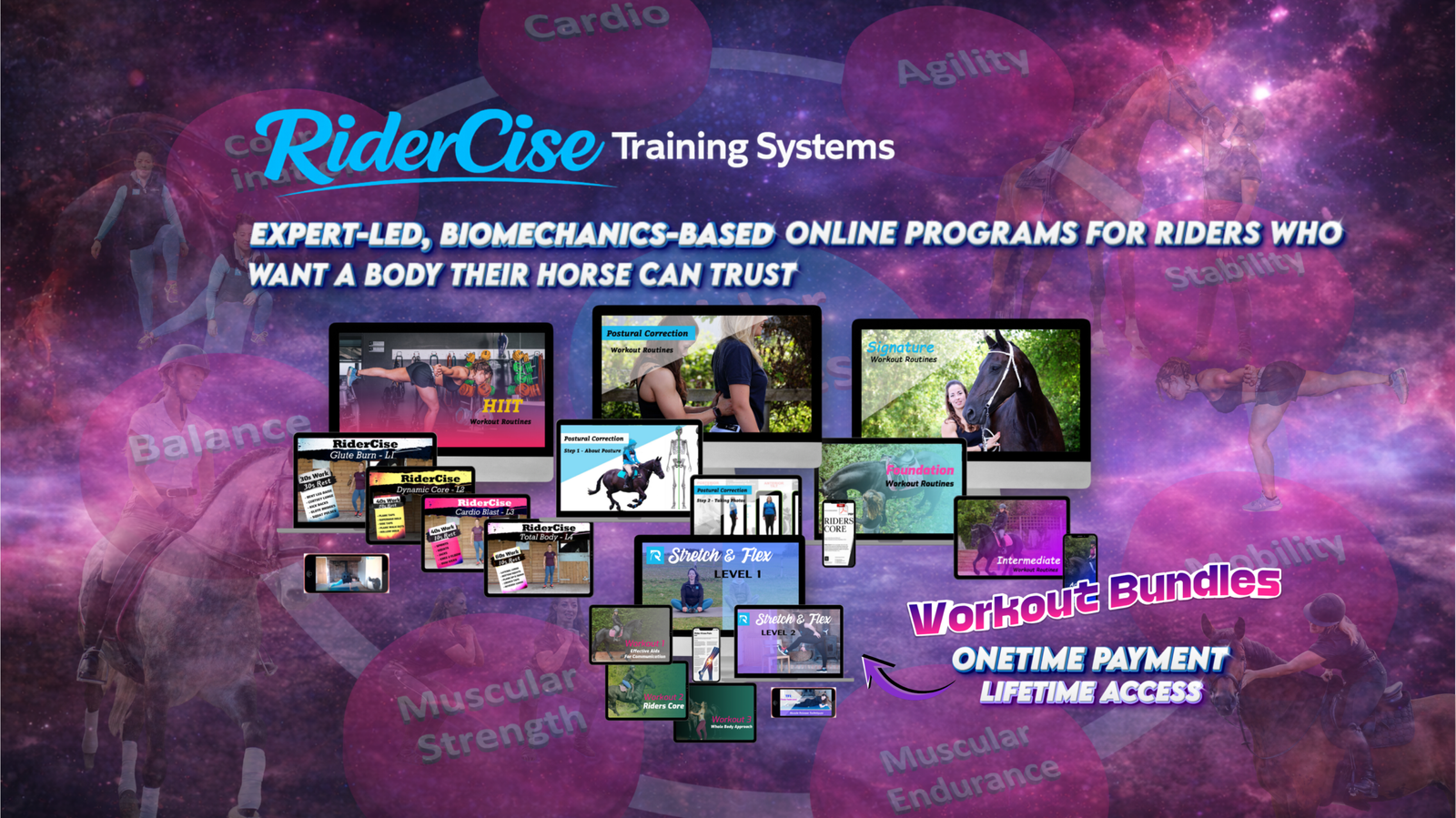
An equestrian workout focuses on conditioning the muscles and systems your body relies on when you ride.
This includes developing:
- Muscular strength
- Cardiovascular fitness
- Mobility
- Coordination and reaction
- Muscle recruitment (how muscles work together)
This is what rider conditioning really is — using targeted exercise to improve how your body performs in the saddle, not just how it looks or feels off it.
Why Riders Need Equestrian Workouts Specifically
Whether you are a leisure rider or a competitor, following a structured equestrian workout approach is important — not just for you, but for your horse.
Horse riding requires multiple muscle groups to work together to keep you balanced, stable, and aligned without collapsing or relying on the horse for support.
Without this, riders often compensate by:
- Pulling on the reins
- Gripping with the knees or thighs
- Collapsing during transitions
- Losing balance in the saddle
These are not conscious choices — they are physical responses to a body that isn’t fully prepared for the demands of riding.
If your body hasn’t been conditioned correctly, it can also lead to:
- Slower progress in your riding
- Increased fatigue
- Aches and pains after riding
An effective equestrian workout helps prevent this by preparing your body to meet those demands properly.
How Your Body Affects Your Horse
When you are not in control of your body, it directly impacts your horse.
It can lead to:
- One-sidedness
- Uneven muscle development
- Tension or soreness
If you collapse during a transition, your body will instinctively try to stabilise itself. Most riders do this by gripping or using the reins.
This is a natural reaction — but it is not an effective one.
To stabilise correctly, your body needs coordinated activation from multiple muscles, including:
- Glute medius
- Transversus abdominis
- Multifidus
- Obliques
- Diaphragm
- Erector spinae
This level of control doesn’t happen automatically. It requires targeted training — which is exactly what an equestrian workout develops.
Why General Fitness Isn’t Enough
One of the biggest misconceptions is that general fitness translates directly to riding.
It doesn’t.
- Running improves cardio but not rider-specific strength
- Yoga improves mobility but not control or stability under load
- Cycling builds strength but limits mobility and coordination
Each form of exercise has benefits — but none of them fully prepare your body for riding on their own.
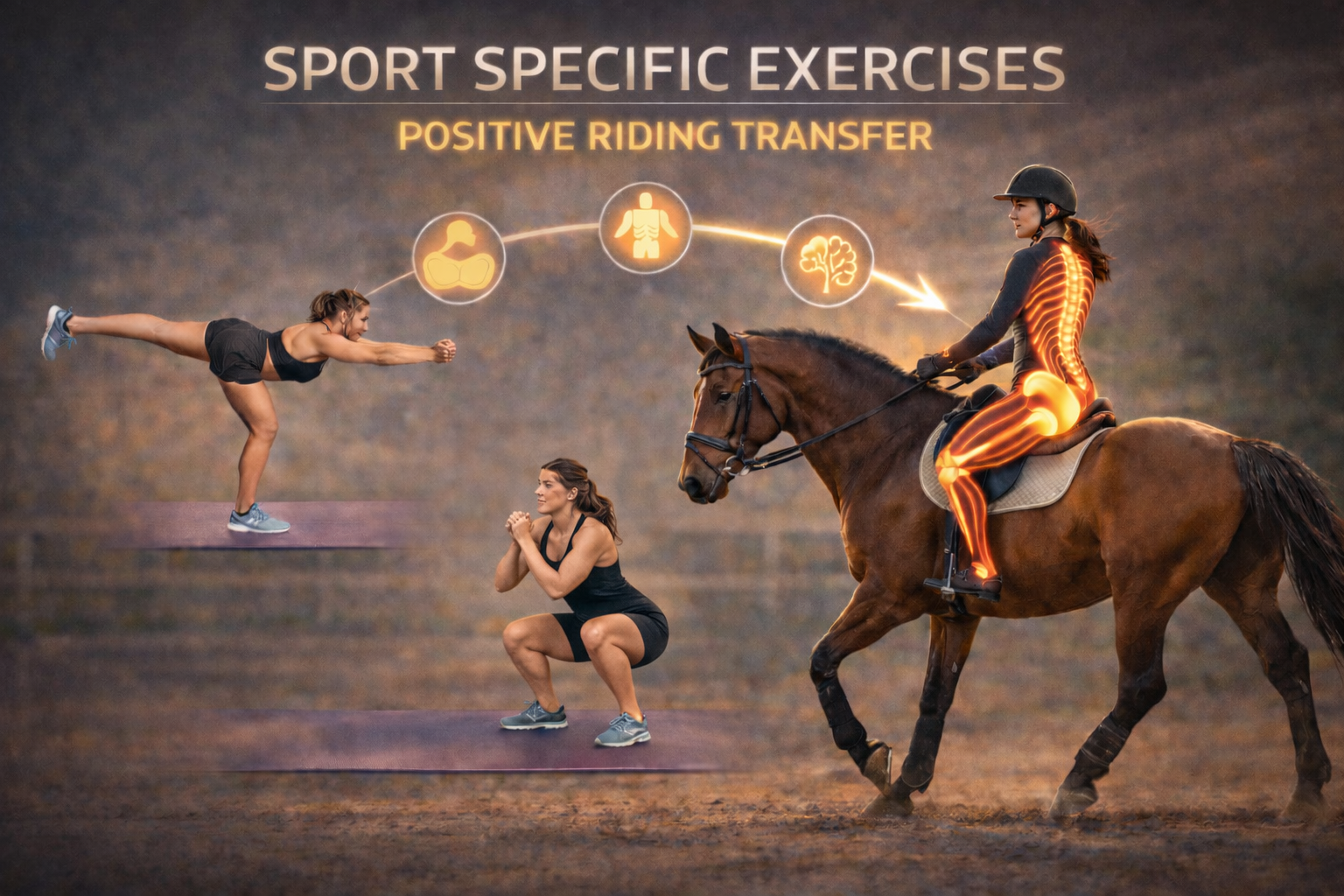
An equestrian workout bridges that gap by combining all the elements you need in a way that directly transfers to the saddle.
How to Build an Effective Equestrian Workout Routine
To become properly conditioned for riding, your training needs to develop:
- Strength to maintain posture
- Coordination so muscles work together
- Cardio fitness to sustain performance
- Mobility for independent movement
You can achieve this by combining different types of exercise — for example:
- Strength training + mobility work
- Cardio + coordination-based training
But the key is not just doing more — it’s doing the right type of work.
That’s what makes an equestrian workout different.
It is structured, specific, and designed to improve how your body performs when you ride.
The Bottom Line
Riding well places a significant demand on your body.
If your body isn’t prepared for that demand, it will compensate — and those compensations are what show up in your riding.
An equestrian workout doesn’t just make you fitter.
It improves your control, your balance, your communication, and ultimately, your partnership with your horse.
Because better riding isn’t just about what you do in the saddle.
It’s about what your body is capable of producing when you’re in it.
Start Understanding Your Body First
If you want to improve your riding, the first step isn’t doing more — it’s understanding what your body is currently doing and why.
👉 Watch my free “How I Assess Riders” video
https://ridercise.co.uk/newsletter-sign-up/
Inside, I’ll show you:
✔ What I look for when assessing riders
✔ How your movement patterns affect your riding
✔ Why your body responds the way it does in the saddle
Ready for a Structured Equestrian Workout?
If you’re ready to go beyond awareness and start improving how your body actually performs in the saddle, my rider-specific programs are designed to give you that structure.
These are not generic workouts.
They are targeted equestrian workouts built to improve:
✔ Strength
✔ Stability
✔ Coordination
✔ Balance
✔ Control
👇 Explore How RiderCise Can Help you Below 👇